Prospect: The Lo-Fi Space Western That Works
Christopher Caldwell and Zeek Earl build a whole frontier from analogue clutter and two performances
Contents
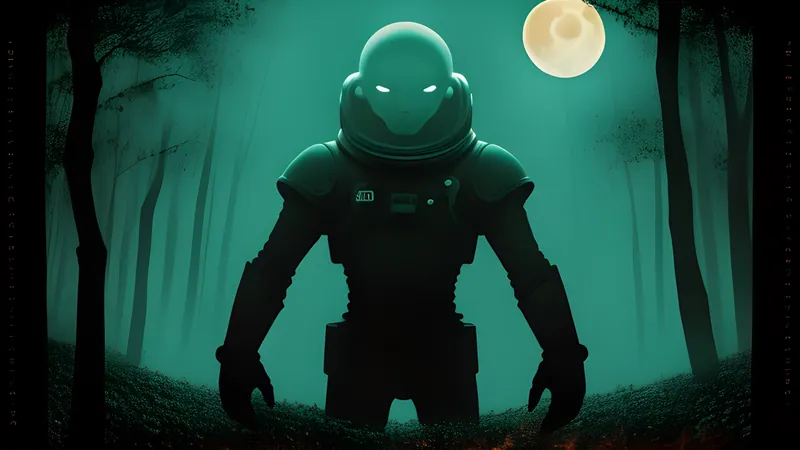
The first thing you notice about Prospect is the dirt. Not the alien landscape, which is a real forest in Washington State shot through drifting yellow haze, but the equipment: the scuffed helmets with their fogged plastic visors, the cassette-deck computers, the spacesuits that look sewn rather than fabricated, the sense that every object in this future has been repaired a dozen times by someone who could not afford a new one. Christopher Caldwell and Zeek Earl’s 2018 debut is a science-fiction film that spends its money where you can touch it, and the result is one of the most convincingly lived-in futures of its decade.
The pair had already made a short of the same name in 2014, and the feature is an expansion of that idea rather than a departure from it. A teenage girl named Cee (Sophie Thatcher) and her father Damon (Jay Duplass) descend in a battered pod to the surface of a toxic forest moon. They are prospectors, working the low end of a gold rush, harvesting a precious organic gem called aurelac that grows inside living pods buried in the soil. The extraction is delicate and dangerous, a bit of surgery performed with a syringe and a steady hand while the clock of their limited supplies runs down. It is a working-class science-fiction film about a bad job in a beautiful, poisonous place.
The frontier grammar
Calling it a space western is accurate down to the bone. The film borrows the western’s oldest engine, the isolated party in hostile country, strangers met on the trail who might rob you or ride with you, the law nowhere near. When Cee and Damon cross paths with another prospector, a silver-tongued drifter named Ezra played by Pedro Pascal, the encounter carries the exact charge of two gunfighters sizing each other up across a saloon. Ezra talks in a courtly, ornate register, a frontier dandy’s speech full of formal flourishes, and Pascal makes the mannerism feel like a survival strategy rather than an affectation. This was one of the roles that told people what he could carry, two years before The Mandalorian made it obvious to everyone else.
The western bones matter because they give the film a spine that its budget could never have built from scratch. Caldwell and Earl do not have to explain their economy, their politics, their star systems. The genre does the world-building for them. A gem, a claim, a rival, a deadline, a long walk to the pickup point through country that wants you dead. We have watched this story on horseback a hundred times, and transplanting it to a fungal moon refreshes every beat.
The father-daughter dynamic that opens the film is its quiet foundation. Jay Duplass plays Damon as a small-time chancer forever one big score from the life he keeps promising, and Cee has clearly heard the promise before. Their shorthand, the practised routine of two people who have worked dangerous jobs together for years, tells you everything about the world without a line of exposition. The film trusts you to read a relationship from the way two people pack a bag, and that economy is what lets the later betrayal land so hard.
Why the analogue future works
The design choice that defines Prospect is its commitment to a used, analogue, retro-futurist aesthetic, the tradition that runs back to the tea-stained corridors of Alien and the taped-together interiors of the original Star Wars. Nothing here is sleek. The interfaces are physical switches and dials. The suits are canvas and rubber. The guns look machined in a shed. This is a deliberate rejection of the glassy, weightless, holographic future that computer-generated imagery makes cheap, and it pays off in a currency screens rarely trade in: consequence.
Because the technology is fragile, everything the characters do has stakes. A cracked visor is a death sentence. A jammed mechanism cannot be waved away with a glowing panel. When Cee has to perform a task under pressure, the audience understands the physics of the danger, because the physics are made of objects we recognise. This is the same principle that makes practical creature effects frightening, the knowledge that the thing on screen occupied real space and could go wrong. Prospect extends that principle to an entire world.
The sound design deserves its own paragraph. Breath is everywhere in this film, the constant close rasp of people inside helmets, and Caldwell and Earl use it the way a good horror director uses silence. You are always aware of the barrier between lung and atmosphere, of how thin it is, of the toxic air pressing in. The moon is beautiful and it is trying to kill you, and the film never lets you forget the second thing while it shows you the first.
There is a lesson here for anyone who thinks a science-fiction film needs scale to earn its keep. Caldwell and Earl expanded their world outward from a short they had already proven, keeping the crew small, the locations real and the effects tactile, and the discipline shows in the confidence of the frame. The camera lingers where a bigger film would cut, letting you watch a suit seal or a gem come loose from its pod, treating process as spectacle. That patience is a directorial signature, and it flatters the two performances at the centre by giving them room to breathe inside all that heavy costume. Thatcher spends most of the film behind glass and still holds the eye, which is the surest sign that the filmmakers understood what they had.
The real ancestor of this thing
The collector in me wants to trace the lineage precisely, because Prospect sits at a specific junction. On one side is the grand tradition of the space western itself, from Outland to Firefly, the frontier hauled into orbit. On the other is the recent wave of micro-budget science fiction that rebuilt the genre on the cheap by choosing atmosphere over spectacle and character over scale.
Its closest living relatives are the American independents who proved a whole cosmos could be implied rather than rendered. Think of Monsters, Gareth Edwards’s road movie through a quarantined zone, which shares Prospect’s trick of treating a science-fiction premise as a landscape to walk across rather than a plot to explain. Think of The Endless, where two brothers turned a shoestring into cosmic unease through sheer commitment to place. And for the single most useful pairing, reach for Moon, Duncan Jones’s debut, another film that built a tactile, lonely, working-future out of one strong idea and refused to let the seams show. All three understood the same lesson Prospect learned: a small science-fiction film survives on texture and faces.
There is a lineage in the other direction too. If The Vast of Night is the radio-age cousin of this movement, all voices and darkness, Prospect is its outdoor sibling, all light and dirt and physical labour. The two films came out within a year of each other and make a fine double bill about how much science fiction you can buy with conviction alone.
Spoilers below
The engine of the plot turns over when Ezra and his partner arrive at Cee and Damon’s harvest site. A negotiation over the claim curdles into violence, and Damon is killed, leaving Cee stranded and Ezra wounded, his arm ruined in the fight. The film’s central relationship then becomes a forced alliance between the girl and the man partly responsible for her father’s death, two people who need each other to reach the orbital pickup before it leaves them on the moon forever.
What makes the second half work is that the film refuses to sentimentalise it. Cee amputates Ezra’s arm to save his life, a scene played with the same grim practicality as the gem extraction, and the bond that forms between them is built on usefulness and mutual survival rather than affection. Ezra keeps talking, keeps performing his courtly frontier act, and slowly the performance reveals a man with more decency than his profession allows. Pascal and Thatcher carry the whole back half on this uneasy chemistry, and Thatcher in particular gives Cee a hard, watchful competence that never tips into precocity.
The climax involves a settlement of religious prospectors and a final scramble to the extraction point, and the film has the wisdom to keep its resolution small. Cee gets off the moon. Ezra makes a choice that costs him. There is no galaxy saved, no grand reveal, only two people who did a dangerous job in a lethal place and one of them living to leave it. The last image is of Cee, older in the eyes than when she landed, carrying what she took from the moon, and it lands as quiet elegy rather than triumph.
The verdict is that Prospect is the rare debut that knows exactly what it can afford and spends every cent on the screen. It is a grubby, tactile, morally serious little film that treats the frontier as a workplace and gets more genuine tension out of a cracked visor than most blockbusters manage with a collapsing planet. Watch it, then chase it with Moon for the same handmade loneliness, and The Endless for where this scrappy, place-first strain of science fiction goes when it turns toward the strange.
Related Content