Prince of Darkness: Carpenter's Quantum Apocalypse
The horror film where physics and the Devil turn out to be the same subject
Contents
There is a moment early in Prince of Darkness (1987) when a physics professor tells a room full of graduate students that everything they were taught about the solid, reliable world is a comforting fiction — that at the level where matter is actually made, certainty dissolves and the universe runs on probability and dread. It plays like a lecture. It is, in fact, the whole horror film in miniature. John Carpenter’s strangest picture is the one where the seminar and the séance turn out to be describing the same thing, and where the Devil finally shows up wearing the equations of quantum mechanics.
This is the middle film of what Carpenter came to call his Apocalypse Trilogy — bookended by The Thing in 1982 and In the Mouth of Madness in 1994 — three films about the end of everything, none of them connected by plot, all connected by a single terrible idea: that reality is thinner than we think, and something is pressing on it from the other side. Prince of Darkness is the trilogy’s most underloved third, and the one that repays a rewatch most generously, because what once looked like a muddle now looks like a filmmaker thinking on screen.
The green cylinder in the basement
Carpenter wrote the script himself and hid behind a pseudonym on the credits — “Martin Quatermass,” a homage so specific it doubles as a reading list, and one I’ll come back to. The premise is a locked-room apocalypse. An old priest dies in Los Angeles. He belonged to a secret Catholic order, the Brotherhood of Sleep, which for two thousand years has guarded a single object in the sealed basement of an abandoned downtown church: a great cylinder of swirling, luminous green fluid. The surviving priest, played with grey exhaustion by Donald Pleasence, has no idea what it is and no faith left to fight it with, so he does the modern thing. He calls a scientist.
Professor Howard Birack — Victor Wong, wry and quietly authoritative — brings a team of graduate students and academics to the church to study the thing empirically: physicists, a radiologist, a translator for the ancient text that comes with it. What they find is that the fluid is alive, sentient, and old beyond reckoning. It is the essence of the Anti-God’s son, and it is awake, and it wants to open a door. The text, decoded, reads less like scripture than like a differential equation. The Brotherhood, it turns out, were not praying over a relic. They were containing a physics experiment that has been running for millennia and is about to conclude.
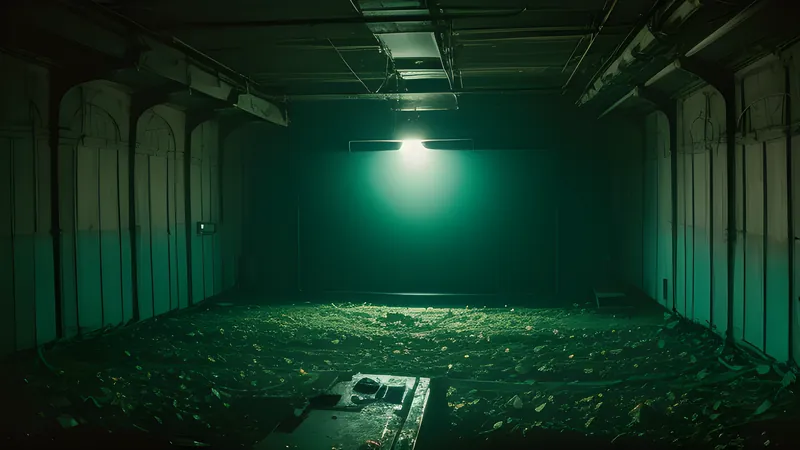
Carpenter shoots the church like a submarine under pressure. Gary Kibbe’s photography keeps the greens and the blacks close and clammy, and the score — Carpenter with Alan Howarth — is one of his best, a slow liturgical dread that sounds like an organ drowning. Outside, the city’s homeless population gathers and stands in silent ranks around the building, controlled by the thing inside, so that the team is besieged before it even understands there’s a siege. Among them, unnervingly, is Alice Cooper, wordless and blank as a possessed vagrant. The pop-culture stunt casting could have been a joke. Carpenter uses it as a void.
The transmission from 1999
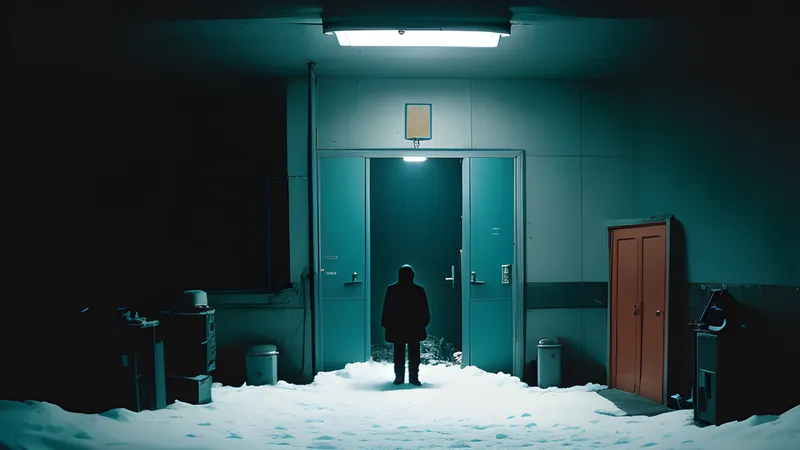
The film’s masterstroke, and the image that has kept it alive for cultists, is the dream. One by one, every person sleeping in the church begins to receive the same broadcast — described in the film as a tachyon transmission sent backward through time from the year 1999. It shows a grainy, degraded shot of the church’s own front doors at night, and a shadowy figure emerging from them, and it carries a warning: this is not a dream, it is an actual recording from the future, and you are being told what is coming so that you might prevent it.
Nothing else in 1980s horror looks quite like this. The dream footage is deliberately ugly — low-resolution, hissing, shot to resemble a signal barely surviving the crossing — and its recurrence, growing clearer each time someone sleeps, is genuinely unsettling in a way special effects rarely manage. Carpenter had stumbled onto something the genre would spend the next two decades catching up to. The cursed, degraded transmission carrying doom into the present is the exact engine of Ringu a decade later and the entire J-horror wave after it. Watch the Prince of Darkness dreams and you are watching the video-signal-as-contagion idea being invented, years early, and mostly ignored.
Why the physics is the horror
Here is the thing most dismissals of the film miss, and the reason to argue for it. Prince of Darkness is not a religious horror film with some science bolted on for flavour. Its actual thesis is that theology and physics are the same enquiry conducted in different vocabularies, and that the frontier of one is the frontier of the other. Birack’s speeches about Schrödinger, about matter as probability, about the observer changing the observed, are not decoration. They are the film explaining why the Devil can be real: if certainty is an illusion all the way down, then the door between our universe and its mirror — its antimatter, its Anti-God — is a physical possibility, not a superstition.
Carpenter takes the oldest content in the genre, the Devil coming for the world, and reroutes it through the strangest ideas in twentieth-century science, and the collision produces real unease because both sides are speaking with authority. The priest and the professor end up needing each other, and the film treats that alliance with total seriousness. It is a horror film for people who found the Big Bang and the Book of Revelation equally hard to sleep on.
This is where the “Martin Quatermass” gag pays its debt. The pseudonym salutes Nigel Kneale, the British writer whose Professor Bernard Quatermass serials — above all Quatermass and the Pit — invented exactly this move: the scientist who investigates the supernatural rationally and discovers the supernatural was rational all along, that the demon in the buried Martian craft is real and explicable and worse for being both. Carpenter is one of Kneale’s great heirs, and Prince of Darkness is his most direct tribute. Pair the two films and you have the whole tradition of science-fiction horror where the lab coat and the crucifix reach for the same switch. (Kneale, by all accounts, was not flattered. The homage stands anyway.)
The other ancestor is Lovecraft, and here the trilogy shows its wiring. The Anti-God as an ancient, indifferent, mathematically describable thing pressing against the membrane of reality is a Lovecraftian conception, and Carpenter would make it explicit in In the Mouth of Madness. Set the three apocalypse films beside his political horror They Live — another film about a hidden truth we’ve been kept from seeing — and a clear obsession emerges across all of Carpenter’s best work: the real world is a screen, and something appalling is standing just behind it.
The verdict: Prince of Darkness is dense, talky, and slow in its first hour, and those are the exact qualities that make it grow on rewatch while flashier films of its year have faded. It is Carpenter reaching further than his budget or his genre usually let him, and the reach is the reward. Come for the green cylinder; stay for the argument that the end of the world is a solvable equation nobody wants to finish solving.
Spoilers below
The climax delivers the transmission’s promise with a piece of horror-movie fatalism as bleak as anything Carpenter shot. The fluid possesses one of the students, Kelly, using her body as the vessel to reach through a mirror and haul her father — the Anti-God — out of the antimatter world on the other side of the glass. The figure the whole film has dreaded, the shape from the 1999 broadcast, is about to step through into ours.
Catherine, the film’s most rational sceptic, does the only thing left. She tackles the possessed Kelly bodily through the mirror into the other side, sacrificing herself to seal the door, and Brian smashes the glass so nothing can follow. The world is saved by a single act of physical courage, and the cost is total: Catherine is gone, on the wrong side of a broken mirror, forever.
Then Carpenter turns the screw one final time. Brian sleeps, and the transmission comes again — but now the shadowy figure emerging from the church doors is Catherine. The warning was never about the Anti-God coming through. It was about her, changed, coming back. Brian wakes, walks to a mirror, and slowly reaches out to touch its surface. Carpenter freezes the frame before we learn whether his hand meets glass or passes through.
It is the perfect end for a film built on quantum indeterminacy: a final image held in superposition, the door neither open nor shut, the outcome collapsed only in the viewer’s dread. The apocalypse was averted and also merely postponed, and the transmission from 1999 is still, technically, on its way. Carpenter leaves you exactly where his physics professor promised he would — in a universe that refuses to resolve, watching a hand approach a mirror, certain of nothing.
Related Content