Prime Cut: Lee Marvin Versus the Cattle Mob
A Chicago enforcer drives into Kansas to collect a debt from a slaughterhouse, and Michael Ritchie turns the American heartland into an abattoir with a fairground attached
Contents
Prime Cut opens in a meat plant. The camera follows the process — the machinery, the conveyors, the grinding, the extrusion, the links coming off the line and into a box — and the sequence is shot with the calm, admiring competence of an industrial documentary, which is what makes it so bad when you work out what has gone into the hopper. A man is being turned into sausages. The sausages are then posted to Chicago, because the Kansas end of the business has a message for head office about the debt collectors head office keeps sending.
That is the first five minutes. Everything else in the film is a consequence of it, and the whole picture proceeds on the same logic: take an image of wholesome American plenty, and show what it is made of.
The premise, and the two men in it
Chicago sends Nick Devlin (Lee Marvin) to Kansas City to recover half a million dollars from Mary Ann (Gene Hackman), who runs a stockyard, a slaughterhouse and a meat-packing operation, and who has decided he no longer needs to remit. Devlin is an enforcer with a reputation and a grievance of his own. Mary Ann is delighted to see him.
Hackman had just won an Academy Award for The French Connection and he plays Mary Ann as a man having the time of his life: hearty, hospitable, faintly camp, entirely without menace on the surface, running his empire from a farmhouse and treating Devlin’s arrival as a social occasion. Marvin plays Devlin as a slab of granite in a good suit, which is what Marvin had been playing since Point Blank taught the industry that his stillness was worth more than anyone else’s action. The contrast is the film’s engine. One man is doing all the talking and the other is doing all the arithmetic.
The debt is straightforward. The sideline is not. Mary Ann’s operation deals in girls as well as beef: orphanage-raised young women, kept in a barn on straw, sold at auction to buyers who inspect the stock in cattle pens. Sissy Spacek, in her first film role, plays Poppy, one of the lots. Devlin buys her, which is the closest thing to a moral choice anybody makes in ninety minutes, and it is transacted in exactly the same currency and the same register as everything else in the film.
Ritchie, of all people
The most interesting fact about Prime Cut is who made it. Michael Ritchie had directed Downhill Racer in 1969 and would make The Candidate the same year as this and Smile three years later — the great American satirist of institutions, the man who understood that ski teams and political campaigns and beauty pageants are all the same machine with different bunting. He was, by temperament, a documentarian of the wholesome, and his method was to shoot a national ritual absolutely straight until the ritual indicted itself.
Prime Cut is that method applied to a pulp thriller by Robert Dillon, and it is why the film is more than an exploitation curio. Ritchie shoots Kansas the way he shoots a campaign trail: the wheat, the grain elevators, the county fair with its bunting and its livestock judging and its enormous prize sunflowers. Nothing is stylised. The light is beautiful. Gene Polito’s photography treats the Midwest as a postcard and refuses, ever, to signal that anything is wrong.
Which means the horror has to be assembled by the viewer. Girls are penned and sold because that is what a livestock market does, and Ritchie films the auction with the same eye he films the cattle, and the equivalence is left sitting there without comment. Fairground, farm, abattoir, brothel: one continuous economy, all of it under a lovely sky, all of it filmed by a man who plainly liked the look of Kansas.
The combine
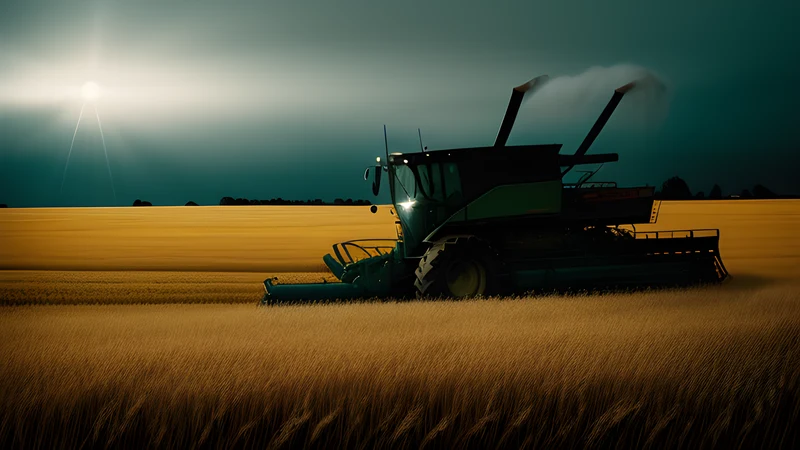
The set-piece everyone remembers is the harvester chase, and it deserves the reputation.
Devlin and Poppy are in a wheatfield. A combine harvester starts up and comes for them. That is the entire idea, and its brilliance is that a combine is slow — this is a chase at walking pace, in daylight, in a crop, and there is nowhere to go because the wheat is over head height and you cannot see the machine until it is close. Ritchie stages it without cheating: wide shots that establish the geometry, the crop coming down in a line, the thing eating everything in its path with a farm implement’s patience. When the harvester takes a car apart, it does so in the manner of a machine designed to reduce large objects to small ones, which it is.
Every other film would have made this a monster. Ritchie makes it agricultural. The threat is that a piece of ordinary equipment doing its ordinary job will process a human being without noticing, and that is the film’s thesis rendered as an action sequence. Nothing in Kansas is hunting Devlin. It is simply harvesting.
Schifrin plays it pretty
The score is the film’s quietest act of sabotage. Lalo Schifrin had spent the previous few years writing the most propulsive crime music in American cinema — the jagged, percussive work for Bullitt and Dirty Harry that told an audience precisely how tense to be — and Ritchie hired him and then asked for the opposite.
What Schifrin writes for Prime Cut is largely lyrical and largely pastoral: open, warm, unhurried, the sort of thing you would score a wheat harvest with if you meant the wheat harvest sincerely. It plays under the countryside. It plays under the fair. It declines, repeatedly, to tell you that a scene is sinister, and in the sequences where a more obedient composer would be sawing away at the strings, the music sits there being lovely about Kansas.
The effect compounds with Polito’s photography and Ritchie’s refusal to stylise. Three separate departments — camera, music, direction — are all sincerely insisting that this is a nice place, while the script quietly lays out an economy that fattens, pens, sells and processes people. The film never argues with itself out loud. It just makes the audience the only element in the room that has noticed, which is a far more uncomfortable position to occupy than being told what to think by a minor chord.
It is also, incidentally, why the violence hits so hard on first viewing. Nothing has prepared you, because everything responsible for preparing you has been instructed to look the other way.
The real ancestor is two years downstream
The collector’s connection here runs downstream. Prime Cut came out in 1972. The Texas Chain Saw Massacre arrived in 1974, and Tobe Hooper’s film — the slaughterhouse family, the killing-floor tools turned on people, the American countryside as a meat-processing operation that has stopped distinguishing between species — is Prime Cut’s idea with the crime plot removed and the panic left in.
Ritchie gets there first and gets there in a suit. His Kansas is prosperous, sunny and legally trading; Hooper’s Texas is a ruin. The through-line is the abattoir as the truth beneath the national self-image, and once you have watched Mary Ann conduct business from a farmhouse porch, Hooper’s family looks less like an aberration and more like the same firm after the money ran out.
Closer to home, the picture sits in a tight cluster of early-1970s films about a professional walking into the American interior and finding an organisation waiting: Charley Varrick the following year, The Outfit alongside it. All three understand that the syndicate had moved out of the city and gone into legitimate business, and that the frightening thing about American crime by 1972 was its letterhead.
The case against
It is a nasty film, and some of the nastiness is simply nasty. The auction sequence and the barn are shot with a leer that the satire does not entirely cover; Ritchie wants the indictment and the frisson at once, and a viewer who declines to grant him the first is left with only the second. Spacek is astonishing in her debut and is given a role that consists of being an object with a face. The plot is thin enough to see daylight through, and the last act is essentially a series of arrivals.
Marvin, too, is on cruise. He is very good at this and he has done it before, and Prime Cut asks him for nothing he had not already given Boorman with more at stake.
Where it sits
National General released it in 1972 to indifferent business, and it has lived since as a repertory item and a disc for people who collect this decade. It is short, mean, gorgeous to look at and genuinely strange, and it is the only film where Ritchie’s institutional eye and pure genre violence occupy the same frame.
Watch it for Hackman’s hospitality, for the harvester, and for a sunflower field photographed like an advertisement while something unforgivable happens in it.
Spoilers below
Devlin does not recover the money. He recovers Poppy, and then he burns the operation down, and the film treats those as the same act.
The escalation is stepwise and businesslike. Mary Ann sends men; Devlin removes them. Mary Ann sends his brother Weenie, who is stupid and cruel and dies of it. The Chicago end, meanwhile, turns out to have an interest of its own in how this resolves, because Devlin’s history with the organisation was never as clean as an errand implies — the debt he came to collect is entangled with a grudge he has been carrying, and the film lets you notice that the man Chicago picked for this job was picked because he would not come back with a cheque.
The last movement is at the stockyard. Devlin comes for Mary Ann on his own ground, among the pens, and Mary Ann dies where he did business, which Ritchie stages with no ceremony at all — the man who has been the film’s only source of warmth and charm is put down in the mud among the animals, and the camera does not linger. There is no speech. There is no reckoning. Nobody explains anything to anybody.
Then Devlin and Poppy drive out, and the film’s final gesture is its coldest. The girls are freed and the barn is emptied and the operation is finished, and the audience is invited to feel that something has been rescued. What is actually on screen is one man with a personal grievance settling it, and a young woman leaving in a car with the enforcer who bought her at auction because he was the highest bidder in the room. Ritchie ends on the wheat and the sky, exactly as beautiful as they were in the first reel. The plant will be sold. The fair will run again next year. Somebody else will send the sausages.
Related Content