Practical Miniatures and the Lost Art of the Model Shot
Why a well-lit model still out-frightens a flawless render
Contents
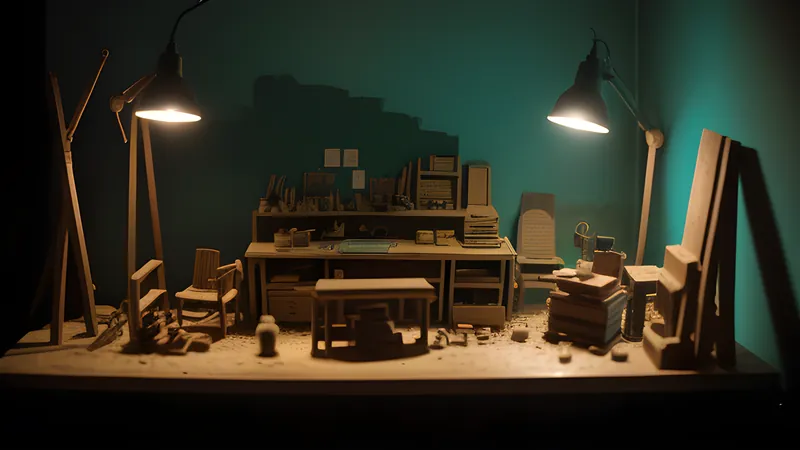
There is a quality to a well-shot miniature that a computer has never quite managed to fake, and it has nothing to do with resolution. A model of a spaceship, a burning building, a flooded city street built at a fortieth of full scale — these things sit in front of a real lens, and real light strikes them, bounces around inside their crevices, catches on the actual grease and grime the model-maker rubbed into the panels. The image that comes back carries a truth the eye reads before the brain can articulate it: this object exists, and light has touched it. That single fact is why the model shot still convinces in films decades old, and why a great deal of expensive digital imagery ages into a smeary uncanniness within a few years.
What the camera knows
Photography is a record of light, and light behaves according to physics whether it is falling on a full-sized building or a plywood model of one. When a miniature is lit and shot correctly, every optical cue the human visual system uses to judge reality is present and correct — the soft falloff of shadow, the way a highlight blooms on a wet surface, the faint imperfection of a lens rendering a real edge. Computer graphics has spent thirty years and enormous sums learning to simulate those cues, and it has got remarkably good, but simulation is always a model of the thing, and a miniature is the thing at a smaller size.
The genre that leaned hardest on this truth was creature horror and science fiction, where the monster had to feel physically present in the room with the actors. The great practical films understood that a rubber suit, an animatronic head or a stop-motion armature shares the actors’ space and the actors’ light, and that shared light is the glue that sells the illusion. I have written about this at length in my piece on the death of the man in the suit, and the argument for miniatures is the same argument scaled up: a real object photographed on set inherits the credibility of everything around it, while a digital element has to earn its place in the frame from scratch, every time, and frequently fails.
The tabletop apocalypse
Consider what a miniature actually buys a filmmaker beyond credibility, because the practical cost is high and the reasons had better be good. A model lets a small crew stage catastrophe. A city can flood, a laboratory can explode, a spacecraft can break apart, all on a stage the size of a squash court, with a camera running fast to make the small look slow and vast. The physics of scale does the acting: shoot a model at high frame rates and play it back at normal speed, and the debris falls with the ponderous weight of full-sized rubble, because slowing time is how you fake mass. This is a craft with its own grammar of undercranking, its own tricks of forced perspective and atmospheric haze sprayed between the camera and the model to imply distance.
John Carpenter’s The Thing (1982) is the touchstone for how practical craft and real materials produce a horror digital work still struggles to match. The film’s creatures are latex, mechanics, goo and armature, built by Rob Bottin’s team, and they convince because they occupy the same freezing, firelit Antarctic set as Kurt Russell — the flamethrower’s glow falls on the monster and the man in the same shot, from the same source. I have argued for that paranoia machine and what it owes its pulp ancestors in my full piece, and the reason it still frightens forty years on is precisely the reason a good miniature endures: it was a real object in real light, and the camera cannot be fooled about that even when the audience can.
The rubber-suit sublime
The purest celebration of the small-scale illusion is the kaiju film, where an entire tradition was built on a man in a monster suit trampling a scale-model city. It is fashionable to condescend to the Japanese monster movies for their obvious artifice, and the condescension misses the artistry entirely. The tokusatsu craftsmen built cities of balsa and plaster designed to crumble photogenically, wired them with pyrotechnics, and choreographed a stuntman’s destruction of them with the precision of a ballet. The suit is visibly a suit, and the film knows it, and the pleasure is a theatrical one — the delight of watching a made thing perform. I have written about that rubber-suit sublime in its own essay, and it belongs in any honest account of miniatures because it refuses the pretence of photorealism and finds a different, older kind of conviction: the handmade catastrophe, staged in front of you, real enough to touch.
There is a lesson here for the whole medium. Artifice openly acknowledged can be more durable than realism strenuously faked, because the audience is invited to admire the craft rather than to be deceived by it. A stop-motion skeleton has a stutter in its movement, and that stutter is a signature of the human hand that posed it frame by frame. Some part of the viewer knows a person made this, and that knowledge is a pleasure rather than a flaw.
The tricks that hide the seam
The reason miniature work looks like magic is that it is built on a set of deceptions with their own long-perfected grammar, and the grammar is the part being forgotten. Forced perspective places a small model close to the lens and a full-sized element far away, and the flattening of the image welds them into a single believable space; the trick only works because a real lens really compresses depth in a way the eye trusts. Atmospheric haze, sprayed or hung between the camera and a model city, imitates the way distance softens and blues everything the further it recedes, so a stage a few metres deep reads as miles. These are not shortcuts. They are a body of optical knowledge accumulated over decades of people staring at the results and learning what the eye will accept.
Undercranking — running the camera faster than normal so playback slows the motion — is the single most important of these, because scale and time are linked. A collapsing model building falls too fast for its apparent size, and the brain reads the wrongness instantly; slow the footage and the debris acquires the ponderous drift of genuine mass. Every convincing miniature disaster you have ever seen was shot fast and played slow, and the calculation of exactly how fast is a craft skill in its own right. What worries me is not that computers can now do this work, which they can, but that the underlying knowledge — how light, haze, scale and time conspire to fool the eye — is passing out of the culture along with the model shops. A filmmaker who understands why the old trick worked will make better digital images too, because the physics the miniature obeyed is the physics the render still has to imitate.
Why the argument is not mere nostalgia
None of this is a demand that cinema return to the model shop and abandon the render farm, which would be a foolish thing to want. Digital imagery does things no miniature ever could, and the best modern films blend the two so seamlessly that the seam is the point of the exercise. The argument is narrower and more practical than nostalgia. It is that the industry, in its rush to the wholly digital, quietly discarded a body of knowledge about how light and scale and real materials read on film, and that a generation of filmmakers now reaches for a computer to solve problems a table, a model and a fast camera would solve more cheaply and more convincingly.
The proof is on the screen. A great many films from the practical era hold up because their effects were photographed rather than computed, while a great many recent ones already look dated because their weightless digital elements never obeyed the physics the eye expects. The miniature endures for the same reason the empty room in a ghost story endures, a mechanism I traced in my essay on the architecture of fear: both trust a real thing, really photographed, to carry a conviction no simulation can quite counterfeit. If you want the argument as a viewing list — the films where the practical craft is the whole show — I have gathered them in the practical-effects showcase canon. Run them and watch the light behave. It is doing something no render has yet learned to fake.
Related Content