Popcorn: The Movie-Marathon Slasher
A 1991 slasher that stops every twenty minutes to make a better film inside itself
Contents
Popcorn arrived in 1991, which was the worst possible year for it. The slasher was commercially dead, the audience had gone to The Silence of the Lambs, and the meta-horror moment that would have made this film a hit was five years away and would belong to Wes Craven. It flopped. It then spent two decades as a tape that people who had seen it kept describing to people who had not, with the slightly manic energy of someone who suspects they hallucinated a film.
They had not. And the thing they all describe first is never the plot. It is the films inside the film.
The premise
A university film society needs money. They take over a decaying movie palace, the Dreamland, and stage an all-night horror marathon, digging out prints of forgotten gimmick pictures from a memorabilia dealer’s collection along with the promotional apparatus that came with them. Someone in the theatre starts killing them.
That is the frame, and the frame is ordinary. What is inside the frame is Mosquito, The Attack of the Amazing Electrified Man and The Stench — three fake 1950s exploitation features, presented as excerpts, each with its own gimmick, each shot properly. Mosquito comes with Projecto-Vision, a giant insect on a wire swung out over the audience. The Electrified Man comes with Shock-O-Scope and buzzers in the seats. The Stench comes with Odorama and a smell pumped into the auditorium.
These are pastiches of William Castle, who really did wire cinema seats for The Tingler in 1959, really did fly a skeleton over the audience for House on Haunted Hill, and really did hand out cards letting the audience vote on an ending. The film gets the pastiche exactly right — the cheap monochrome, the earnest narration, the science delivered by a man in a lab coat with a pointer — and it gets the reason right too, which is harder. Castle’s gimmicks were not embarrassment. They were an argument that cinema is an event that happens to a room, and Popcorn is the only film I know that stages that argument rather than describing it.
Who wrote it
Alan Ormsby wrote the script and began directing before being replaced; Mark Herrier finished and is the credited director. That is a bad sign in production terms and a very good sign in terms of where the interesting material came from, because Ormsby’s CV is the film’s real pedigree.
He wrote and starred in Children Shouldn’t Play with Dead Things, he wrote Deranged — the Ed Gein film that came out the same year as The Texas Chain Saw Massacre and lost the argument for fifty years — and he wrote the 1982 Cat People. That is a man who has spent his career in the sub-basement of American horror, and the memorabilia-dealer scenes in Popcorn, where a shabby man in a shabby shop explains what a gimmick print used to mean, are written by someone who has actually been in the shop.
The shoot happened in Kingston, Jamaica, largely for cost reasons, and the film is stranger for it. The Dreamland does not look like an American picture palace. It looks like a building that has been somewhere hot for a long time, and the fake-Americana of the marathon is happening inside architecture that keeps failing to play along.
The craft: the theatre as a machine
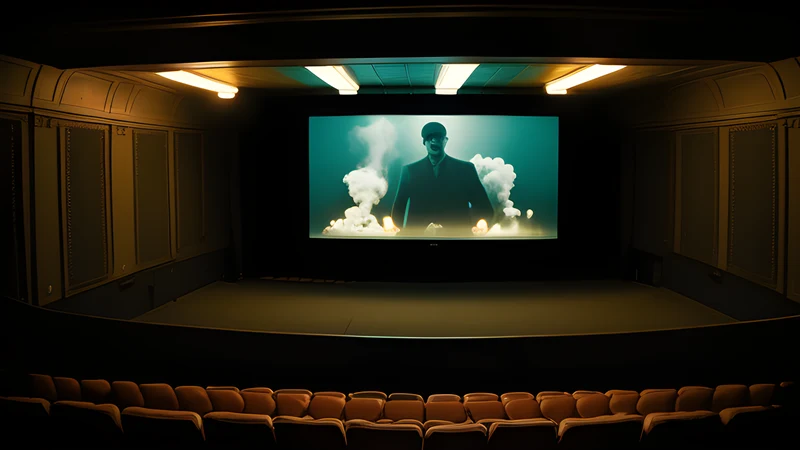
Herrier’s best decision — or Ormsby’s, or the production designer’s — is to treat the auditorium as a mechanism with a backstage. The film knows what a cinema physically is: a projection box, a rigging loft, a screen with a space behind it, ducts, a stage, a house that goes dark on a cue. Almost every set-piece uses a piece of that machinery for its actual purpose. The audience is present, hundreds of them, watching, laughing, being frightened on cue by a paper mosquito, while behind and above them the real thing is happening in the plant that makes the illusion work.
That is a genuinely good structural idea and it produces the film’s one flawless sequence, which is the Electrified Man screening: the seats buzzing, the crowd shrieking with delight, the gimmick doing precisely what Castle designed it to do — and one person in the room for whom the gimmick is not a gimmick. Nobody can tell the difference between a stunt and a death, because the room has been engineered so that they cannot. The audience is complicit by design.
The mask work is the other technical draw. The killer’s disguises are practical face appliances, and the film treats them as objects with weight and edges — pulled on, peeled off, fitted. There is no digital cheating available in 1991 and the film does not want any; it wants you to see the seam. That gets it a place, unfairly overlooked, in the conversation that runs through the practical-effects showcase canon.
There is one more thing the film understands about cinemas that almost nothing else does: they are loud. A packed auditorium at a horror marathon is a room of several hundred people screaming on purpose, and Popcorn builds its soundscape on that. The crowd noise is a constant bed under the whole middle of the film — laughter, shrieks, the projector, a public-address system, a band on the stage. It means the film can stage a killing without silence, which is the slasher’s default and its laziest instrument. Take away the hush and you take away the audience’s cue that something is about to happen. Every other slasher of the period tells you when to be frightened by turning the sound down. This one tells you nothing and lets you sit in the din.
The real ancestor
Castle is the surface answer and the film puts him on the poster in everything but name. Dig one layer and the grandparent is Theatre of Blood, Douglas Hickox in 1973, with Vincent Price killing critics using the methods of the plays they panned — a film about performance as a murder weapon, in which the theatre’s own equipment does the work.
The closer relative, though, is Demons. Lamberto Bava in 1985, produced and co-written by Argento: an audience locked in a cinema while the film they are watching comes out of the screen. Bava and Argento’s cinema of the damned is doing the identical trick — the auditorium as the trap, the screening as the ritual — with more style and less wit. Popcorn is the American cousin, sober where Demons is delirious, and the two make an excellent double bill for anyone who wants to watch cinema eat its own audience twice in one night.
There is also Anguish, Bigas Luna in 1987, which nests a film inside a film inside a cinema and then breaks the frame. Popcorn never has that nerve. It builds the apparatus and then uses it for a whodunit.
The case against
The frame story is weak. The students are types, the romance is inert, and the film’s dramatic engine — a heroine’s recurring nightmare, which she is trying to write into a screenplay — is a device so creaky that even 1991 knew it. Whenever Popcorn is being a slasher it is a mediocre slasher, competently shot, entirely forgettable. Whenever it is being a fake 1950s film it is electric.
That imbalance is a real flaw rather than a charming quirk. A film that is at its best when it stops being itself has a structural problem, and the replacement of the director mid-shoot is visible in the seams: the tonal register wobbles between affectionate pastiche and straight-faced stalking without anyone appearing to have decided which one the audience should be in.
It also lacks nerve at the level of theme. The premise is one step from a real argument about what horror audiences want from a room full of strangers in the dark, and it keeps declining to make it. Craven made that argument five years later with much cruder tools and it changed the genre. Compare what a self-aware slasher can achieve when it commits — the whole question of the genre auditing its own rules, which is what the final girl rule and the films that broke it is about — and Popcorn looks like a film that arrived early and then sat down.
And the cast is stranded. Jill Schoelen had already been the best thing in two better horror films by 1991 and she is given very little here beyond a nightmare and a reaction shot; Ray Walston, as the memorabilia dealer, wanders in with the film’s only fully written character and then leaves. A production that changes director in its first weeks rarely protects its actors, and the evidence is on screen in performances that seem to be calibrated for three different films.
Where to find it: it has been restored and released on disc after years of scarcity, and the transfer does the fake films justice, which is the whole reason to bother.
Spoilers below
The killer is Toby, and the film’s mythology is its most Ormsby-ish move.
Years earlier a filmmaker named Lanyard Gates made a film called The Possessor, screened it, and murdered his family live on the stage in front of the audience as the climax of the screening. The screening ended in a fire. Toby survived it, and he has come back to the Dreamland to complete the performance his father started, using face appliances to move through the marathon as whoever he needs to be. The recurring nightmare Maggie has been trying to turn into a screenplay is her own memory: she is Gates’s daughter, the child who was meant to die on that stage.
Put like that it is nonsense, and the film half knows it. What redeems it is the shape. Gates’s crime is a gimmick taken to its conclusion — Castle wired the seats, and Gates decided the only honest version of an event-cinema climax was for the event to be real. Every fake film in Popcorn has been building that argument for you: here is a mosquito on a wire, here is a buzzer in your chair, here is a smell, here is a man actually killing his wife. The escalation is the point, and the marathon is a scale with the murder at one end of it.
The finale returns to the auditorium, the projector, the screen, and lets the film’s own apparatus resolve it — Toby’s ending arrives via the machinery he has spent the night hiding inside, which is the only ending this premise could honestly take.
Toby is the film’s other quiet idea: a man who has no face of his own performing every night to an audience that thinks it is watching a show. He is a projectionist’s ghost, doing exactly what the building was built to do. The Dreamland has been converting people into images since 1950. It finally got one who converted back.
Related Content