Pontypool: The Horror Film Built From Language
Bruce McDonald's radio-booth apocalypse
Contents
Most zombie films are about bodies. Pontypool is about words. Bruce McDonald’s 2008 Canadian oddity stages an entire apocalypse inside a small-town radio station, never leaves the building, barely shows you a single infected person, and manages to be one of the most genuinely original horror films of its century — because the thing eating the town is not a virus in the blood. It is a virus in the language. Certain English words, once understood, infect the speaker, and the infected can only try to purge the corrupted word by repeating it, mangling it, and killing to escape it.
It sounds like a student’s clever conceit. In execution it is a lean, dread-soaked chamber piece that turns the act of speaking — the tool a radio host lives by — into the murder weapon.
One room, one voice, one very good actor
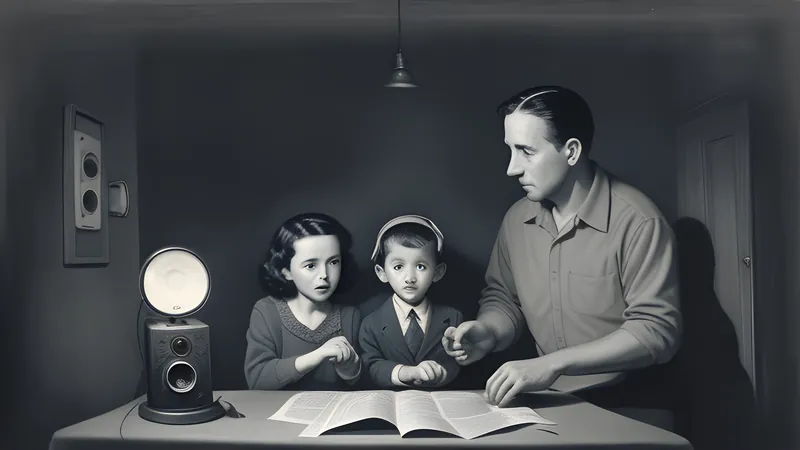
The film belongs to Stephen McHattie, and it would not exist without him. He plays Grant Mazzy, a fired big-city shock-jock reduced to the morning slot at CLSY radio in the small Ontario town of Pontypool, broadcasting from a converted church basement. McHattie has one of the great faces and one of the great voices in character acting — gravel and bourbon, a man who has said too much for a living — and McDonald builds the film around letting him talk. Mazzy is the kind of provocateur who treats a school-bus cancellation report as a chance to perform, and the film’s cruel joke is that his gift for words is precisely what the apocalypse turns against him.
He shares the booth with his producer Sydney Briar (Lisa Houle), all professional patience, and their young technician Laurel-Ann (Georgina Reilly). The infection reaches them the way news always reaches a radio station: over the phone, down the wire, through a correspondent on the line. Their traffic reporter “in the Sunshine Chopper” — who, in the finest detail of a film full of them, is on a hill with a sound effect and no helicopter anywhere near him — begins describing a mob attacking a doctor’s office, and then his reports curdle into repetition and static and screaming. The horror arrives as audio. The film makes you lean in and listen for the apocalypse, and the leaning-in is the trap.
Why a film about nothing is so frightening
The reason Pontypool works, where a hundred low-budget single-location horrors fail, is that its constraint is also its subject. McDonald had almost no money — this is a film shot largely in one room — and rather than disguise the limitation he made it the point. We are trapped in the booth with Mazzy, receiving the catastrophe the way his listeners do, as voices and bulletins and things half-understood. Not showing the carnage is not a budget dodge; it is the correct aesthetic choice for a story about how information becomes contagion.
McDonald and screenwriter Tony Burgess (adapting his own novel Pontypool Changes Everything) tighten the screws through pure sound and performance. The score by frequent McDonald collaborator brooding-jazz sensibilities keeps the room unstable; the sound design makes every crackle on the phone line a potential vector. And McHattie modulates the whole film with his voice alone — the swagger draining out of Mazzy sentence by sentence as he realises that the job he has done all his life, filling silence with talk, is now a way of killing people. When he finally has to broadcast to a town he can no longer safely speak to, the film locates a real, novel terror: what do you say when saying anything might be the infection?
The conceit also does something sly and durable. A virus carried by comprehension is a horror metaphor that keeps paying out — for propaganda, for panic, for the way a phrase repeated on air can become a weapon, for the sense that language itself has become unstable and untrustworthy. The film never lectures. It just builds its monster out of the one thing every viewer uses to make sense of the film, and lets the implication sit.
The bloodline, and the branch it grew
Pontypool belongs to the honourable tradition of horror that treats media itself as the haunted object. Its clearest cousins are the films where the vector is a signal rather than a bite. David Cronenberg — a fellow Canadian, and no accident — got there first with Videodrome, where the television broadcast rewrites the flesh of anyone who watches, and Pontypool is that idea moved from the eye to the ear, from the image to the word. The other essential pairing is Ringu, Hideo Nakata’s cursed-videotape masterpiece, which established the modern grammar of horror-as-transmission — a thing that spreads because it is copied, watched, passed on. Pontypool takes the same fear and locates it in the most intimate transmission medium of all, the human voice.
It is also, formally, an heir to the radio-panic tradition that runs all the way back to Orson Welles’s 1938 War of the Worlds broadcast — the terror that lives in the bulletin describing it, the disembodied authoritative voice telling you the world has ended. McDonald builds a whole film out of what Welles found in one night: that a voice on the radio, calm then cracking, can frighten an audience more than any image. Among modern low-budget horror, the film’s nearest spiritual kin is the sort of single-location dread that trusts restraint over spectacle — the discipline of showing almost nothing and making the almost-nothing unbearable.
The verdict, argued
Pontypool is a small film with a large idea, and its greatness is in refusing to betray the idea for the sake of a bigger climax. It never breaks its own rule and shows you a zombie horde in the streets; it stays in the booth, where the concept is purest and the terror most specific. That discipline costs it a certain kind of crowd-pleasing payoff and buys it something rarer — a horror film you argue about on the drive home, because the ending declines to resolve the puzzle it has set.
It is the best kind of cult film: genuinely strange, made for almost nothing, carried by a great actor doing the work of his career in a single room. If you have exhausted the zombie shelf and think the sub-genre has nothing left to say, this is the film that proves the form was never really about the walking dead at all. Watch it late, alone, with headphones, so that the voices are as close to your ear as the film intends. Stay through the credits.
Spoilers below
The mechanics of the infection resolve into the film’s central horror gag: the virus lives in English, specifically in terms of endearment and comprehension. A word only infects once it is understood, and the infected become fixated on the word, repeating it in loops, garbling it, before the condition tips into aphasic violence and they mob the nearest speaker, mouths working, trying to chew their way back to meaning. McDonald shows the disease almost entirely through this behaviour — people stuttering a single word into oblivion — rather than through gore, which is why the film gets under the skin. Laurel-Ann’s turn, trapped in the booth, is the film’s one sustained horror sequence, and it is built from repetition and a face coming apart, not from prosthetics.
The escape, such as it is, is the boldest stroke. Trapped with the infected Dr Mendez — who has taken refuge in the booth and delivers the film’s half-mad diagnosis — Mazzy and Sydney work out that the way to survive an infected word is to sever the sound from its meaning. If understanding is the vector, then deliberately mis-understanding is the cure. Sydney, infected and looping on a word, is talked back from the brink when Mazzy floods it with nonsense, assigning the word a false meaning until it loses its grip. The solution to a plague of language is to break language on purpose — to make the words mean nothing.
Mazzy’s response is to do the one thing a radio host can: he takes to the air and starts broadcasting deliberate nonsense, scrambling the language for any listener still tuned in, weaponising his gift in reverse. The film ends ambiguously, with the authorities apparently moving to bomb the station and the town, and a strange coda that suggests Mazzy and Sydney may have found a way through — or may simply be the last two voices talking in a dead room. Pontypool never confirms whether the cure works or whether anyone is left to hear it. What it leaves you with is the image of a man who talked for a living, discovering that the only way to save anyone was to make sure his words stopped meaning what he said — and choosing, all the same, to keep talking.
Related Content