Pink Flamingos: John Waters and the Art of Bad Taste
How a $10,000 Baltimore provocation became the founding text of trash cinema
Contents
There is a photograph John Waters likes to reproduce: Divine, three hundred pounds of drag menace in a skin-tight red dress, cheekbones drawn up towards the temples in that famous shark’s-fin makeup, strolling down a Baltimore street as though she owned the pavement and everyone on it. That image is the whole film in miniature. Pink Flamingos, shot in 1972 for something close to ten thousand dollars, is a work of enormous confidence dressed in the cheapest clothes it could find. Half a century on, its reputation rests almost entirely on its final ninety seconds, which is a shame, because the ninety minutes before it are a far stranger and more disciplined piece of filmmaking than its status as a gross-out dare suggests.
Waters called it “an exercise in poor taste,” and the phrase matters. Exercise implies rigour. This is a film built by someone who studied Warhol’s Factory pictures, Herschell Gordon Lewis’s splatter, Russ Meyer’s cartoon anatomy, and the whole grubby drive-in economy, then decided to out-nasty the lot of them on a budget that wouldn’t cover a studio caterer’s weekly bill.
The plot, such as it is
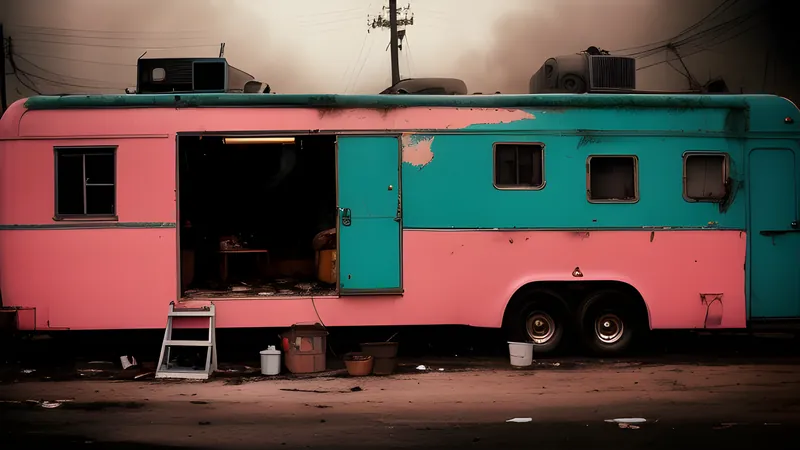
Divine plays Babs Johnson, who lives in a pink trailer with her egg-obsessed mother Edie (Edith Massey, sitting in a playpen in her underwear demanding eggs), her chicken-fancying son Crackers, and her “travelling companion” Cotton. Babs holds the tabloid title of “the filthiest person alive,” and a rival couple, Connie and Raymond Marble (Mink Stole and David Lochary), covet it. The Marbles run a baby-selling ring funded by kidnapping young women, impregnating them via their manservant, and flogging the infants to lesbian couples. That is the engine of the plot. The competition for the filth crown escalates through arson, an assault involving a rosary and a real chicken, and finally the notorious ending that I will keep below the line.
What surprises a first-time viewer, coming to it braced for endurance, is how much of Pink Flamingos is funny in a deadpan, almost Beckettian register. Edie in her playpen is a genuinely great comic creation. The Marbles’ escalating panic as their filth ranking slips has the shape of good farce. Waters understood, better than most of his imitators would, that transgression without wit is just a slaughterhouse video.
Why the ugliness works
Here is the craft argument, and it is easy to miss because the surface is so deliberately repellent. Pink Flamingos works because Waters shoots filth with a flat, frontal, almost documentary calm. The camera sits at eye level, the framing is symmetrical and static, the 16mm colour is oversaturated in that home-movie way where reds bleed and skin tones go orange. Nothing is stylised into safety. When something appalling happens, the direction refuses to flinch, cut away, or wink. That flatness is the joke and the horror at once.
Compare it to almost any modern shock comedy, where the editing does the laughing for you — a reaction shot, a music cue, a smash cut to signal “we know this is outrageous.” Waters denies you that cushion. He holds. The held shot forces the audience to sit inside the transgression and decide, unaided, whether to laugh or gag. That is a genuinely radical formal choice, and it is why the film still lands when a hundred slicker provocations have curdled into cringe.
Divine is the other reason it holds. Harris Glenn Milstead, the sweet-natured Baltimore boy inside the monster, gives a performance of total commitment. The voice is a snarl pitched somewhere between Bette Davis and a docker; the walk is pure runway contempt. Divine plays Babs as an aristocrat of squalor, wounded and imperious, and that seriousness underneath the outrage is what keeps the character from being a mere gag. You believe this creature would kill to keep her title. Waters would spend the next two decades refining Divine into the near-tragic figure of Female Trouble and the genuinely tender one of Hairspray, but the raw voltage is all here.
The Dreamlanders and the Baltimore underground
Pink Flamingos is a home movie in the truest sense: made by a repertory company of friends, neighbours and misfits Waters had been filming since the late 1960s. The Dreamlanders — Divine, Mink Stole, Edith Massey, David Lochary, Mary Vivian Pearce — were amateurs in the technical sense and virtuosos of nerve. Massey was a barmaid Waters spotted; her flat, sing-song line readings are unteachable. This matters to the film’s texture. You cannot fake the loose, dangerous amateurism of people who genuinely do not care what a producer might think, because there was no producer. Waters shot on weekends, developed the footage himself where he could, and cut it on the cheapest available equipment.
The distribution story is the part cinephiles should remember. Pink Flamingos became one of the founding titles of New Line Cinema — Robert Shaye’s fledgling outfit picked it up and rode it through the midnight circuit for years, the way another new company might have ridden a mainstream hit. The film that helped bankroll the company that would eventually make The Lord of the Rings is a movie whose climax involves dog excrement. Keep that in your pocket for the next dinner party.
Roger Ebert’s response is instructive. He refused to give it a star rating at all, essentially declaring it beyond the reach of his scale. I have a permanent quarrel with star ratings anyway, so I read that as the only honest response available to him: Pink Flamingos is a film that dares you to have an opinion about taste itself, and a number can’t hold that.
What it fathered
The collector’s pleasure here is tracing the bloodline. Pink Flamingos did not invent transgressive cinema — Waters was drinking from the same well as the underground filmmakers before him — but it became the permanent reference point, the thing every later provocateur has to be measured against. When Troma built an entire studio on gleeful bad taste, they were working Waters’ seam; you can see the family resemblance clearly in The Toxic Avenger and Troma’s grubby superhero satire. The difference is that Troma’s outrage is cartoonish and cushioned, where Waters keeps his frighteningly deadpan.
Its more important legacy is the midnight-movie ecosystem it helped build. Pink Flamingos played the same late-night repertory houses that turned other unclassifiable objects into rituals, and to understand that world properly you want the whole map — start with El Topo and the birth of the midnight movie, then read the midnight-movie canon as a viewing list. Waters’ film sits in that canon as its rudest member, the one that traded surrealist mysticism for a trailer park and an egg-mad old woman. Its closest sibling in spirit is another 1970s midnight staple that turned audience complicity into the whole point — The Rocky Horror Picture Show and the film that became a ritual is the party to Waters’ assault, and the two together define what the midnight crowd wanted.
There is one older ancestor worth naming, because Waters names it himself. Pink Flamingos belongs to the long tradition of the sideshow: the parade of human oddity offered up for a paying crowd. Waters loves the outsider, the reject, the person society has filed under “monstrous,” and hands them the leading roles. That impulse runs straight back to Freaks and the 1932 film that ended a career, Tod Browning’s tragedy about circus performers, which Waters has cited as formative. Both films ask the same uncomfortable question: who exactly is the freak here, the person on screen or the person paying to gawp?
The verdict
Pink Flamingos is not a film I can recommend the way one recommends a good night out. It is disgusting on purpose, and the final scene remains one of the genuinely irreversible images in cinema — once seen, permanently filed. What I can argue is that it is a real film, made with a real point of view, by an artist who knew exactly what he was doing and did it with more control than his detractors ever credited. The flatness of the camera, the seriousness of Divine, the deadpan comic timing — these are choices, and good ones.
Its bad taste is a moral position. Waters aims his outrage upward, at the smug and the respectable, and downward never; his affection is entirely with the outcasts committing the atrocities. That generosity, buried under all the filth, is why the film has aged into something almost sweet. You come for the notorious ending and stay for the strange tenderness of a director who genuinely loved his monsters.
Where to see it: the Criterion edition restores the film with Waters’ commentary, which is essential — his cheerful, erudite narration reframes the whole thing as the art-school prank it always was. Watch it once, sober, and then never eat before a Waters film again.
Spoilers below
The ending is the film’s calling card and its curse, so let us be precise about what happens and why it matters. After the Marbles are captured, tried in a mock trial by Babs and her family, and executed by shooting, Babs and Crackers walk down a Baltimore street. A small dog defecates on the pavement. Divine scoops the excrement into her mouth, chews, and grins at the camera, gagging slightly, in a single unbroken take. It is real. Waters filmed it in one shot precisely so no one could claim a trick.
The technical bravery of the choice is the held take — the same principle that governs the whole film taken to its logical extreme. There is no cut to hide behind, no dissolve, no merciful edit. The camera stays, Divine performs, and the audience is trapped in the moment with her. It is the flat frontal style pushed to the point where craft and endurance become indistinguishable.
What people forget is the voiceover that closes the film, where the narrator declares this act the proof of Divine’s title. The gesture is framed as a triumph, a coronation. That is the real provocation, deeper than the image itself: Waters asks you to read the most repellent act imaginable as a victory, an assertion of total freedom from the tyranny of good taste. Read straight, it is unbearable. Read as Waters intends — as the punchline to a ninety-minute demolition of respectability — it is, appallingly, a happy ending. The monster wins, keeps her crown, and walks off down the street she owns. Divine reportedly regretted the scene defining a whole career; you can see why. But it is the perfect, terrible full stop to the filthiest joke ever committed to film.
Related Content