Pi: Aronofsky's Migraine in Black and White
A $60,000 debut shot on high-contrast reversal stock that made paranoia into a visual style
Contents
Pi (1998) is what a headache would look like if it could hold a camera. Darren Aronofsky’s debut feature was made for around sixty thousand dollars, shot on high-contrast black-and-white reversal film that renders skin as chalk and shadows as pits of ink, and it is engineered from its first frame to make you feel as unwell as its hero. The film opens on a mathematician pressing his hand to his skull, and by the time it ends it has given the audience a contact migraine, a paranoid stock-market thriller, a Kabbalistic conspiracy, and one of the most infamous acts of self-surgery in American independent cinema. It won Aronofsky the Directing Award at Sundance and announced a filmmaker who understood that style could be a delivery system for physical sensation.
More than twenty-five years on, Pi looks like a Rosetta Stone for everything Aronofsky would do after — the obsessive protagonist grinding himself to ruin, the body punished for the mind’s ambitions, the montage cut like a nervous system firing. It is his cheapest film and in some ways his purest, a proof of concept made before he had the money to smooth off any of the edges.
The man and the number
Max Cohen (Sean Gullette, who co-wrote the story) is a number theorist living as a shut-in in a Chinatown apartment stacked with humming hardware, convinced of three axioms he repeats like a mantra: mathematics is the language of nature, everything can be represented in numbers, and there are patterns everywhere. He suffers from crippling cluster headaches, hallucinations and paranoia, self-medicating with a pharmacy of pills, and he has built a homemade supercomputer he calls Euclid to hunt for a pattern underlying the stock market. When Euclid spits out a 216-digit number and then apparently dies, Max discards it as a bug — and then discovers that number is being sought by two very different parties.
On one side is a Wall Street firm, represented by a woman who takes an interest in Max’s predictions and wants his gift monetised. On the other is a sect of Hasidic Jews, led by a man Max meets in a coffee shop, who believe the same 216-digit string is the true name of God encoded in the Torah, the key that will usher in the messianic age. Max, wanting only to understand the pattern for its own sake, finds himself hunted by finance and faith alike, both convinced his broken mind has touched something enormous. His only anchor is his old mentor Sol Robeson (Mark Margolis), a retired mathematician who chased the same number decades earlier, suffered a stroke for it, and now warns Max that the pattern is a door better left shut.
Why the ugliness is the technique
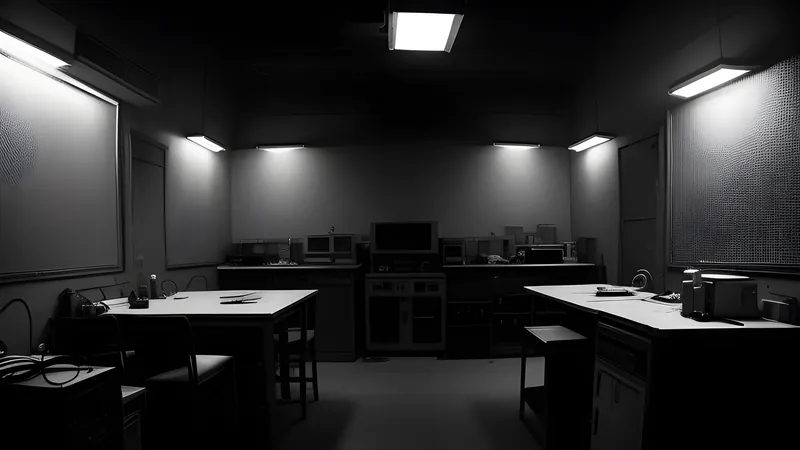
Aronofsky’s aesthetic choices in Pi are not economising — though they were forced by the budget. They are the meaning. The reversal stock produces a brutal, silvery contrast with almost no grey, so every shot feels overexposed and airless, the visual equivalent of light stabbing into a migraine. The director bolts the camera to Gullette’s body with a rig later nicknamed the Snorricam, so that as Max lurches through the streets he stays fixed in the centre of frame while the entire world reels around him, a queasy first-person subjectivity that puts the audience inside his disorientation rather than observing it. And the editing deploys what Aronofsky called hip-hop montage: fast, repetitive bursts of a pill bottle opening, a swallow, a pupil dilating, cut to a percussive rhythm, compressing an action into a violent flurry of fragments.
Under all of it runs Clint Mansell’s score, his first collaboration with Aronofsky, a driving electronic pulse of drum-and-bass and techno drawn from the era’s club underground that treats mathematics as something that throbs. The soundtrack is a document of late-nineties electronica pressed into service as a nervous system. The whole film runs at the tempo of an anxiety attack, and it never once relaxes. This is a director discovering that if you assault the senses precisely enough, the audience does not watch a breakdown — they undergo one.
The ancestors and the heirs
The obvious lineage runs through paranoid conspiracy cinema and the tortured-genius thriller, but Pi’s truest ancestors are stranger and more specific. Its scuzzy monochrome dread and industrial soundscape descend directly from David Lynch’s Eraserhead (1977), another black-and-white nightmare of a man cornered by forces he cannot name, shot in grimy close-up and scored with mechanical hum. Its body-horror streak — the mind’s obsession erupting through the flesh — is pure Cronenberg, and it shares blood with the wet transformation of The Fly (1986). And its aesthetic of urban decay and information-sickness anticipates the paranoid drug haze of A Scanner Darkly, where a splitting consciousness again becomes both plot and picture.
Its most direct heir, of course, is Aronofsky himself. Requiem for a Dream two years later took the hip-hop montage and the addiction structure of Pi and applied them to four people instead of one; The Fountain took the same fixation on a man who cannot let go of an impossible answer and stretched it across a thousand years; Black Swan took the artist destroying her own body in pursuit of perfection and set it in a ballet studio. The template is all here, in ninety minutes of screaming black-and-white, made before anyone was watching.
The verdict, spoiler-free
Pi is not a comfortable film and was never meant to be one — it is a deliberate ordeal, and the ordeal is the point. It asks whether the search for a total pattern, the dream that everything can finally be made to add up, is a form of divine ambition or a symptom of a mind coming apart, and it declines to separate the two. Some viewers find it a sophomoric headache with a great soundtrack; others find it the most honest film ever made about the pain of thinking too hard. Both camps are responding to the same thing, which is a young director with total conviction and no resources refusing to blink.
Watch it for the aesthetics alone if nothing else, then trace the paranoia forward into A Scanner Darkly and the obsession into The Fountain. And if you want the same claustrophobic dread of a locked room and an unsolvable pattern, the mathematics-as-death-trap of Cube is Pi’s Canadian cousin from the same year.
Spoilers below
Max’s descent accelerates once he understands what the number is doing to him. Sol, it emerges, did not simply fail to crack the pattern; he came close enough that it broke him, and he abandoned the search deliberately to save his own life, dying of another stroke partway through the film with a warning Max refuses to heed. The number, in the film’s logic, is not information a human mind can hold. Everyone who has touched the true pattern has been destroyed by the contact, and Max’s headaches, hallucinations and seizures intensify as he gets closer, his body registering the proximity of the answer as agony.
The Hasidic sect and the Wall Street firm both close in, each willing to take the 216-digit string from Max by force if persuasion fails. In a hallucinatory sequence Max finds a pulsing brain on a subway staircase, pokes it with a pen, and — the film blurring the line between vision and event — appears to be granted or to seize the total understanding he has chased, the pattern finally complete in his mind. It does not liberate him. It leaves him convulsing, unable to function, the knowledge burning through him like a current with no earth.
The ending is the most notorious image Aronofsky has ever committed to film. Max, tormented beyond endurance by the pattern lodged in his skull and the pain it brings, takes a power drill to his own head — a homemade trepanation, boring into the temple to let the pressure, or the knowledge, or the God, out. The screen goes white. Afterwards, in the film’s final scene, Max sits on a park bench in the sun, and the neighbourhood girl who has spent the film testing his mental arithmetic asks him to multiply large numbers in his head. He looks at the leaves moving on a tree, smiles, and says he does not know. The gift is gone. He has drilled the pattern-seeking machinery out of his own brain, and for the first time in the film he is at peace — a mathematician who has purchased serenity by amputating the part of himself that could not stop counting. Aronofsky leaves it genuinely ambiguous whether this is a tragedy or a cure, whether Max has been lobotomised or saved, and the refusal to decide is what keeps the film alive twenty-five years on.
Related Content