Phase IV: Saul Bass's Only Feature, and the Ants Win
The greatest title designer in cinema made one film, about insects, and the studio took the ending away
Contents
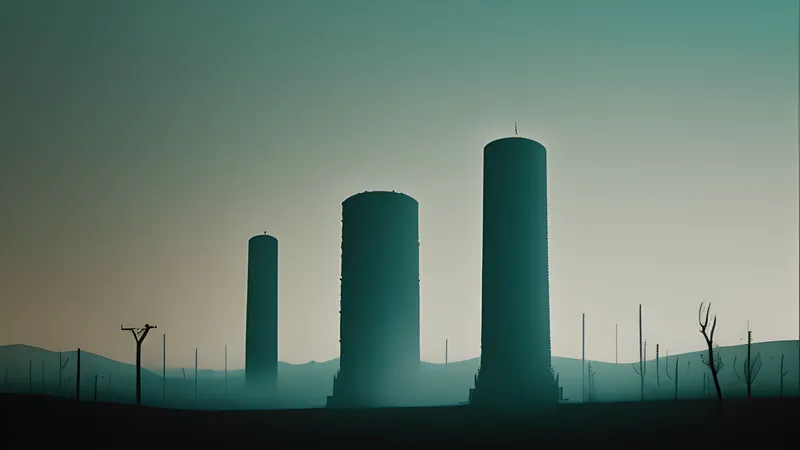
Somewhere in a scorched desert, the ants build towers. They are smooth, dark, precisely tapered, arranged with obvious intent, and they throw hard-edged shadows across the sand in the early light. Nobody built them for the film in the sense that matters — the ants are real ants, photographed at their own scale — but the shapes are pure Saul Bass, and looking at them you understand instantly that a graphic designer has taken charge of a science-fiction picture and is going to conduct the whole thing in shapes.
Phase IV is the only feature Saul Bass directed. He made it in 1974, Paramount cut the ending off it, it failed, and he never directed another. It is one of the strangest films any studio released that decade and it has spent fifty years slowly being recognised as what it is.
The title designer’s only film
Bass is the reason film titles are an art form. He did the paper cut-outs for The Man with the Golden Arm, the vertiginous spirals for Vertigo, the slashing bars for Psycho, the grid for North by Northwest, and decades later the neon plunge for Scorsese. He also designed corporate identities that outlived the corporations. His entire professional life was the compression of an idea into a shape.
That training is visible in every frame here, and it explains both the film’s power and its commercial death. Bass does not think in scenes. He thinks in images that carry the whole argument at once, and a ninety-minute narrative made by someone with that instinct is going to be austere, patterned, and largely uninterested in the things audiences turn up for. There are three significant human characters. There is almost no plot. There is a great deal of looking.
The setup is deliberately vague: an unspecified cosmic event, described in the opening narration in terms that pointedly refuse to be astronomy, has changed something. The result is not mutation. The ants are the same size they have always been. What has changed is that the separate species have stopped competing, coordinated, and begun to act as one intelligence — and a two-man research team in a sealed geodesic laboratory has been sent to find out what they want.
The ants are the actors
Ken Middleham did the insect photography, and it is the reason the film exists. He had shot the extraordinary bug footage for The Hellstrom Chronicle, and here he gets ants in macro close-up doing genuinely astonishing things: carrying, communicating, dying, organising, relaying a poisoned sample down a chain of bodies. The production reportedly shot the desert exteriors in Kenya, standing in for Arizona, and hired ant wranglers to get colonies to perform.
What Bass understood is that real ants at real scale are more alien than any giant one could be. A monster ant is a man in a suit or an armature on a wire, and it is legible — it has a face, it can be aimed at, it can be shot. Middleham’s ants have no faces you can read and no behaviour you can interpret. You watch a column of them move a grain of poison and you cannot tell whether you are watching a funeral, an experiment, or a decision.
This is the restraint principle taken to its logical end. Bass does not withhold the monster. He shows it constantly, in enormous detail, and it stays incomprehensible. The film’s central horror is that the antagonist is fully visible and still cannot be understood.
Set it against Them!, twenty years earlier and the founding text of insect science fiction, and the inversion is exact. The 1954 film makes the ants huge so that men with flamethrowers have something to burn; its subject is human competence under pressure. Bass leaves them small and makes them clever, and his subject is human irrelevance. One film ends with the species winning. The other is called Phase IV.
Geometry as dread
The design thinking runs the picture. The laboratory is a geodesic dome — a lattice, a grid, a designed shape — sitting in a landscape the ants have also designed. The film is a war between two graphic systems, and Bass shoots it that way: the humans behind hexagons, the ants behind their own hard verticals, the desert between them a flat plane of yellow.
The colour is a strategy. The heat is rendered as a sickly, over-baked yellow-white that leaves the frame with no cool value in it at all, so the film is physically uncomfortable to sit in front of. When the ants act, they act in black — black towers, black columns, black shapes crossing the yellow — and the composition does the work an effects budget would otherwise have to do. Two colours and a shape, which is precisely how Bass built title sequences.
The score is largely electronic drone and abstraction, and it declines to score the ants as menace. There are no stings. The insects arrive as texture, and the film’s most disturbing passages are the calm ones.
The other Bass signature is that the film’s key sequences are essentially wordless. He was constitutionally a silent filmmaker; the human dialogue is functional and occasionally clunky, and the picture springs to life every time everyone shuts up and Middleham’s footage takes over.
Two men and an argument
Nigel Davenport plays Hubbs, the entomologist, and the performance is the film’s clearest idea about people. Hubbs wants to win. He escalates, he provokes, he gasses the colony to see what it does, and when it answers he escalates again — a scientist whose curiosity is indistinguishable from aggression. Michael Murphy plays Lesko, a mathematician brought in to find a language in the ants’ signals, and his instinct is the opposite: he wants to talk.
That is the whole argument, and Bass stages it as a slow reversal inside a sealed dome while something outside methodically works out what the dome is made of. Lynne Frederick’s Kendra, a local survivor taken in by the team, is the human cost the argument runs up. The film’s ancestor here is less the creature feature than the chamber piece — three people, one room, a rising temperature and a disagreement about whether the thing outside is an enemy or a correspondent, which is territory Stalker would occupy later with different metaphysics and the same essential unease about what wants what.
The studio took the ending
Bass shot an ending Paramount would not release. It was cut before the film went out, considered lost for decades, and eventually resurfaced and was screened — a sequence of images running several minutes, closer to an experimental short than a resolution. The released version ends abruptly and comparatively conventionally, and the film has spent its life being judged on a conclusion its director did not choose.
That is the standard tragedy of the period, and here it is unusually pointed. A studio hired the man whose entire genius was compressing meaning into abstract imagery, and then removed the abstract imagery he had compressed the meaning into.
The case against
It is cold to the point of inertia. The human material is thin, the dialogue often flat, and Davenport’s obsession is the only character trajectory that develops. Anyone arriving for a creature feature will find ninety minutes of insects going about their business and two Englishmen arguing, and the film has no interest in meeting them halfway.
The vagueness cuts both ways too. The refusal to explain the cosmic event is a strength for an hour and a limitation by the end — the film gestures at cosmic scale and cannot quite pay for it, and the resolution in the released cut arrives with an unearned suddenness that the deleted footage was evidently meant to justify.
The verdict
Phase IV is a designer’s film about design — about two intelligences building structures at each other across a desert, one of which has already worked out what the other is for. It is more frightening than any giant-insect picture ever made because it never once cheats: the ants are ants, doing what ants do, filmed with total attention until their ordinary behaviour becomes the most alien thing you have seen. Bass made exactly one feature and put his whole method in it, and the industry declined the offer.
Watch it for Middleham’s photography, for the yellow, and for the towers. Then follow the ecological chill forward to Silent Running, and the pattern-making back to 2001: A Space Odyssey, whose monolith is the ancestor of every one of Bass’s black towers and whose refusal to explain gave him the licence.
Spoilers below
The film is structured as phases of an experiment, and the experiment’s subjects are running it. Hubbs opens by destroying the towers, and the colony’s response is a demonstration of learning: it studies the attack, adapts, and returns with a countermeasure. When Hubbs deploys a yellow poison, the ants take it into the colony and lose ants to it in sequence, generation after generation, until one emerges with resistance — and Bass shows you the whole process in macro, a species doing R&D in real time, paying for the knowledge in bodies. It is the most chilling stretch in the film and there is not a human being in it.
The counter-attacks are precise rather than furious. The ants disable the dome’s cooling; the temperature climbs; they take the vehicles, the communications, the air. They kill Hubbs — who by then has become the film’s real monster, willing to spend Kendra’s life for data — by drawing him out into a trap of his own making. Nothing they do is rage. Everything they do is engineering.
Lesko’s answer is the one the film has been arguing for. He stops trying to defeat them and starts trying to reply — building a signal out of geometry, sending a shape into the desert, waiting for an answer. The reply he gets is Kendra, alive, delivered back to him, and the released cut closes on the two of them absorbed into whatever the colony is building, with a narration announcing that they knew what was wanted of them. Phase IV has arrived and it is not extinction. It is conscription.
The suppressed ending pushed that further into pure imagery — a rapid montage of the human and insect futures fused, closer to a Bass title sequence than an epilogue, refusing to state in words what the released version’s narration spells out. Restored to the film it does not change the meaning. It changes the register from a statement to a vision, which was the only register Bass ever really worked in.
Related Content