Phantasm: Coscarelli's Dream-Logic Nightmare
A 24-year-old made a horror film that runs on the grammar of a child's worst dream
Contents
Phantasm should not work. On paper it is a jumble — a killer mortician, a flying silver ball that drills into skulls, hooded dwarves, a portal to another planet, and a thirteen-year-old boy on a bicycle trying to convince anyone that his brother is in danger. Written down, it reads like four films shuffled together and dealt at random. Watched, it plays like something far more coherent and far stranger: a child’s nightmare, transcribed with the compressed, associative logic that dreams actually use. Don Coscarelli was twenty-four when he made it in 1979, financing it himself, shooting it on weekends over a long stretch, doing the camerawork and the editing with his own hands. What he produced is one of the few horror films that genuinely thinks the way the unconscious does.
A boy, a brother, and the man from the funeral home
The engine of Phantasm is grief, though the film almost never says so out loud. Mike is a boy whose parents have recently died. He lives with his older brother Jody, a young man barely equipped to be a guardian and visibly itching to leave, and he is terrified — reasonably, given the year he has had — that Jody will abandon him too. Mike follows Jody everywhere, spies on him, clings. When their friend Tommy dies and is buried at Morningside, the local cemetery and funeral home, Mike sees something at the graveside that no one else does: the Tall Man, the mortician, lifting a heavy coffin single-handed, as though it weighed nothing.
The Tall Man is played by Angus Scrimm, and the performance is the film’s dark sun. He is gaunt, towering, immaculate, and almost silent — a figure of pure institutional menace who has taken over the machinery of death in this small town. To a boy who has just watched death take his parents, the man who runs the funeral home is the natural shape for terror to take. Coscarelli understood that instinctively. The Tall Man is death as a person, the undertaker as ogre, and every child who has ever been frightened by a cemetery at dusk recognises him on sight.
Why the dream-logic works
Most horror films that reach for the oneiric end up merely vague. Phantasm is precise about its dreaminess, and that precision is what makes it land. Dreams have their own rules — objects transform, spaces connect that should not, a fear becomes literal without warning — and Coscarelli builds the whole film on those rules rather than on the cause-and-effect of ordinary plotting. Mike’s fear that his brother will disappear becomes a plot about the dead being stolen and remade. His fear of the mortician becomes an actual monster running the mortuary. The film externalises a grieving child’s anxieties and lets them behave with the vivid, unarguable literalism of a nightmare.
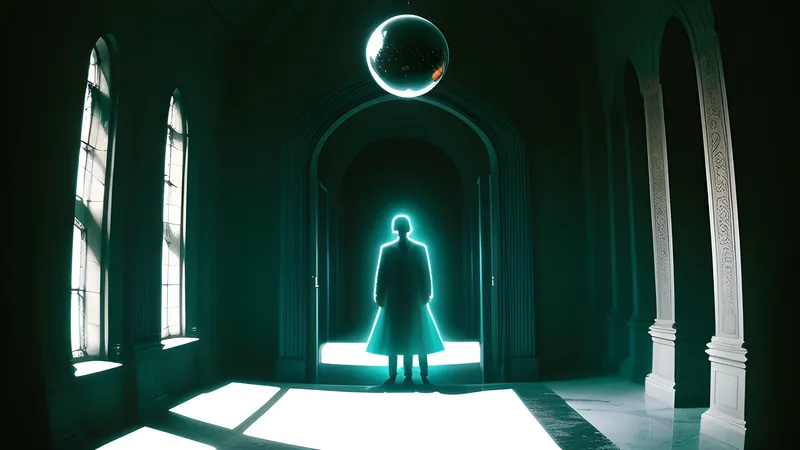
The famous silver sphere is the perfect emblem of this method. It is a chrome ball that flies through the marble corridors of the mausoleum, slams into a forehead, extends a blade, and drills, spraying blood. It makes no rational sense as a weapon. It makes total sense as a dream-object — sleek, impossible, arriving from nowhere, doing something too horrible and too specific to have been invented while awake. Coscarelli shoots it with a giddy, home-made ingenuity that only adds to the unreality. When the film reaches for its bigger images — the blinding white room, the two chrome pillars standing like a doorway, the red-skied world glimpsed on the far side — it keeps the same handmade, half-glimpsed quality, so that nothing is ever explained enough to stop being frightening.
The company it keeps
Phantasm sits squarely in the great run of late-1970s American independent horror, films made outside the studio system by young people with more nerve than money. Its most obvious contemporary is John Carpenter’s Halloween, released the year before — another regional, self-financed picture built around a near-silent embodiment of death stalking a small town. Where Carpenter went for clean, geometric suspense, Coscarelli went for delirium, but the two films share a moment and a spirit: the discovery that a handful of committed amateurs could make something that outlasted the year’s studio product by decades.
Its deeper kinship is with the dream-logic strain of horror, the films that treat narrative coherence as an obstacle to fear rather than a prerequisite for it. The fractured, curdled-coastal-town nightmare of Messiah of Evil runs on the same current, and so does the whispering ambiguity of Let’s Scare Jessica to Death, where the question of what is really happening is never meant to be answered. Reach across to Italy and the real ancestor of Phantasm’s architecture — the interdimensional doorway, the film that stops obeying the laws of space — is Lucio Fulci’s The Beyond, which arrived two years later and shares the conviction that hell is a place you can reach through the wrong door in an ordinary building.
The sound and the shape of it
Two things bind the film’s loose limbs together. The first is Fred Myrow and Malcolm Seagrave’s score, whose main theme is a stalking, repetitive figure that owes something to the era’s other minimalist horror scores and works the same hypnotic trick — a phrase that circles and will not release you, keeping the film’s pulse steady even as its images fly apart. The second is Coscarelli’s editing, done by his own hand, which trusts the elliptical cut. Scenes drop you in late and pull you out early; connective tissue that a conventional film would spell out is simply removed, so the viewer is always a half-step behind, reconstructing, which is exactly the disorientation the film wants.
There is genuine dread in the smaller strokes, too. The Lady in Lavender, a spectral seductress who lures men in the local cemetery, is one of the film’s most unnerving figures precisely because she is never fully explained — a fragment of a wider nightmare glimpsed at its edge. And the ordinary Californian suburb the story unfolds in, all sun-bleached streets and dry hills, grounds the delirium in the mundane, so that the mausoleum’s marble corridors feel like a wound in the middle of an ordinary town.
The verdict
Phantasm is a rough film, and the roughness is inseparable from its power. The seams show; the budget shows; the acting is earnest and uneven; the plot, examined in daylight, dissolves in your hands. None of it matters, because the film is not trying to be examined in daylight. It is trying to reproduce the specific terror of being a frightened child who cannot make the adults believe him, and it does that better than almost anything else in the genre. Angus Scrimm’s Tall Man became an icon for a reason — he is the most primal kind of horror figure, the grown-up who runs the house where they take the dead, seen through the eyes of a boy who has just learned what death costs.
It spawned a long line of sequels, and Scrimm played the Tall Man across four decades, but the original remains the one to start with and the one that matters most. Watch it and stop trying to solve it. Let the sphere fly, let the doorway open, and trust that the film knows exactly what it is doing even when you cannot say what that is. Few horror films have ever been this faithful to the way fear feels from the inside of a bad dream.
Spoilers below
The plot, to the extent it holds still, is this: the Tall Man is robbing the graves of the town, crushing human corpses down under the crushing gravity of his red-skied home world into squat, hooded slaves, and shipping them through a gateway — the two chrome pillars in the white room — to labour there. Mike uncovers this by breaking into Morningside, losing fingers to a slammed drawer, severing the Tall Man’s hand (which keeps moving on its own, bleeding yellow), and enlisting his sceptical brother Jody and their ice-cream-man friend Reggie into the war against the mortuary. The trio’s attempts to trap and destroy the Tall Man escalate into a full siege of the funeral home.
The ending is the film’s masterstroke and its most argued-over moment. After the apparent defeat of the Tall Man, Mike wakes and is told, gently, that none of it happened — that Jody died in a car crash some time ago, that the whole adventure was a grieving boy’s fantasy built to keep his brother alive a little longer. It reframes everything: the monster who steals the dead, the fear of abandonment made literal, all of it the architecture of loss. And then, in the final seconds, the Tall Man’s arms burst through a mirror and drag Mike screaming out of frame. The dream is not over. The consolation is snatched back. The film refuses to let you choose between “it was all imagined” and “it was all real,” and that refusal is the entire point. Grief does not resolve into one clean reading, and neither does Phantasm. It is the same trapdoor that Coscarelli’s dream-logic siblings Messiah of Evil and Let’s Scare Jessica to Death leave open beneath their heroines — the horror still standing, the truth still unbelievable, the door never quite shut.
Related Content