Patrick: The Comatose Telekinetic Ozploitation Chiller
Richard Franklin's villain cannot move, cannot speak and cannot blink on cue, which is exactly why he works
Contents
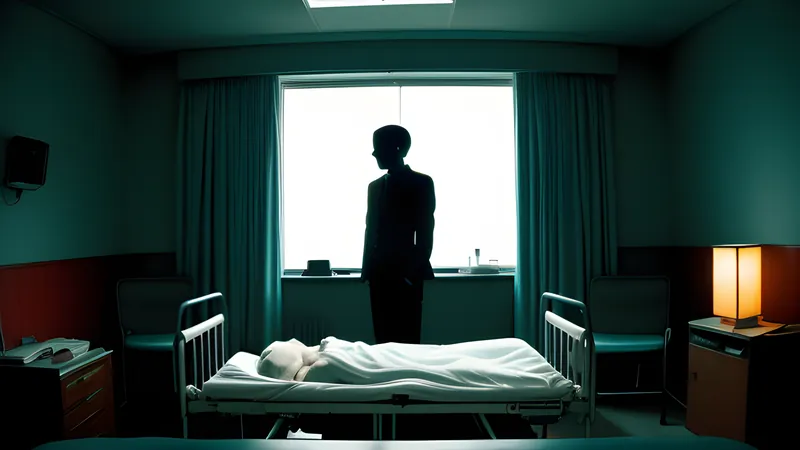
Consider the pitch meeting. Our antagonist has been in a coma for three years. He does not move. He does not speak. He does not open and close his eyes for effect, because his eyes are already open and they stay that way. He cannot be shot in a chase, cannot loom in a doorway, cannot deliver a line. He lies in a bed in a private clinic in Melbourne for ninety minutes. The only voluntary act available to him is spitting.
Somebody green-lit that in 1978, and Richard Franklin made it work, and Patrick is still the most instructive film in the entire Ozploitation run — because it is a horror picture built by a director who had been paying very close attention to the right teacher.
The problem Franklin set himself
Patrick (Robert Thompson) put himself in the bed. The film opens with him committing a double murder in a bathroom, using a domestic appliance and a full bath, and by the second scene he is a case file at the Roget Clinic: unresponsive, fed by tube, warehoused. Kathy Jacquard (Susan Penhaligon) arrives as a new nurse, freshly separated from her husband and pointedly disinclined to go back. Dr Roget (Robert Helpmann) regards Patrick as a piece of decomposing furniture and says so with relish. Matron Cassidy runs the ward like a customs post.
Then Kathy notices that the vegetable is paying attention.
Everett De Roche’s screenplay — De Roche again, the same year he wrote Long Weekend, which tells you something about the man’s range and something about how much of this era he personally wrote — takes the premise somewhere better than a haunted-hospital picture. Patrick’s telekinesis is real and the film establishes it early, so the mystery is never whether. The mystery is what he wants, and what he wants turns out to be squalid and entirely human: he wants Kathy, exclusively, and he intends to remove anyone else who touches her.
That is the film’s genuinely nasty idea. Patrick is not a demon or a psychic experiment or a warning about science. He is a possessive young man with a crush and no body, and the coma has simply relieved him of every social constraint that would normally moderate a possessive young man with a crush. He can act on it, at range, without consequence, while everyone in the building treats him as a piece of clinical furniture. He is unaccountable in the most literal sense: nobody would believe an accusation against him even if someone made one.
Robert Thompson lies very still
Here is the craft. Franklin has an antagonist who cannot act, so he redistributes the acting.
Thompson’s performance is a serious piece of work and it is almost never discussed as one, because it consists of remaining motionless with his eyes open, on camera, for the length of a feature. No blinking on cue, no micro-expressions, nothing an actor is trained to reach for. What he provides is a surface, and Franklin then does the only thing available: he makes Patrick’s face a screen and lets every other performer project onto it.
Which means the horror in Patrick is generated entirely by reaction shots of people looking at a man who is not doing anything. Penhaligon carries most of it, and she is superb — the film lives or dies on whether you believe a competent nurse could come to feel watched by a coma patient, and Penhaligon builds it through a slow accumulation of professional habits breaking down. She starts talking to him the way nurses talk to the unconscious. Then she starts listening for a reply. The film never has to show you Patrick thinking, because Penhaligon shows you a woman deciding that he is.
Franklin’s camera does the rest of the work. He moves it when Patrick cannot: slow pushes onto the bed, the frame drifting closer while the subject stays inert, so the sense of approach is manufactured by the apparatus rather than the actor. He withholds the reverse angle. And he uses Brian May’s score — the Australian Brian May, who would go on to score Mad Max the following year — to insist on menace that the image is refusing to supply, which is a trick that only works if the images are disciplined enough to withstand it. Strings arrive over a man doing nothing. Repeat until the man doing nothing is unbearable.
The spitting is the masterstroke, and it belongs to De Roche. One voluntary muscle. It converts Patrick from an object into a presence with an opinion, it is disgusting rather than frightening, and it lands every single time because the film has spent so long establishing that he can do nothing at all.
The real ancestor is Rear Window
Everyone shelves Patrick next to Carrie, which arrived two years earlier and made telekinesis briefly bankable, and the commercial influence is undeniable. The film’s actual DNA is Hitchcock, and Franklin was about as direct a Hitchcock disciple as the seventies produced — he studied at USC, cultivated the man himself, and would go on to direct Psycho II in 1983, a sequel to the untouchable that turned out to be far better than anyone had any right to expect.
So look at Patrick as Rear Window (1954), inverted.
Hitchcock’s Jeffries is immobilised in a single room with a broken leg. He cannot act physically. He therefore exerts his will on the world entirely by watching it, and by directing other people — Lisa, Stella — to do the moving on his behalf. The suspense engine is a man who can see everything and reach nothing.
Franklin takes that figure and recasts him as the monster. Patrick is Jeffries with the moral polarity reversed: immobile, watchful, exerting will at a distance, and using the people around him as limbs. Hitchcock’s audience roots for the watcher and is quietly implicated in his voyeurism. Franklin’s audience is made to sit in the same room as the watcher and feel it. The clinic is the courtyard, Kathy is the window Patrick looks into, and the terrible thing about it is that Patrick has no leg to heal — his confinement is permanent, so his jealousy has nowhere to go except outward, forever.
The closest sibling in the wider genre is The Sender, which four years later put another psychic patient in another institution and let the staff take the damage. Patrick got there first and did it with a quarter of the machinery.
The Goblin cut, and the afterlife
Two pieces of trivia that are actually criticism. The Italian distributor took Patrick, recut it, and commissioned a fresh score from Goblin — the same year the band’s work with Argento was rewiring what horror was allowed to sound like. The Italian Patrick is therefore a different film in the most meaningful sense available: a picture whose entire tension is manufactured in the sound layer, handed to a band who manufacture tension in the sound layer, and the result plays as prog-horror rather than Hitchcockian suspense. Seek it out if you can; the comparison is the best free lesson in scoring you will get.
Italy then produced Patrick Still Lives in 1980, an unofficial sequel by Mario Landi with no connection to Franklin beyond the name, and it is exactly as restrained as that provenance suggests. Mark Hartley — who had made the Ozploitation documentary that taught a generation this cinema existed — remade Patrick properly in 2013 with Charles Dance as Roget. It is handsome, competent, and it explains too much.
The case against
The film drags in its second act. Franklin’s method requires patience from the audience and he occasionally mistakes inertia for suspense, so there are stretches where the clinic politics and Kathy’s marital business circle without advancing. Helpmann is enormous fun and pitched about fifteen degrees broader than the film around him. And the effects, when Patrick finally reaches out and does something physical, are 1978 effects on a 1978 budget — the film is at its weakest precisely when it delivers what it has been promising, which is a structural hazard of the whole approach.
None of that touches the achievement. Franklin took a villain with no available actions and built a suspense film around him by understanding that suspense was never located in the villain. It lives in the people watching, and in the camera, and in the gap between what a room believes and what is true. That is a Hitchcock lesson, learned properly, and applied in a Melbourne clinic on a budget that would not cover the catering on Topaz. Start with this one, then the wider canon.
Spoilers below
Patrick’s campaign escalates along a line the film draws carefully. He types on Kathy’s typewriter, which is the moment the film converts him from a suspicion into a correspondent — an unmoving body producing text, which is a genuinely eerie image and one that has aged into something the internet has made much stranger than 1978 could have known. He then goes after her men: her estranged husband Ed, and Dr Brian Wright, the colleague she is drifting towards. Both attacks are conducted at range, both are plausibly deniable as accidents, and both work.
Roget’s contempt is what gives the film its cruellest joke. He spends the picture insisting that Patrick is meat, that the reflexes are nothing, that Kathy is projecting — and he is professionally, confidently, catastrophically wrong. The man in the bed listens to every word of it. When Patrick eventually reaches for him, it plays as the settling of an account that Roget did not know he had open, which is the closest the film comes to a moral.
The ending is where De Roche and Franklin earn it. Kathy, finally understanding that the only way out is through the bed, acts — and Patrick appears to die. The clinic exhales. The film moves towards an ending. And then, on the last beat, the corpse spits.
That final gesture is why the film outlives its cycle. It denies you the release, obviously, in the standard shock-coda manner of the period. What it also does is retroactively confirm the film’s whole premise: nobody in that building was ever able to tell the difference between Patrick alive and Patrick dead, because the difference was never visible from outside. Kathy cannot know. The audience cannot know. The only person who could resolve it has one working muscle and no interest in explaining himself.
Related Content