Parents: The Cannibal-Suburbia Black Comedy
Bob Balaban's 1989 debut, Randy Quaid's smile, and a horror film told entirely from child height
Contents
The horror in Parents arrives at dinner, every night, on a plate, and the film never once tells you what you are looking at. Michael Laemle, ten years old, sits at a table in a late-fifties American home while his mother serves and his father carves, and the meat is discussed in the affectionate, slightly forced language that families use. It is always meat. Nobody says what kind. The camera stays at the boy’s eye level, so the plate is close and the adults are large, and Bob Balaban lets that arrangement do everything for ninety minutes.
I found this on a shelf years after it vanished from cinemas, filed under comedy by a shop that clearly had not watched it. Vestron released it in 1989, it failed, the company was in trouble and shortly gone, and the film went into the long dark where interesting American pictures wait. It is the best-directed cannibal film I know, and the reason is that Balaban understood the subject was not cannibalism.
The premise, kept clean
Nick Laemle takes a job at Toxico, a chemical concern doing defoliant research, and moves his family to a new development. Michael starts a new school, does not speak much, and worries the staff. He also starts to wonder about the food. That is the entire engine, and Balaban runs it for the full length without ever confirming or denying the boy’s suspicion above the point where a viewer could be spoiled. The film’s suspense mechanism is a child’s epistemology: he cannot ask, he cannot leave, he cannot be believed, and the two people he would normally take a fear to are the fear.
Why the direction is the whole achievement
Balaban was an actor of two decades’ standing before this, which shows in a specific way: he trusts faces and he trusts stillness.
The camera lives at roughly four feet from the floor. This is the film’s controlling decision and it is applied with real discipline — kitchen counters are at eye height, the underside of the dining table is a location, and adults are shot from below so that Randy Quaid’s jaw arrives before his eyes do. The technique costs nothing and it reorganises the audience’s body. You spend the film physically small.
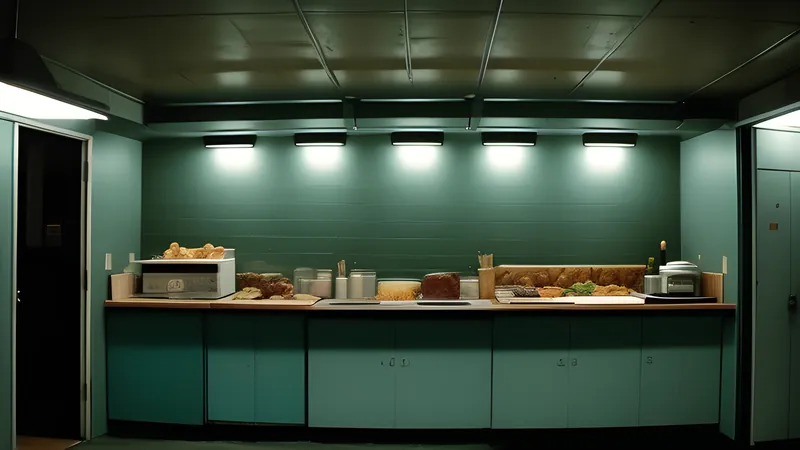
The palette is the second mechanism. The house and the school are rendered in the saturated storybook colours of a period advertisement — the aspirational fifties of a magazine spread, everything clean, everything arranged. Balaban never breaks this scheme for a horror lighting cue. There is no thunderstorm. There is no blue wash for the frightening scenes. The film’s terrible material happens in beautiful, well-lit rooms, which means the audience is denied the usual signal that it is now permitted to be scared. The tension has nowhere to discharge.
Angelo Badalamenti’s score does the rest, and it is one of his best. He works in the period’s own vocabulary — lounge, mambo, easy listening — and then bends it slightly, so a record that would have been playing in a real 1958 living room curdles about a bar and a half in. The film’s soundtrack is a house that is trying very hard to sound normal.
Randy Quaid’s Nick is the performance the film is built on. He is warm. He is funny. He makes jokes with his son and he means them. Quaid plays a man of enormous physical presence being deliberately gentle, and the gentleness is what terrifies, because you can see the scale of what is being held back. Mary Beth Hurt’s Lily is the harder trick: a woman performing wifely competence at such a pitch that her cheerfulness reads as a load-bearing structure. Bryan Madorsky, the boy, was reportedly not a professional and Balaban uses that — Michael watches rather than acts, which is exactly right. And Sandy Dennis, as the school counsellor Millie Dew, gives the film its one adult who listens, in a performance of such peculiar, distracted decency that her scenes feel like weather changing.
The real ancestor of this is a Tobe Hooper film about a dining room
The cannibal-family shelf points immediately at The Texas Chain Saw Massacre, and the debt is real, though it is not the debt people assume. What Balaban borrows is the dinner scene, leaving Hooper’s grime where he found it — the sequence where the horror stops being a chase and becomes a family meal with a guest, and the film’s worst material is served as hospitality. That scene is the germ of Parents, extended to feature length and moved into a house with matching curtains.
The other parent is the American fifties itself as a genre. Balaban’s suburb is assembled out of period advertising, and the film’s real argument is about what the postwar family was selling. Nick works on chemical defoliants for a living; he is a decent man doing appalling work in a lab, and he comes home and carves. The film is quite explicit that the two activities belong to the same worldview and quite silent about connecting them for you. Set it beside Motel Hell, which reaches the identical conclusion through farce — Farmer Vincent is also a small businessman with a product line — and the pair make a genuine argument about American appetite as an industry.
For the neighbours: Society arrived the same year and does the class version with rubber; We Are What We Are does the family-ritual version with a great deal more sympathy; and TerrorVision does the same decade’s suburb as a shrieking cartoon, which is instructive precisely because it is the opposite technique.
The obvious comparison is David Lynch, and the comparison is fair but usually made lazily. Blue Velvet had come out three years earlier and had made the saturated-suburb-with-rot-underneath a recognisable mode. Balaban’s film is more disciplined and less interested in the sublime; his suburb has no lodge, no dream logic, no other world underneath. There is only a house, and the people in it, and dinner at six.
How it disappeared
The commercial story explains why you have probably not seen it. Vestron had come out of the video business and moved into production, had one enormous hit with Dirty Dancing, and spent the proceeds on a slate that included this. By 1989 the company was in serious trouble, and a picture like Parents — a horror film with no monster, a comedy with no laughs in the trailer, marketed to nobody in particular — is the first thing that dies when a distributor stops being able to buy screens.
So it went out small, confused the few people who saw it, and passed into the video shelf, where it sat under a cover that promised something broader. Balaban went back to acting and directed only occasionally afterwards. The film’s rehabilitation has been slow and entirely driven by physical media: a good transfer, a proper restoration, and a generation of viewers finding it on a repertory bill and asking why nobody told them. That trajectory is completely standard for American films that arrive with the wrong shape for their moment, and it is why the video shop, for all its faults, mattered — it kept the orphans in circulation long enough for someone to notice. The streaming era has been considerably worse at this.
The case against
It has one idea and it holds it for ninety minutes. A viewer with no patience for slow tightening will find the middle act static, because the film deliberately withholds escalation — Michael’s suspicion is confirmed at the same slow rate throughout, and the picture refuses to give you a set piece to release the pressure. The dream sequences, where Michael sinks into a bed of blood, are the film’s least interesting passages: they are conventional, they announce themselves as symbolism, and they belong to a more ordinary film. Madorsky’s flatness is right for the part and is still, for some viewers, a wall.
And there is a fair objection about the ending, which I will not describe above this line: the film’s final movement is more conventional than its first eighty minutes, and it resolves a picture that had been arguing, brilliantly, that resolution was the thing a child could never get.
I would still put it above almost every horror film of 1989 on the strength of its control. The film knows exactly what a small boy at a large table feels like, and it never blinks.
Spoilers below
Michael’s suspicion is correct. The film eventually shows him the room in the basement, and Balaban stages the discovery with almost no emphasis — a door, a light, a hanging shape — because the sequence’s job is confirmation rather than shock. What makes the scene land is the boy’s face afterwards at the dinner table, eating, because there is nothing else to do.
The last act turns on Millie Dew, the counsellor, who is the only adult who took Michael seriously and who visits the house to say so. Her fate is the film’s cruellest stroke: the machinery of concern arrives, does its job properly, and is consumed by the thing it came to investigate. Sandy Dennis plays her final scene with a nervous, over-polite goodwill that makes it unbearable.
The confrontation between Nick and his son is where the film converts. Quaid’s performance finally releases the pressure he has been holding since the first reel, and the scale of the man is the point — the audience has spent an hour and a half at four feet, and now the thing at six foot four is moving. The house burns. Michael goes to his grandparents.
The final scene is the reason the film stays with people. Michael, safe, is offered lunch by his grandmother, and the camera holds on the plate. The film ends without telling you what is on it. That is the correct ending, and it retrospectively justifies every withheld answer in the preceding ninety minutes: the boy has escaped his parents and inherited the question, and the question is what the family passes down.
Where to watch
It has been rescued by boutique restoration after years of poor transfers, which matters here more than usual because the film is a colour argument and a muddy print destroys it. Streaming availability is patchy and rotates. Double-bill it with Motel Hell if you want the comic version, or with Society if you want 1989’s other verdict on the American family.
Related Content