Paprika: Kon's Dream-Detective Kaleidoscope
A revisit of Satoshi Kon's 2006 final feature, the film that made dream logic into a working thriller engine
Contents
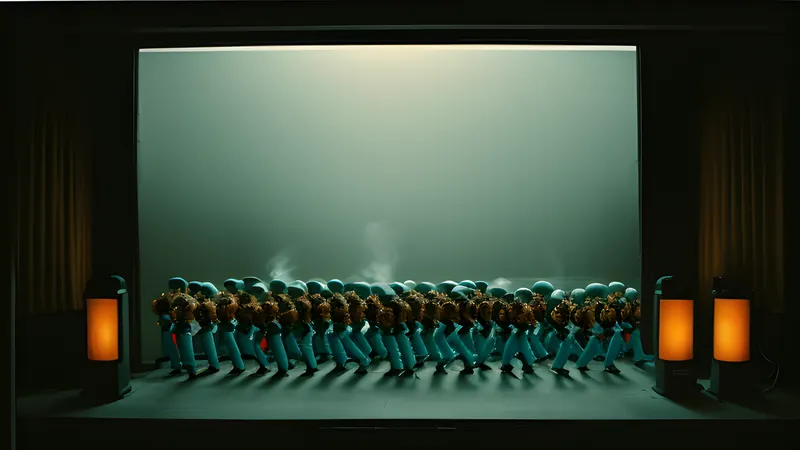
A refrigerator marches down a city street. Behind it come dolls, frogs playing brass instruments, maneki-neko cats, torii gates, a fleet of household objects with faces, all of them singing, all of them advancing with the cheerfulness of a festival and the momentum of a flood. Paprika deploys this parade as a recurring motif, and the first time it appears it is funny. By the last time it is the most frightening thing in the film, and Satoshi Kon has not changed a single element of it. He has only changed what you know.
The machine and the theft
The premise is clean enough to fit on a card. A research institute has developed the DC Mini, a device that lets a therapist enter and record a patient’s dreams. It is unfinished, it has no access restrictions, and several units are stolen. In the wrong hands, the device allows a person to be entered while awake, which means dreams can be pushed into the world rather than merely observed.
Dr Atsuko Chiba, a cool and formidable researcher, moonlights as an unlicensed dream therapist under the alias Paprika — a red-haired, wisecracking figure who moves through other people’s dreams with the confidence of someone who was born in one. The device’s inventor, Dr Kosaku Tokita, is a vast, childlike genius who built a thing of enormous power without a moment’s thought about who might pick it up. And Detective Konakawa Toshimi is a patient: a man with a recurring dream about an unfinished film, who has come to Paprika because his own head has become unusable.
Yasutaka Tsutsui’s 1993 novel supplies the machinery; Kon and his Madhouse team supply everything else. What they build from it is a detective story where the crime scene is a mind, and the pleasure of the film is watching a genuine procedural structure — clues, suspects, alibis — operate inside a space where physics is optional.
The cut is the special effect
Kon’s reputation rests on his editing, and Paprika is where the technique reaches its final form. He was a match-cut fanatic: a character steps forward in one reality and lands in another, an object rhymes across a transition, a gesture completes itself somewhere the gesture did not start. The film moves between waking and dreaming dozens of times, and it almost never announces the switch.
The craft point is that Kon never uses a dissolve or a ripple or any of the visual grammar cinema invented to say “this is a dream”. He uses a straight cut, on movement, and he trusts you to notice. That is why the film’s reality slippage is unnerving instead of decorative — a dissolve tells you where you are and lets you relax; a hard cut on a matched action leaves you a beat behind, which is precisely the sensation of realising you have been dreaming. Kon reproduces a psychological state through a purely mechanical choice at the editing bench.
This is also why Paprika is animated and could not easily be anything else. The match cuts depend on total control of every element in both frames, so that a spinning object here becomes a spinning object there with the exact same weight and speed. Live action can approximate it at enormous expense. Animation gives it to Kon for the price of a storyboard, and he spends the currency lavishly.
Susumu Hirasawa’s score is the other half of the mechanism. His music — synthesised, choral, driving, built on a vocal patch that sounds like nothing else in film — refuses to signal genre. It plays the parade as a celebration and the horror as a celebration, so the sound gives you no help in working out how to feel. Kon and Hirasawa had worked together before, and the collaboration reaches its peak here: the parade theme is the sound of joy that will not stop, which turns out to be a definition of madness.
Konakawa’s unfinished film
The strand that keeps Paprika from being merely a brilliant contraption is the detective. Konakawa’s recurring dream is about a film he cannot finish, and Kon builds the man’s psychology out of the language of cinema itself: chases through genre, a corridor of screens, an anxiety expressed as a shot that will not resolve into the next shot.
Kon was making an argument here, and it is the most personal thing in his work. Cinema and dreaming are the same technology — both are edited, both are experienced in the dark, both put you inside someone else’s images and let you believe you are the author. Konakawa’s therapy consists of learning to watch his own dream as a film, which is to say learning to be an audience for himself. When the film wants to be moving rather than dazzling, it goes to him, and it works.
This is the throughline from Millennium Actress, where the same idea is the whole structure rather than a subplot: a life told as a filmography, a woman’s memory and her movies edited into a single continuous sequence. Paprika takes that fusion and weaponises it.
Paprika herself
The character is the film’s other great piece of engineering, and she is worth separating from the plot she serves.
Paprika exists only inside dreams, which frees Kon from every constraint of continuity that normally governs a lead. She changes shape constantly and without ceremony — she becomes a sphinx, a mermaid, a winged fairy, a figure out of a legend, whatever the dream she has walked into requires of a guide. Each borrowing is a piece of shared pop iconography, and the joke is that a person’s dream is furnished almost entirely from things they did not make.
What keeps this from collapsing into a showreel is that her performance stays constant while her body does not. The voice, the timing, the amused impatience, the way she looks at a patient sideways — those persist through every transformation, so the audience tracks her across forms without a moment’s confusion. This is a rule most fantasy cinema gets backwards: the identity has to live in behaviour, at which point you can do anything you like with the shell. Kon understood that a shape-shifter is only interesting if you can always tell it is her.
The contrast with Chiba is the design’s real payload. Chiba is drawn with a stiffness that borders on the architectural — dark hair pinned flat, tailored jacket, a posture that has been holding itself upright for years. Paprika is drawn as motion. Put them on screen together, as the film repeatedly does, and the character work has already made an argument about this woman before a line of dialogue arrives. It is efficient in the way only animation can be: two people who are the same person, distinguishable at a glance, disprovable at a glance too.
The ancestor and the descendants
The collector’s cross-reference points backwards to the reality-erosion thrillers rather than to other animation. Paprika is a cousin of Total Recall — the same central question of whether the protagonist’s experience is being manufactured — and of Videodrome, where an external technology colonises a mind until the mind stops being able to tell where it ends. Kon’s difference from both is temperamental. Cronenberg treats the invasion as disease; Verhoeven treats it as a joke with teeth; Kon treats it as a carnival, and the carnival is scarier than either.
Forwards, the debt everyone points to is the corporate-espionage-in-a-dream architecture that Hollywood adopted a few years later, complete with the shared-dream premise and the folding of a city. Kon got there first with a fraction of the budget and considerably more imagination about what a dream actually looks like. The honest comparison is unkind to the imitators: their dreams obey rules and are basically well-lit heist locations. Kon’s dreams are made of the debris of a personality, which is what dreams are.
The verdict, argued
The case against is that Paprika is overloaded. It has more ideas per minute than its running time can metabolise, its plot mechanics in the final act become genuinely hard to follow, and Kon’s fondness for spectacle occasionally leaves his characters as figures being carried through their own film. The villain’s scheme, once assembled, is thinner than the imagery wrapped around it. If you want a thriller that closes cleanly, this will annoy you.
The case for is that no other director has made the inside of a head look like this. The film is a demonstration that animation can do something the medium is almost never asked to do — reproduce a mental state directly, without metaphor or a wobble effect — and Kon’s technique is so assured that the film is exhilarating even when it is incomprehensible. It was the last feature he completed before his death in 2010, at forty-six, and the cruelty of that is impossible to separate from watching it now: this is a director arriving at the top of his powers with everything still ahead of him. Watch it twice. The second time, watch the cuts.
Spoilers below
The chairman of the institute is the man behind the theft, and his motive is the film’s best idea.
Confined to a wheelchair, he has decided that the dream world is superior to the waking one and that the correct response is to bring it over — to flood reality with dream until the two are one thing. His accomplice Dr Osanai is a subordinate acting out of a devotion that curdles into possession, and the pair of them use the DC Mini to reach into waking minds and pull them into the parade. That is what the parade actually is: the accumulated dreams of people who have been taken, marching, delighted, gone.
The revelation reframes every appearance of the procession. Its cheerfulness is the point. Each person swept into it is enjoying themselves enormously, which is why nobody resists — the film’s model of catastrophe is not violence at all, it is consent. The refrigerators and the frogs are people, and they are singing.
Kon’s resolution then does something audacious. Chiba and Paprika, kept as separate presences for the whole film, are finally acknowledged as one person who has been refusing to admit it: Paprika is the part of Chiba that is alive, and Chiba’s rigidity has been a way of keeping her at arm’s length. The climax has Paprika absorb the chairman’s expanding dream by becoming an infant and then growing — consuming the nightmare by out-dreaming it — and the two halves of the woman merge in the process.
The last beat belongs to Konakawa. His unfinished film turns out to be a memory of a friend who died young, a film the two of them started together and never completed, and his guilt has been running that reel on a loop for decades. The therapy ends with him buying a ticket to a cinema, alone, to watch something new. After all the spectacle, Kon closes on a man choosing to sit in the dark and let someone else’s dream in. That is the whole thesis, and he gets it in one shot.
Go next to Millennium Actress for the same director doing this with tenderness instead of firepower, and to Total Recall for the live-action ancestor that asked the question first.
Related Content