Panic in the Streets: Kazan's Plague-Chase Noir
Forty-eight hours, a New Orleans wharf, and a manhunt in which nobody may be told why
Contents
A man loses at cards, gets up to leave, and is shot in an alley for the offence of walking away from the table with money. This is an ordinary killing in an ordinary port city and it would fill four paragraphs of a newspaper. Then a coroner’s assistant notices something odd in the blood, and the county pathologist looks again, and a public health officer is called out of bed, and by breakfast the murder has stopped being a murder. It has become the first case in an outbreak of pneumonic plague, and the man who did it is a carrier who has been walking around New Orleans for a day and a half.
Panic in the Streets came out of 20th Century Fox in 1950, directed by Elia Kazan, and it is the film in which the American crime picture discovered that the most frightening deadline is biological. The clock is not a bomb or a trial date or a train. It is an incubation period. Every person the killer has spoken to since Tuesday is a branch in a spreading tree, and the tree doubles.
The two men who cannot say the word
The film’s structural masterstroke is a gag order. Clint Reed, the Public Health Service officer played by Richard Widmark, works out within a reel that the only way to stop the outbreak is to find everyone who was in a room with the dead man — and that telling the public would empty the city in a night, scattering carriers across every state on the rail map. So the manhunt must be conducted in silence. Reed cannot explain to a single witness why he is asking. He must extract the truth from dock workers, café owners, seamen and small-time crooks while telling them nothing, in a city where nobody talks to officials on principle.
That constraint generates the film’s best scenes and its cleverest irony. Reed’s authority is enormous and unusable. He can quarantine a ship; he cannot make a frightened Greek restaurant owner admit who ate there on Tuesday. Widmark plays him as a man being strangled by his own knowledge, and it is a fascinating inversion of the persona he had been building — the twitchy menace of the hustler in Night and the City redirected into a decent man’s frustration. Widmark’s nervous system was always the point; here Kazan aims it at bureaucracy.
Paul Douglas is his opposite number, a police captain who spends the first half of the film convinced that Reed is a hysteric with a medical degree, and their antagonism is written with real intelligence. Warren is not stupid. He is correctly sceptical of a federal officer arriving with an invisible emergency and demanding that the city’s entire detective strength be redirected onto a killing nobody cares about. The film earns his conversion slowly, through evidence, which is a rarer thing in the genre than it should be.
Why it works: a city photographed for real
Kazan shot the whole picture on location in New Orleans, and it was his first film made outside a studio. He said afterwards that it changed how he worked — that the streets gave him things he could not have invented and would never have been permitted to build. It shows in every frame. Joseph MacDonald’s camera goes into the actual wharves, the coffee warehouses, the Greek and Italian cafés, the barbers and the boarding houses, and Kazan populates them with people who plainly live there. The extras have faces the casting office would have rejected.
The technique matters because the film’s subject is contact. A picture about contagion needs a real city, because the whole argument is that a place is a network of people who touch each other — the man who served the coffee, the man who carried the crate, the woman who took the money. Kazan films New Orleans as a system of interconnections, and the plague is simply the thing that makes the connections visible. Shoot that on a backlot and you have a thriller. Shoot it on the docks and you have a map.
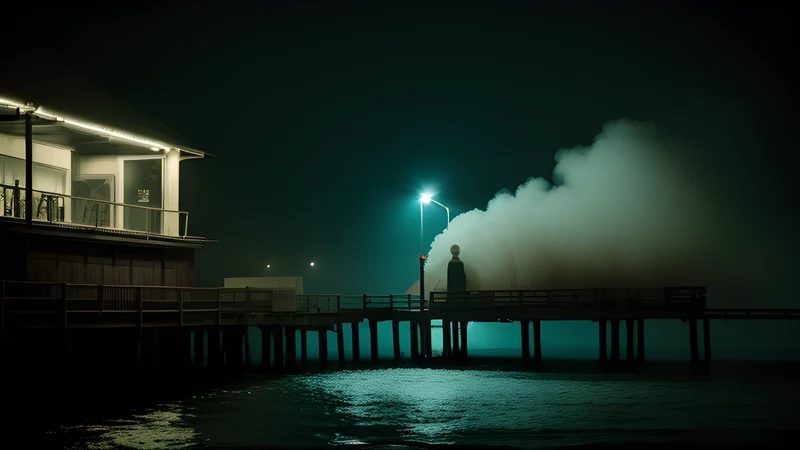
The wharf sequences are the pinnacle. Rope, water, cargo netting, coffee sacks, rats, and a single hanging light — Kazan and MacDonald use the geometry of a working dock as an obstacle course, and the final chase is staged around loading equipment with an ingenuity that a hundred later films would loot. The great craft decision is that the environment is never dressed for menace. The dock is menacing because it is a dock: dark, wet, full of machinery designed to lift things heavier than a person.
Jack Palance makes his film debut here as Blackie, and the arrival is startling. He is given no backstory, no motive beyond appetite, and a face the camera cannot stop looking at, and he plays the part with a hulking stillness that suggests a man who has never once considered a consequence. Zero Mostel is his sweating, giggling underling, and the pairing is superb — Mostel’s terror doing the work that Palance’s calm refuses to.
The reading that will not go away
Two years after this film, Kazan testified before the House Un-American Activities Committee and named names. Nobody can watch Panic in the Streets now without the timing intruding, and the resonance is not manufactured by hindsight alone: this is a film in which a righteous official goes from person to person demanding to know who else was in the room, on the grounds that an invisible infection is spreading through the body politic and that concealment is complicity. Whether Kazan intended any of that in 1950 is unknowable and probably beside the point. The picture makes the argument for compulsory disclosure with total conviction, and it is genuinely persuasive, and that is precisely what makes it uncomfortable.
I raise it because the film is better for the discomfort. It believes wholly in Reed. It believes the city must be swept, the contacts named, the reluctant made to talk. Watched cold, that is a competent procedural; watched with the calendar open, it is a document.
Where it sits in the cabinet
The immediate family is the semi-documentary crime cycle that Fox and Eagle-Lion were running at the time, and its closest sibling is He Walked by Night — the same faith in method, the same police laboratory, the same conviction that a city can be solved by procedure. Kazan’s film beats it by finding an emergency that procedure cannot fully handle, and by casting a hero whose expertise is medical rather than ballistic.
The nearer cousin, structurally, is The Big Clock, released two years earlier and running on the same fuel: an investigation that must be conducted while concealing its real purpose from everyone taking part in it. Both films understand that the best suspense engine available to a crime picture is a hunt in which the hunter cannot say what he is looking for.
The descendants are enormous and largely uncredited. Every outbreak thriller in which a scientist argues with a mayor about whether to tell the public is running this film’s script, usually at greater length and with worse dock work. What almost none of them keep is the discipline: Kazan never shows us a hospital ward, never cuts to a montage of the afflicted, never once dramatises the disease. The plague in this film is a word said quietly in offices, and it is more frightening for it.
The verdict
Panic in the Streets is the strongest of the semi-documentary noirs, and its strength is that Kazan found a subject where location shooting was an argument rather than a texture. Widmark is excellent, Douglas is better than the part deserves, and Palance arrives fully formed. The film’s confidence in its own righteousness has aged into something more interesting than the filmmakers can have intended, and the last twenty minutes on the wharf remain a masterclass in staging a chase in a real place.
It won an Academy Award for its story, which went to Edna and Edward Anhalt, and it turns up in restored form fairly regularly. Watch it on the largest screen you can find; the docks deserve the width.
Spoilers below
Blackie’s motivation is the film’s coldest joke. He has no idea what the dead man was carrying, and he never learns. When he discovers that the police and a federal officer are hunting for anyone connected to the killing, he draws the only conclusion his world permits: the dead man must have been worth something. He concludes that Reed’s frantic search means the victim smuggled in something valuable, and he sets out to find it. The entire third act is a criminal chasing a treasure that is a bacterium.
That is a genuinely brilliant piece of construction, because it means the film’s antagonist is spreading the disease faster the more the authorities pursue it. Blackie is not fleeing the manhunt. He is investigating it, and every man he grabs and interrogates in his search for the imaginary loot is another contact, another branch. The secrecy that Reed insisted on to prevent panic is what generates Blackie’s fatal misunderstanding. The film is honest enough to let its hero’s correct decision be the thing that lights the fuse.
Fitch is the mechanism by which it collapses. Mostel’s cringing accomplice, sick and terrified and finally inoculated, is the crack in Blackie’s operation, and the plague itself starts working through the gang from inside. By the last reel Blackie is running with dying men.
The chase ends in a coffee warehouse and then on the wharf, and it is one of the great physical finishes of the era. Blackie tries to get to a ship, climbs a mooring rope towards the hull, and is defeated by a rat guard — the metal disc fitted to a ship’s hawser precisely to stop vermin boarding. He cannot get past it. He falls into the water and is taken. The image is almost too neat to be borne, and Kazan plays it entirely straight: the man carrying the plague is stopped by the device the port installed to keep plague off its ships. A city’s dull, unglamorous, decades-old public health infrastructure catches the thing that the manhunt could not. For a film so committed to the heroism of the individual officer, it is a startlingly institutional last word, and it is the best thing in the picture.
Related Content