Opera: Argento's Needles-Under-the-Eyes Cruelty
A young soprano is taped to a pillar with needles beneath her eyelids and forced to watch — Argento's most self-incriminating image
Contents
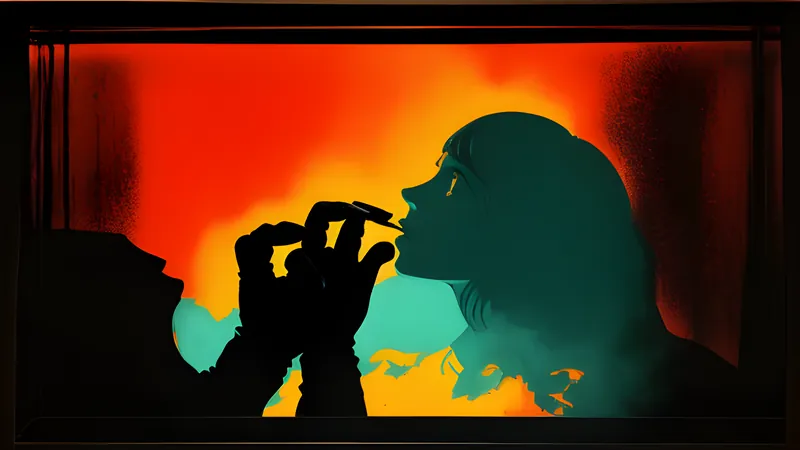
The image is so precise it functions as a confession. A young woman is bound, and a strip of tape has been fixed beneath each eye with a row of needles pointing upward through it. If she closes her eyes, the needles go in. So she keeps them open, and she watches a murder committed a few feet away, and the killer watches her watching. Dario Argento made Opera in 1987, and in one piece of stage business he articulated the thing his critics had been circling for fifteen years: that his cinema is about compelled spectatorship, and that the person he is really describing is you, in the seat, unable to look away from what you paid to see.
He had already answered his critics once, sardonically, in Tenebrae. Opera answers them again, and this time the tone is closer to a shrug of complicity. The film is his last unambiguously great work, made at the point where his personal life and his professional standing were both coming apart, and it plays like a man taking his own machinery to pieces on stage to show you the mechanism while it is still running.
The understudy and the Scottish play
Betty, played by Cristina Marsillach, is a young soprano understudying Lady Macbeth in a modernist production of Verdi’s Macbeth at the Teatro Regio in Parma. The star is struck by a car outside the theatre, and Betty goes on. The production is being staged by Marco, a director of horror films slumming in high culture, played by Ian Charleson — and the casting is a small act of genius, because Charleson brings a wry, exhausted decency to a character who is transparently Argento’s self-portrait, a man who fills a Verdi opera with live ravens and then wonders why the company thinks he is vulgar.
Argento loads the premise with theatrical superstition. Macbeth is the cursed play; you do not say its name in the building; misfortune follows the production. Argento treats the superstition as literal machinery and lets it drive the film. From Betty’s first performance, a killer begins working through the people around her, and each murder is staged for her benefit — she is restrained, her eyes pinned open, and made the sole audience for an act performed exclusively for her.
That is a whodunit with almost no interest in the “who”. The film’s real question is what it does to a person to be made a spectator of atrocity, and whether the pleasure the watcher feels is separable from the crime. Argento does not resolve it. He simply keeps arranging the seats.
Ronnie Taylor, the ravens, and the bullet
Opera is the best-photographed film Argento ever made, and the credit belongs to Ronnie Taylor, who had won an Academy Award for Gandhi and arrived with a completely different toolkit from the gel-happy Italians Argento had been working with. The Teatro Regio interiors are lit with real depth — gold, black, cavernous — and Taylor gives the film a burnished classicism that makes the violence land harder by contrast. The house looks like a house. The blood looks like an intrusion.
Then Argento does the thing only he would do: he puts the camera on a wire and flies it. The raven point-of-view shots skim the auditorium ceiling and swoop over the heads of the audience, and they were achieved practically, with a rig running the length of the theatre. They are exhilarating and slightly obscene — the film’s own eye taking flight over the paying public, which is precisely the joke. Argento had been accused of turning his audience into accomplices; here he literally circles them from above.
The set piece everyone remembers is the peephole. A character stands behind a locked door, looking through the fisheye lens at the corridor beyond. The killer fires. Argento follows the round in slow motion, through the peephole’s optics, into the eye behind it — a shot achieved with a purpose-built rig and Sergio Stivaletti’s effects work, and one of the great sick flourishes of eighties horror. Read it as craft and it is a bravura piece of engineering. Read it as argument and it is the whole film: the apparatus for looking becomes the channel for the wound.
The score keeps the same argument going by sonic means. Verdi and Bellini supply the diegetic music. Against it, Argento cuts in Claudio Simonetti and slabs of heavy metal, so the film lurches from a soprano’s aria to distorted guitars mid-sequence. Some of it is Brian Eno’s ambient work, which does the connective drift. The effect is the same technique he had trialled in Phenomena, refined into a thesis: high culture and low aggression occupying the same building, exactly like a horror director staging Verdi.
The ancestor: Powell’s camera
Everyone reaches for The Phantom of the Opera, which Argento would eventually film outright in 1998 with mixed results. The theatre, the disfigured obsessive in the walls, the soprano elevated overnight — the furniture is all there, and it is the least interesting reading available.
The real ancestor is Peeping Tom. Michael Powell’s 1960 film destroyed his career by proposing that the camera is a weapon, that filming a woman’s death and watching a woman’s death are morally adjacent acts, and that the audience for such a thing is implicated by the fact of its attendance. Britain punished him for it. Opera is that argument restaged with a Verdi orchestra, and Argento’s needles are Powell’s mirror-and-tripod arrangement translated into pure physical coercion. Powell made his killer film the victim’s terror so she would see herself dying. Argento removes the intermediary and simply pins the eyes. The proposition is identical, and Argento arrives at it thirty years later with an Academy Award-winning cinematographer and a raven cam.
The descendant is worth naming too, because it closes the circuit. Berberian Sound Studio is a film about an Englishman losing his mind inside the Italian genre-film industry, and its whole method — horror generated by the machinery of horror production — is Opera’s reflexivity taken to its logical end. And in the same year as Opera, Argento’s own assistant director Michele Soavi delivered Stagefright, a theatre slasher that plays the same premise as pure geometry. Watch the two together and you can see a house style handing itself down in real time.
The case against
The production was miserable and it shows. Argento’s father Salvatore, his producer through most of his career, died around the making of it. His relationship with Daria Nicolodi — who appears here as Betty’s agent Mira — was ending. And Argento’s working relationship with Marsillach was, by every account including his own, poisonous.
That last one is a real problem on screen. Betty is written as passive by design, a woman whose entire function is to be positioned and made to look, and the argument that this is deliberate is sound. It also leaves the film with a hole where its protagonist should be. Marsillach plays her at a register of stunned withdrawal that never modulates, and whether that is a performance choice, a directorial instruction or the visible residue of a set gone wrong, the effect is a film whose emotional centre keeps sliding off. Compare her with Jessica Harper’s watchful intelligence in Suspiria and the gap is instructive.
The plotting is thin even by Argento’s standards, the English track is rough, and the final act relocates to Switzerland for a coda so tonally strange that the international cut trimmed it. Some viewers regard the coda as the film’s collapse. I think it is the most interesting thing in the last reel, for reasons that belong below the line.
What survives all of it is the conviction. Opera is a film about the ethics of looking made by a director who had decided to stop defending himself and simply demonstrate the charge. It is his cruellest film and his most honest one, and there is a reasonable argument — one I would make — that no Argento film after it recovers the same clarity.
Spoilers below
The killer is Inspector Santini, the policeman investigating the murders, played by Urbano Barberini — a piece of casting Argento seeds early and hides in plain sight, since the audience is trained to read the investigator as an ally. The revelation reframes every scene in which he has been standing close to Betty, taking notes, promising protection.
The motive reaches back into Betty’s childhood, and it is the film’s genuine nastiness. Santini had been the lover of Betty’s mother, a woman who took erotic pleasure in watching him kill — she was the spectator, and the murders were performed for her. Betty, as a child, saw this. The needles are therefore an inheritance: Santini is recreating with the daughter the arrangement he had with the mother, and the horror the film has been describing is a family tradition. Argento’s thesis lands with an audible click. The pleasure in watching violence is transmissible, it runs in the blood, and the person insisting she is unlike her mother has spent the film in her mother’s exact seat.
The ravens deliver the reveal. The birds, brought in for Marco’s production and treated by the company as an eccentricity, remember. In the film’s most gloriously operatic gesture they are released into the auditorium and mob Santini in front of a full house, and one of them takes his eye — the organ the whole film has been about, removed by the creatures whose point of view Argento has been borrowing all along. Poetic justice rarely gets a better staging.
Then the Swiss coda, which most critics treat as a mistake. Marco is shooting a film in an alpine valley; Santini, alive, comes for Betty again; and the resolution gives way to a final scene of Betty alone in a meadow, cradling a lizard, insisting on her difference from her mother and her love of small living things. Argento holds on her face and ends there.
It is bizarre, and it is the correct ending. The whole film has argued that Betty’s calm is a symptom, that she has been trained to watch, and that the mother is in her. The coda hands her open sky and freedom and then lets her deliver a protestation of innocence that scans, at the angle Argento has chosen, as something considerably less reassuring. He gives his heroine the meadow and lets you decide what got out of the theatre with her.
Where to watch: seek the uncut Italian version with the coda intact — Scorpion and Cult Films editions restore Ronnie Taylor’s blacks, which the old transfers turned to mud. Follow it with Tenebrae for Argento arguing with his critics in a suit, or with Peeping Tom for the film that made the same case and paid for it.
Related Content