Only Lovers Left Alive: Jarmusch's Weary Vampires
Tilda Swinton, Tom Hiddleston, a lute score, and immortality as a very long Tuesday
Contents
The first shot of Only Lovers Left Alive (2013) is a spinning record on a turntable, seen from above. Jim Jarmusch then dissolves that rotation into two overhead shots of his vampires — Adam in a Detroit room full of guitars, Eve in a Tangier room full of books — both lying flat, both revolving, both stoned on blood. It is a lovely piece of visual rhyme and it is also a joke with a very long fuse: these people are on a loop, they have been on it for centuries, and the needle is running out of groove.
Everything you need to know about the film is in that opening. The vampires have exquisite taste. The vampires are also bored out of their minds. Jarmusch has made the only film I know that treats immortality as a scheduling problem.
What it is
Adam (Tom Hiddleston) is a reclusive musician living in a derelict house in Detroit, surrounded by vintage instruments and analogue equipment, writing music he refuses to release and which keeps escaping into the world anyway. He does not go out. He has a human errand-boy, Ian (Anton Yelchin), who sources rare guitars and asks no questions, and he buys clean O-negative from a haematologist at the local hospital (Jeffrey Wright) under an alias that tells you exactly how funny Jarmusch finds all this.
Eve (Tilda Swinton) is his wife of several centuries, currently in Tangier, where she reads books by running her fingers over them and takes her blood from Christopher Marlowe (John Hurt), who is alive, elderly, undead, and still quietly aggrieved about who got the credit for the plays.
They talk by video call. She works out that he is in trouble and flies to Detroit — night flights only, in stages, with a passport in a false name. And for about an hour the film is two immortals mooching around an abandoned American city at three in the morning, and it is glorious.
Then Eve’s younger sister Ava (Mia Wasikowska) arrives from Los Angeles. Ava has no manners, no discipline, and no interest in sourcing blood responsibly. What she does to the equilibrium is the film’s plot and it lives below the line.
Why it works: worldbuilding by consumption
There is no vampire lore exposition in this film. No rules are explained. Jarmusch builds the entire world out of what his characters own and drink, and it is a masterclass in economy.
Blood is a food supply chain, and the supply is contaminated. They call humans “zombies”, which is the film’s flattest and best joke, and the reason they no longer hunt is that human blood is no longer safe to drink. So Adam bribes a doctor and Marlowe has an arrangement in Tangier, and both plots are, structurally, sourcing problems. Jarmusch shoots the drinking like heroin — the eyes roll, the head goes back, the shot goes overhead — and then shoots the acquisition like a supermarket run. That contrast does more work on the theme of decadence than a hundred lines of dialogue.
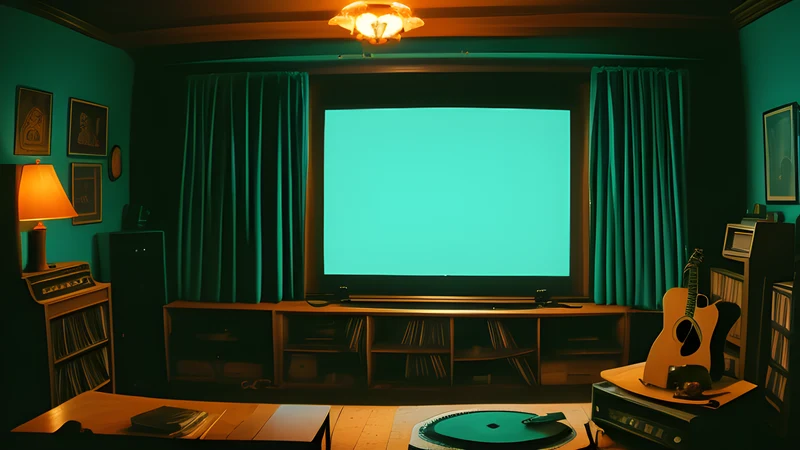
Everything in the frame is old and analogue and slightly broken. Adam’s house is a museum of dead technology: reel-to-reel, valve amps, a Tesla-derived power rig, guitars from the 1950s. Eve packs for a transatlantic move and takes nothing but books. These people are curators, and Jarmusch’s set-dressing is the characterisation. You never need to be told they are centuries old; you can read it off the shelves.
Detroit is the co-star and the argument. Yorick Le Saux shot the city at night — the derelict houses, the empty streets, the vast dark of a place that used to make things. Adam drives Eve past the Michigan Theatre, an opera house now used as a car park, and it is the single most efficient image in the film: a magnificent thing, still standing, repurposed for storage, exactly like the two people looking at it. Jarmusch then has Adam observe that the city will come back when the water wars start, because there is water here. It is the only optimistic line in the film and it is delivered by a suicidal vampire.
The score refuses to be gothic. Jozef van Wissem plays lute; Jarmusch’s own band SQÜRL plays drone rock; the two are laid over each other. A lute is a genuinely ancient instrument and a fuzz pedal is a modern one, and playing them simultaneously is the whole conceit of the film rendered in sound. There are no organs, no strings, no Bernard Herrmann shrieks — the horror vocabulary is simply absent, because Jarmusch is not making a horror film so much as a film about people who have been alive long enough to find horror embarrassing.
Swinton is the reason it flies. Eve is the only character in Jarmusch’s filmography who is happy, and Swinton plays her joy as a discipline — the accumulated knowledge that if you are going to be here forever you had better learn to enjoy a mushroom. Hiddleston has the harder, thinner job: Adam is a rock-star sulk, and he is written as one on purpose.
The real ancestor
Everyone names The Hunger (1983) — Bowie, Deneuve, immortal couple, art direction as theology — and it is a fair surface comparison, though Tony Scott’s film is a perfume commercial with a body count and this is not.
The real ancestor is Herzog’s Nosferatu the Vampyre (1979). Klaus Kinski’s Dracula is the first screen vampire who is comprehensively, unbearably tired — a creature for whom centuries are a sentence and death is the thing he cannot have. Herzog took the monster and made the immortality itself the horror. Everything Adam does in this film — the wooden bullet, the withdrawal, the refusal to release the music, the contempt for a species he has watched make the same mistakes for four hundred years — is Kinski’s exhaustion rewritten for a man who owns good amplifiers. Watch the two together and Jarmusch’s film stops looking like a lifestyle piece and starts looking like a direct descendant.
The second ancestor is Ganja & Hess (1973), the film that first proved you could shoot vampirism as a condition of taste, class and addiction in a fully art-house grammar, and got buried for the trouble. Bill Gunn made the film Jarmusch is working in the tradition of, forty years before the tradition had a name.
The shelf: Let the Right One In is the other great modern film about vampirism as a relationship rather than a threat. A Girl Walks Home Alone at Night arrived a year after this one and shares its record collection almost exactly. And for the long view of what the creature has been made to carry, we traced it across a hundred years in the vampire as sexual metaphor — this film’s contribution to that lineage is that it swaps sex for connoisseurship, which is a genuinely new idea in a very old genre.
The case against
The obvious charge is that the film is a mood board. Adam and Eve have impeccable taste in everything, they name-drop constantly — Tesla, Schubert, Byron, half the Western canon — and the name-dropping functions as flattery: the audience is invited to feel clever for recognising the references, which is a cheaper transaction than the film generally deals in. Ninety minutes of beautiful people admiring their own record collection is a real description of large stretches of this.
The Tangier material is also thin in a way the Detroit material is not. Jarmusch shoots the medina beautifully and populates it with almost nobody; it is a location rather than a place, and the film’s one Moroccan character of substance is a singer performing in a club. Detroit gets an argument. Tangier gets an aesthetic.
And Adam is a bore. Hiddleston commits to it, and I think the boredom is intentional — the film knows a four-hundred-year-old man who broods about how everyone else is a zombie is ridiculous — but a character can be intentionally tedious and still be tedious. Eve carries him and she knows it.
The verdict
Only Lovers Left Alive is the best film Jarmusch has made this century and the funniest vampire film since the genre stopped taking itself seriously. Its great insight is that eternal life would mostly consist of maintenance — the passports, the blood supply, the flights, the storage of things you love — and that the people who survived it would be the ones who kept finding small pleasures worth the admin. Eve is a survival manual. Adam is a warning.
It also has the nerve to be a love story between two people who have already had every conversation and still want to be in the room. That is rarer on film than any amount of fangs.
It streams widely and looks superb on disc; the van Wissem and SQÜRL score is worth the volume and stands up on its own.
Spoilers below
Ava drinks Ian. She has been in the house two days, she has been told the one rule, and she empties Adam’s assistant on the floor of his living room without appearing to consider it a significant event. Then she asks whether they can go out.
The disposal is the film’s best sequence and the only place its horror surfaces properly. Adam and Eve drive the body to an abandoned industrial site outside Detroit and drop it into a pool of acid — a real hazard of a real dead city, used as a mob-grade solution — and stand watching a young man dissolve because the sister could not be bothered to be careful. Jarmusch plays it as housework. That is the moment the film’s elegance shows its bill: these are people who have outsourced their appetite so thoroughly that a corpse is a logistics issue.
Marlowe dies in Tangier, poisoned by contaminated blood from a source that failed. John Hurt plays it small, in a chair, complaining mildly, and the last of Elizabethan literature goes out in a rented room. Whatever you think of the Marlowe-wrote-Shakespeare conceit, the film’s use of it is unimprovable: the man who supposedly authored the language is the first casualty of a bad supply chain.
Adam and Eve run out of options. They reach Tangier and find no blood; Marlowe’s contact is gone; they are starving, which the film shows as a slow greying rather than a rage. In their last hours they sit in a club and listen to Yasmine Hamdan sing, and Adam — who has spent the whole film insisting the human species is a plague — says she is going to be famous, and Eve tells him he ought to hope she isn’t. That exchange is the entire relationship.
The final scene puts them on a wall at dawn, dying, and a young couple walks past, kissing. Eve suggests the obvious. Adam objects, briefly, on the grounds of aesthetics. Then they go over, and the last image of the film is two starving immortals baring their teeth at the first genuinely new thing they have wanted in a century.
The joke lands perfectly. Two hours of refined taste, four centuries of collecting, an entire philosophy of decline — and it all resolves into an old creature doing exactly what old creatures do, in an alley, out of hunger. Jarmusch lets them have it, and the fade to black comes before the bite, which is the most tactful thing in the film.
Related Content