On Dangerous Ground: Ray's Cop Who Feels Too Much
Robert Ryan's brutal detective, a snowbound manhunt, and Bernard Herrmann's strangest score
Contents
For its first forty minutes, On Dangerous Ground is a city picture about a policeman who has become a problem. Jim Wilson works nights, lives alone, eats alone, and has arrived at the stage of the job where the only sensation still available to him is the moment his fist connects with a suspect. His partners have wives and children and go home to them. Wilson goes to a rented room. When his superior finally tells him he is being sent upstate to help with a rural murder case, it is presented as an assignment and understood by everyone as a disposal.
Then the film leaves the city, and something odd happens: it changes genre. The pavements and the shadowed stairwells give way to snow, hard white daylight, empty hills, a landscape with no corners to hide a threat in. RKO released the picture in 1951 after leaving it on the shelf for the better part of a year, and the received wisdom has always been that it is two films awkwardly stitched together. That reading is wrong in an interesting way. The join is the subject.
Two halves and the seam between them
Nicholas Ray directed it for producer John Houseman, working from Gerald Butler’s novel Mad with Much Heart and a screenplay by A. I. Bezzerides, with Ray himself contributing uncredited. Bezzerides is one of the great unheralded names of the cycle — the same year he was shaping this, he had already given Jules Dassin the produce-market fury of Thieves’ Highway, and he would later hand Robert Aldrich the apocalyptic script for Kiss Me Deadly. He wrote working men. His cops and truckers talk like people whose bodies are the equipment, and Wilson’s exhaustion in the early scenes is written from the inside.
The city section is filmed by George E. Diskant in the mode you expect and does it superbly: wet streets, informants in doorways, a stakeout that reveals the police as a species of predator with better paperwork. Ray’s actual interest, though, is in the sequence where Wilson beats a suspect and the film simply stays there, watching, past the point of comfort, while the man goes down and Wilson keeps asking questions in a voice that has stopped expecting answers. Robert Ryan plays this without any of the actor’s usual apologies. Ryan was a big man who specialised in men whose size had become a moral condition — the same quality he brought to the doomed boxer of The Set-Up — and here he gives Wilson a self-disgust so complete that violence reads as a way of getting the day over with.
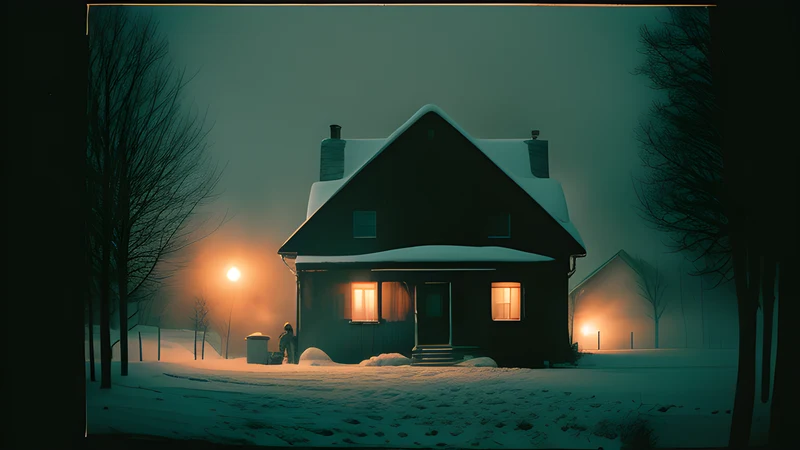
The transition upstate is abrupt and deliberately so. Wilson drives out of the dark and into a snowfield, and the film’s visual argument arrives with him: this man has spent his career in a world where you cannot see more than fifteen feet, and he is now standing in a place with no shadows in it at all. Everything he knows is useless here. He cannot lean on anyone. He cannot read a room, because there are no rooms.
Why it works: Herrmann’s viola d’amore
The score is the reason this film survives its reputation. Bernard Herrmann wrote it in 1951 and regarded it warmly enough to fashion a concert suite from the material, and it is one of his strangest constructions. The city section gets a hammering, brass-heavy anxiety. The manhunt across the hills gets a genuine hunting piece — horns, driving rhythm, the vocabulary of an aristocratic chase applied to two men in overcoats stumbling after a boy across a field, which is exactly the joke and exactly the horror. Herrmann is scoring what the pursuers think they are doing.
And then there is Mary Malden’s theme, carried by a viola d’amore: a soft, old, slightly out-of-time instrument with sympathetic strings that vibrate without being played. Herrmann chose it for a woman who is blind, and the choice is not decorative. The viola d’amore resonates in response to sound around it. It is an instrument that listens. Ida Lupino plays Mary as somebody who has learned to read a room by attention rather than sight, and the score gives her a sound that does the same thing. This is the sort of craft decision that separates a composer from a supplier of mood, and it does more characterisation in thirty seconds than the dialogue manages in a reel.
Lupino’s presence in the film has a further wrinkle. By 1951 she was directing her own pictures for The Filmakers, two years from the desert precision of The Hitch-Hiker, and it is reported that when Ray was unavailable during the production she directed material herself. She never made much of the claim. Watching the farmhouse scenes, the restraint is conspicuous: two people talking in a kitchen, no underlining, the camera declining to hunt for the pathos.
The third man in the hunt
Ward Bond’s Walter Brent is the film’s cleverest piece of construction. Brent is the father of the murdered girl, he has a rifle, and he intends to use it. He is also, structurally, Jim Wilson with the badge removed — the same rage, the same certainty, the same appetite, minus the institution that has spent years pretending to restrain it. Ray puts the two of them in a car together and lets Wilson watch himself drive.
What follows is the film’s real argument. Wilson does not reform because a good woman loves him. He reforms because he is forced to spend a day and a night standing next to an undisguised version of his own violence, and it is unbearable to look at. Bond plays Brent with a limp and a grievance and absolutely no interiority, and that flatness is the performance — the man has been reduced to a single intention, and Wilson can see the reduction happening.
The RKO of this period was Howard Hughes’s RKO, which is to say a studio in a state of managerial collapse, and the film’s shelving and its contested finish belong to that chaos. Ray was reportedly unhappy with how the picture concluded, and the argument over that last reel has trailed the film ever since. I take it up below the line, where it belongs. What matters above it is that the ninety minutes leading to it are among the most unsparing Ray ever shot, and that the studio which shelved them had no idea what it was holding.
Where it sits in the cabinet
The collector’s cross-reference is Ray’s own debut, They Live by Night, which had already established his abiding subject — people whose capacity for tenderness is exactly the thing the world will destroy them for. Wilson is that subject inverted. The tenderness is buried under years of institutional brutality, and the film’s question is archaeological.
The wider ancestor is the police procedural’s first honest confession. Films like He Walked by Night were busy establishing the police as a competent, near-scientific apparatus; Ray, working the same years, made a film in which the apparatus is staffed by a man who is himself a public danger, and the department knows it, and its solution is to send him somewhere else. The descendants run right through the burnt-out-detective tradition, and most of them keep the exhaustion while discarding the thing that makes Ray’s version bite — that Wilson’s cruelty is enjoyable to him, and that the film says so out loud.
The verdict
On Dangerous Ground is the most emotionally naked film in the classic noir cycle, and its awkwardness is inseparable from that nakedness. The seam between the two halves is not a flaw the film failed to sand down. It is the shape of a man being removed from the only environment his personality makes sense in, and the picture is honest enough to let the change of key sound as jarring to us as it feels to him. Ryan gives the performance of his career in the first act and then spends the rest of it doing something harder, which is playing a man with no idea what to do with his hands.
Where to find it: it circulates in decent transfers and turns up in Ray retrospectives, usually programmed after In a Lonely Place and usually to a room that arrived for the wrong film. Bring headphones for the Herrmann if you can.
Spoilers below
The killer is Danny Malden, Mary’s younger brother, and the film reveals it early enough that the manhunt is never a whodunit. Danny is disturbed, frightened, and — this is the detail that reorganises everything — a boy. Ray withholds him for a long stretch, keeping him a shape in the snow, so that when he finally arrives in the frame he is small, and the entire moral architecture of the chase collapses in a single shot. Brent has been carrying a rifle across a county to shoot a child.
Mary knows. She has been sheltering him, and her blindness, which the film could have used as a cheap engine for suspense, is used instead for something sharper: she is the one person in the picture who has never seen her brother as anything except a person, and she is therefore the only one immune to the hunt’s logic. Wilson’s turn happens in her kitchen, when he realises he has spent his career being the rifle.
The chase ends on a rock ledge. Danny, cornered by the two men, backs away from them and falls, and the fall is an accident that both pursuers had spent the day trying to arrange on purpose. Ray stages it without triumph. Brent, having got exactly the outcome he demanded, is left standing over a dead child with nothing to say, and the film’s most merciless second is the one in which his rage simply drains out and leaves an old man in a field.
The finish is the disputed part. Wilson returns to the city, to the room, to the job, and finds it intolerable — and then the picture sends him back upstate to Mary. It is a genuinely happy ending, arriving in a film that has spent ninety minutes arguing that people do not get those, and Ray is reported to have wanted otherwise. I would defend it, narrowly. The film has established that Wilson’s problem is solitude weaponised by authority, and the ending removes both. What it cannot quite survive is the speed: the redemption takes a reel, and the damage took twenty years.
Related Content