Oldboy: The Corridor, the Twist, and Park Chan-wook's Rage
The Korean revenge film that made the world flinch and look again
Contents
Oldboy has been reduced, over twenty years, to three things: a man eating a live octopus, a fight down a corridor filmed in one long sideways take, and a twist so vicious that people who have never seen the film know to be careful discussing it. That reduction does the film a disservice, because underneath the shocks Park Chan-wook made a genuine tragedy — a revenge story so total that it swallows the avenger, the target, and the audience’s own appetite for revenge along with them. Revisited now, with the initial jolt long spent, it plays less like a provocation and more like a Greek drama with the lights turned all the way up.
The setup is a perfect nightmare. Oh Dae-su, an ordinary, drunken, unremarkable man played by Choi Min-sik in one of the great screen performances, is abducted off a rainy street and locked in a shabby private room that looks like a cheap hotel. He is fed, kept alive, allowed a television, and given no explanation. He stays there for fifteen years. Then, as arbitrarily as he was taken, he is released — dropped back into the world with money, a phone and a single burning question: who did this, and why. The genius of the premise is that the “why” turns out to matter far more than the “who,” and the film spends its length teaching Dae-su, and us, to dread the answer.
Vengeance as a machine that eats its maker
Oldboy is the centrepiece of Park’s loose “Vengeance Trilogy,” bracketed by Sympathy for Mr Vengeance and Lady Vengeance, three films obsessed with the idea that revenge is a transaction which bankrupts everyone who enters it. Dae-su emerges from his cell as a self-made weapon, having spent fifteen years shadow-boxing and hardening himself for a fight he cannot yet name. Choi reportedly trained his body into that of a man who has done nothing but prepare, and you believe it — this is a performance of pure, coiled, animal purpose, and Choi lets you see the grief leaking through the fury at every turn.
The film’s antagonist, Lee Woo-jin (Yoo Ji-tae), is the opposite: cool, wealthy, unhurried, a man who has planned his revenge with the patience of an architect. The asymmetry is the point. Dae-su swings a hammer; Woo-jin builds a labyrinth. And the horror the film is walking toward is that Dae-su, for all his rage and preparation, has been a rat in a maze designed years ago, doing exactly what his tormentor wanted at every step. His agency is an illusion, and the film’s dread comes from watching a furious man discover he was never in charge.
Choi and Yoo make the imbalance electric. Choi plays Dae-su as a man running purely on instinct and hurt, forever a step behind, forever reacting; Yoo plays Woo-jin as a host welcoming a guest to a dinner he catered fifteen years ago. The scenes where they finally share a screen have the queasy intimacy of a cat allowing a mouse to think it is winning. That is the film’s cruel comedy: the avenger believes he is the story’s subject when he has been its object all along, a piece being moved across a board he cannot see the edges of.
Why the corridor works
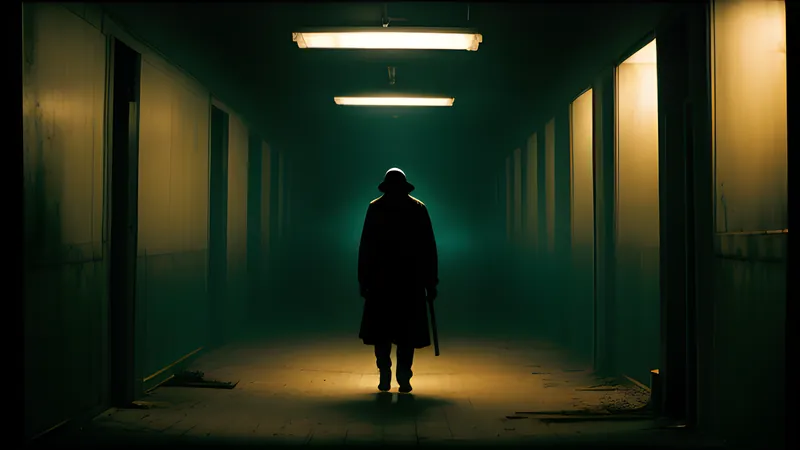
The famous corridor fight is worth slowing down for, because it is a genuine formal landmark. Dae-su, armed with a hammer, takes on a gang’s worth of henchmen in a narrow hallway, and Park films the whole brawl in a single, unbroken, side-scrolling shot, the camera tracking laterally as if the action were unfolding across a two-dimensional plane. The effect is deliberately game-like, flattening the fight into a scrolling arcade beat-’em-up — a man moving relentlessly from left to right, taking hits, giving worse. It is exhausting to watch because it denies you the relief of a cut. Real fights do not have edits, and Park makes you feel every laboured second of Dae-su’s endurance. Cinematographer Chung Chung-hoon, who would go on to shoot for Park and later for Edgar Wright, gives the whole film a saturated, storybook-lurid palette that keeps the horror at one remove from realism, closer to fable.
That fairy-tale surface is the key to why Oldboy survives its own extremity. Park is not a realist. He is a stylist working in a heightened, operatic register where coincidence, cruelty and grand symmetry are allowed to rule. The octopus, the hammer, the hypnosis, the improbable elegance of the villain’s scheme — these belong to myth rather than to the police procedural. Understood as a fable about the cost of vengeance, the film’s excesses stop being shock for its own sake and become the deliberate exaggerations of a moral tale, the way a folk story amputates and blinds to make its point land.
The company it keeps
Oldboy announced Korean cinema to the world stage — it won the Grand Prix at Cannes in 2004 from a jury led by Quentin Tarantino, who reportedly fought for the Palme itself — and it belongs beside the other Korean crime films that turned genre into national self-examination. The obvious partner is Memories of Murder, Bong Joon-ho’s film from the previous year, which shares Oldboy’s conviction that Korean genre cinema could be both viscerally entertaining and morally serious. Where Bong works in dread and frustration, Park works in fury and grief, but both films treat the crime picture as a vessel for something much larger than the plot.
Its other great sibling on this site is Infernal Affairs, the Hong Kong thriller that mapped the two poles of the early-2000s Asian wave. Set them side by side and you can see the whole spectrum: the Hong Kong film’s glassy restraint against the Korean film’s operatic excess, cool fatalism against hot revenge. And for a Western film that shares Oldboy’s theme of a man torturing his way through a maze toward a truth he should never have chased, Prisoners is the closest American cousin — another labyrinth, another father-shaped grief, another warning that the pursuit of vengeance is a trap laid for the pursuer.
The verdict, argued: Oldboy is a masterpiece with a scar, and the scar is part of why it lasts. It is a film that uses shock the way a tragedian uses blood — to make an idea unforgettable. Two decades of imitators have copied the corridor and the twist and produced nothing with its emotional undertow, because they took the surface and missed the sorrow. This is a revenge film that ends by making revenge unbearable, which is the only honest place a revenge film can go.
Spoilers below
The twist is one of the cruellest in cinema, and it works because it retroactively poisons everything sweet the film has offered. During his captivity and after his release, Dae-su falls into a tender relationship with Mi-do, a young sushi chef who helps him hunt his tormentor. The revelation Woo-jin has engineered is that Mi-do is Dae-su’s own daughter, that Woo-jin used post-hypnotic suggestion to steer the two of them together, and that the entire fifteen-year imprisonment and everything after was a machine built to make Dae-su commit incest without knowing it. The “why” that the film taught us to dread turns out to be a mirror: years earlier, Dae-su had glimpsed and idly gossiped about Woo-jin in a compromising moment with Woo-jin’s own sister, and the rumour drove her to suicide. Woo-jin’s revenge is to inflict the same species of unspeakable shame on Dae-su, engineered to the last detail.
The film’s final movement is where Park earns the horror. Dae-su, having learned the truth and desperate that Mi-do never should, literally cuts out his own tongue — the organ of the careless gossip that started everything — and grovels before Woo-jin, reduced to a dog, begging him to keep the secret. It is a scene of total abasement, and it drains the audience’s appetite for revenge completely; there is no triumph to be had here for anyone. Woo-jin, his life’s project complete, has nothing left to live for and shoots himself in a lift, the same enclosed space that has framed so much of the film’s cruelty. The closing scene is deliberately unreadable: Dae-su seeks out the hypnotist to have the memory of the truth erased, and reunites with Mi-do in the snow, his face caught between a smile and a scream. Park refuses to tell us whether the erasure worked, whether the smile is peace or damnation. The ambiguity is the last twist of the knife — a man who may have chosen to forget in order to keep loving the person he should not, which is either mercy or the deepest hell the film can imagine.
Related Content