Nunsploitation: The Convent as a Horror Engine
Why the walled cloister, with its vows and its silence and its absolute authority, became one of exploitation cinema's most efficient machines for dread
Contents
Take a group of women, seal them behind high walls, forbid them the flesh, place absolute authority in a single office answerable to God, and add total silence. You have just described a convent, and you have also described a pressure vessel. Exploitation cinema noticed this in the 1970s and built a whole disreputable subgenre on it — nunsploitation, the convent horror film — which spread across Italy, Spain, France and Japan and produced work ranging from the genuinely serious to the cheerfully indefensible. What unites the good and the shameless is the setting itself, one of the most efficient horror engines the movies ever found ready-made.
The pressure cooker
A horror film needs pressure and confinement, and the enclosed convent supplies both by design. The vow of chastity concentrates desire by forbidding it. The vow of obedience concentrates fear by removing recourse. The physical enclosure — the cloister, the locked gate, the cell — removes escape. And the hierarchy places a fallible human being, the abbess or the confessor, in a position of near-total control over an isolated community with no outside witnesses. Every one of those pressures is a horror device, and the convent stacks them all in one location before the camera even turns.
Crucially, the pressures are religious, which raises the stakes past the merely physical. The threat in a convent film is rarely only bodily harm; it is damnation, hysteria, possession, the terror of a God who might be watching or might have looked away. That metaphysical charge is why the setting outperforms a mere prison, even though the prison-drama grammar of the cell and the cruel warden runs right through the subgenre. The convent is a prison whose inmates believe the walls are holy, and that belief is the extra turn of the screw.
The gothic inheritance
None of this began with the drive-in. The convent has been a machine for dread in Western storytelling for two and a half centuries, and the exploitation films are the pulp descendants of a serious literary line. The Gothic novel practically ran on it: Matthew Lewis’s The Monk in 1796 built its horrors around a corrupted cloister, Ann Radcliffe’s The Italian used Inquisition and convent as instruments of terror, and Diderot’s The Nun, written earlier and published in 1796, turned the forced vocation into a study of institutional cruelty that still reads as an indictment. The imagery the films would later exploit — the reluctant novice, the tyrannical superior, the sealed order hiding its abuses — was fully formed in prose long before a camera existed.
Cinema inherited the theme with prestige attached. Michael Powell and Emeric Pressburger’s Black Narcissus in 1947 is the great respectable ancestor, a Technicolor study of nuns in the Himalayas undone by altitude, memory and desire, in which repression itself becomes visibly unbearable and the film’s famous colour design does the work of dread. Two decades on, Ken Russell’s The Devils in 1971 supplied the immediate detonator. Adapted from Aldous Huxley’s account of the 1634 Loudun possessions and John Whiting’s play, designed in stark white by Derek Jarman, it dramatised a real historical episode in which a French town’s Ursuline convent erupted in accusations of demonic possession and a priest, Urbain Grandier, was burned for it. Russell’s film is a furious piece of history about power weaponising hysteria, and its scandal — heavily censored, still hard to see in full — proved how combustible the material was. Russell would return to religious and erotic provocation throughout his career, as in the deranged Crimes of Passion, but The Devils is where he lit the fuse the exploitation industry then ran with.
The exploitation wave
What followed was a flood of European product that mined the setting for sensation. Italy led, with pictures like Flavia the Heretic in 1974, which used a medieval convent for a genuinely angry story of a woman crushed by religious and patriarchal power, and later curiosities such as Killer Nun in 1979, in which Anita Ekberg’s drug-addled sister spirals into cruelty. Walerian Borowczyk, an art-cinema provocateur, brought his aesthete’s eye to Behind Convent Walls in 1978. At the frankly disreputable end, journeymen like Joe D’Amato churned out convent pictures whose ambitions stopped at the box office.
The most interesting single film in the wave came from Japan, which had its own erotic-cinema industry running in parallel. Norifumi Suzuki’s School of the Holy Beast in 1974 is nunsploitation with a real thesis under the transgression — a beautiful, savage attack on institutional hypocrisy in which a young woman enters a convent to investigate her mother’s death and uncovers systemic cruelty. Suzuki shoots it with the full colour-drenched craft of the Japanese studio system, and the film’s rage at abuse of power is entirely sincere. It belongs to the wider tradition of Japanese studio erotica that ran alongside the American and European scenes, a subject with its own pinku and Roman Porno history.
Spain supplied its own strand, shaped by a country only just emerging from decades of Franco-era censorship, where the Church’s grip on public life gave convent transgression an extra political charge. The endlessly prolific Jess Franco worked the territory more than once, bringing the same hypnotic, aimless eroticism he lent his vampire films — the mood I traced in Vampyros Lesbos — to stories of cloistered desire and inquisitorial cruelty. In the Spanish context the convent film reads partly as a settling of accounts with a national institution, which lent even the trashier entries an undertow of real resentment. The subgenre was pan-European, and each country brought its own quarrel with the Church to the walls.
Why it works as craft
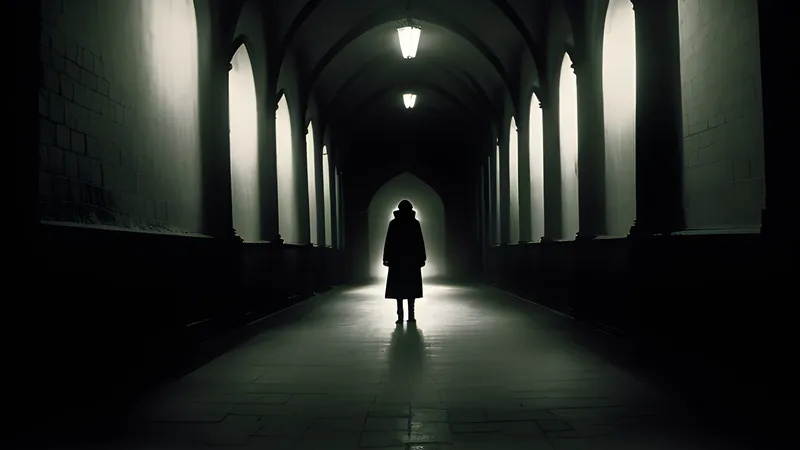
The visual grammar of the convent film is unusually strong, and it is worth naming why the setting photographs like horror. The architecture does half the work: long stone corridors that force deep-focus compositions, iron gates and grilles that frame characters as already imprisoned, the geometry of cloisters turning every walk into a march toward something. The habit itself is a gift to a cinematographer — vast fields of black and white that make any drop of blood or flash of skin register as a rupture in an otherwise austere frame. Transgression reads loudest against the plainest background, and nothing is plainer than a habit.
Sound completes it. Bells, plainchant, the amplified hush of enforced silence, the echo of a single pair of feet on stone — the convent has a built-in soundscape of dread that a filmmaker gets for nothing. The best entries exploit the clinical, institutional quality of the space the way a horror director exploits a hospital or asylum; the same cold architecture of control animates a film like Eyes Without a Face, where sterile order becomes its own source of terror. Even Argento’s coven-run academy in Suspiria borrows the shape — an enclosed institution of women, ruled by a hidden matriarch, hiding an unholy secret behind its walls. The convent is that structure with the theology made explicit.
The argument under the habit
It would be dishonest to pretend the whole subgenre was making a serious point; a great deal of it was cheap sensation dressed in a wimple, and it should be watched with the eyes open about that. The reason the mode still merits attention is that its best films used the sensation to carry a genuine critique. The historical record they drew on — Loudun, the earlier Louviers possessions, the long history of enclosed orders and the abuses that enclosure enabled — is a real story about what happens when authority operates without witnesses. When a nunsploitation film indicts the confessor who wields the sacrament as a weapon, or the abbess who runs her house as a private tyranny, it is aiming at something true, even when its motives are grubby.
That is the paradox worth leaving you with. The convent horror film is often exploitation at its most opportunistic, and it is also, at its sharpest, a folk critique of institutional power that the prestige cinema of the same years rarely dared make so bluntly. The setting is what allows the double life. A machine this efficient — confinement, repression, authority, silence, the fear of God — will always attract both the artist and the hack, because it delivers dread to either one. That is why the subgenre never fully died: every generation rediscovers that the surest way to unsettle an audience is to lock a believer inside the very institution built to save her, and let the walls do the rest. Start with The Devils for the serious ancestor and School of the Holy Beast for the version that keeps its anger and its argument intact, and you will see how much horror was waiting inside those walls the whole time.
Related Content