November: The Estonian Folk-Horror in Silver Monochrome
Rainer Sarnet films a village that steals from the Devil and gets away with it
Contents
The first thing you see in November is a creature made of scythes and cartwheels and a cow’s skull, flying over a field, stealing a cow. It is not a dream sequence. Nobody in the film finds it remarkable. This is simply what happens in this village, on this Tuesday, and the fact that Rainer Sarnet establishes that within ninety seconds and never once flinches from it is why November is the most confident folk-horror film of the last decade.
It premiered at Tribeca in 2017, it is Estonian, it is in black and white, and it is adapted from a novel that most of Estonia has read. It has almost no international profile. It is also, image for image, one of the most beautiful horror films ever made, and I do not say that lightly.
The world, which is the plot
Nineteenth-century Estonia, a peasant village on the estate of a German baron. The villagers are serfs. They are also, to a man and woman, thieves. They steal from the baron, they steal from each other, they steal from the church, and they steal with a total absence of guilt that Sarnet plays as comedy for the first hour and as tragedy for the last.
To help with the stealing they build kratts. A kratt is a servant assembled from household junk — rakes, chains, jawbones, a millstone, whatever is to hand — and animated by a soul purchased from the Devil at a crossroads for three drops of blood. The kratt then works. It must always work; an idle kratt turns on its owner, so the peasants are engaged in a permanent frantic scramble to invent tasks for the machines they built to save themselves labour.
Against this: Liina (Rea Lest) loves Hans (Jörgen Liik). Hans loves the baron’s sleepwalking German daughter. That is the whole romantic engine, and Sarnet runs it dead straight through a landscape where the plague walks around in a borrowed body and the dead come home in November for a sauna.
The film is adapted from Andrus Kivirähk’s Rehepapp, a 2000 novel that is a genuine national phenomenon in Estonia. Sarnet’s achievement is that he did not translate it. He filmed its logic.
The craft: monochrome as a chemical decision
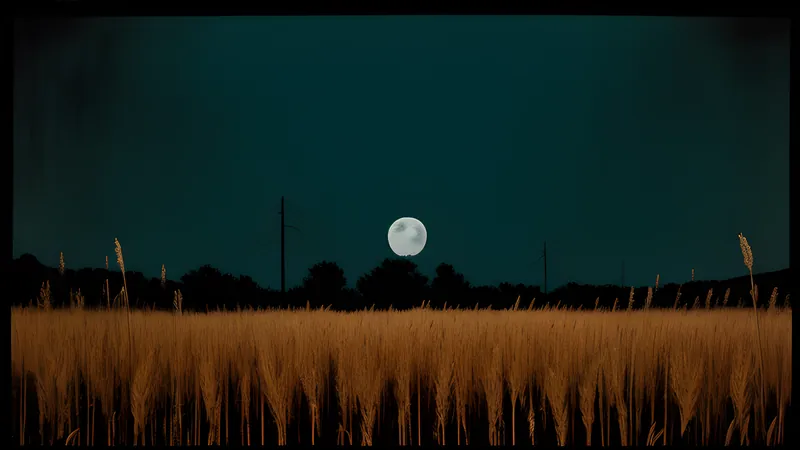
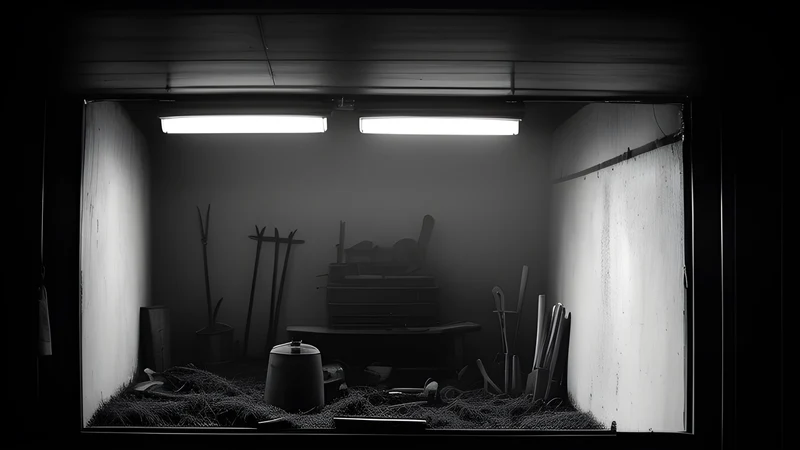
Mart Taniel’s photography is the reason to watch this film even if you bounce off everything else in it. November is shot in a high-silver black and white that has almost no mid-grey in it — the whites are blown to paper, the blacks are total, and the image has the quality of a wet-plate photograph that has been left out in weather.
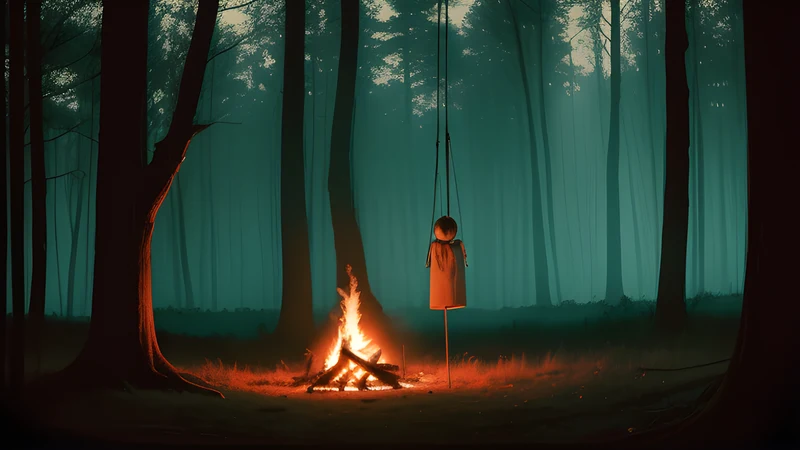
The technique matters because of what it does to the creatures. A kratt is a pile of agricultural scrap. In colour it would read instantly as a prop — rusted metal, wooden handles, a fabricated thing. In Taniel’s monochrome, the scrap loses its material identity. A scythe blade and a bone and a chain all become the same value of white against the same black, and the eye stops parsing the object as a construction and starts reading it as a shape that moves. Sarnet then puppets them with stop-motion-adjacent staging, jerky and wrong, and the result is a creature that is funny and appalling in the same frame. This is the single best argument for black and white in the horror image I know of: the monochrome is not nostalgia, it is a special effect.
Taniel does the same trick with the landscape. Estonian November — bog, birch, mud, low sun, fog — rendered at this contrast becomes an abstraction, and the film drifts constantly between something documentary and something graphic. A shot of villagers walking a track can look like a photograph from 1890 and like a woodcut, and Sarnet cuts between the two registers without transition.
Jacaszek’s score is the third element. The Polish composer works in processed acoustics — strings and voice run through decay until they sound recovered from a damaged tape — and against the deliberately hard-edged sound design of clanking metal it produces a film that is sonically as bifurcated as it is visually.
The real ancestor
The obvious reach is Švankmajer, and the animated-junk lineage is real. But November’s true ancestor is Viy, the 1967 Soviet adaptation of Gogol — the film that established the register Sarnet is working in, where regional folklore is filmed with total literalism, no explanation, and a sense of humour that never undermines the dread. Viy’s flying coffin and Sarnet’s flying kratt are the same object. Both films understand that folklore is funnier and nastier than the genteel versions we inherited, and that the correct response to a peasant tale is to shoot it exactly as told.
The second ancestor is The Phantom Carriage. Victor Sjöström’s 1921 film is the great Nordic picture about the dead moving through the world of the living as a matter of routine administration, and November’s All Souls’ sequence — the dead coming home for a meal and a sauna, greeted by their families with the mild irritation of relatives at Christmas — is Sjöström’s idea a century on.
The third is Valerie and Her Week of Wonders, for the Eastern European conviction that a folk tale is best served by dream construction rather than plot.
The kratt as a labour joke
The kratt deserves its own paragraph because it is the best piece of folkloric machinery in modern horror, and the reason is economic.
The rule is simple. You build a servant out of junk, you buy it a soul, and it works for you. But it must never stop. An idle kratt turns on its master, so the peasant who built a labour-saving device now spends his life inventing labour. Sarnet films the consequence: villagers setting their kratts to carry water from one place to another and then back again, to build a ladder to the moon, to do anything at all, because the alternative is being torn apart by the thing you made to give you rest.
This is the oldest joke about technology, and it was sitting in Estonian folklore long before anyone wrote a paper about it. The kratt is a machine that consumes more human attention than it saves, purchased on credit from a lender who cannot be paid off, and whose failure mode is that it eats you. Sarnet does not gloss it. He simply films a man frantically inventing pointless tasks for his own creation and lets you draw the line yourself.
What makes it horror rather than allegory is the physical fact of the things. The kratts are loud. They clank, they shriek, they move wrong, and Sarnet keeps them in the frame long after the joke has landed, until the sound of a scythe-and-skull assemblage waiting for instructions becomes genuinely unpleasant to sit with.
The case against
The romance does not work, and the film needs it to. Sarnet’s world-building is so dense and so strange that the Liina–Hans thread reads as an obligation — a conventional structure imported to give the images something to hang on. Rea Lest is very good and Jörgen Liik is given almost nothing, and the sleepwalking baroness is a device rather than a person. When the film cuts from a kratt riot to a scene of unrequited yearning, the yearning loses every time.
The tonal management is also genuinely difficult. November is a comedy for stretches — the peasant thievery is played broad, the Devil is a straight-man, the kratts are slapstick — and then it will turn and do something bleak without warning. Some viewers find this exhilarating. Others find it the work of a director who has not decided. The 115-minute runtime does not help; the middle sags while the film waits for its plot to catch up with its world.
The defence is that the tonal instability is the source material’s. Kivirähk’s novel is a satire about Estonian national character — specifically about a people who survived centuries of occupation by stealing, lying and cheerfully worshipping whichever god was nearest — and a film that resolved that into a consistent tone would be a film that had missed it.
Where it sits
November is the least-seen essential film of the modern folk-horror revival, and it sits alongside Hagazussa and You Won’t Be Alone as the third of the European regional trio — the one that chose absurdity where the others chose dread.
It appears on the arthouse streaming services and gets a physical release worth owning, because the transfer matters enormously with an image this contrasty. Watch it on the biggest screen available. It is also the rare film in this cycle you can show to people who do not like horror, because for long stretches it is simply a very funny film about theft.
Spoilers below
Everything from here assumes you have seen it.
The plague is the film’s finest sustained idea and it is entirely a matter of staging. It arrives in the village as a visitor — sometimes a young woman, sometimes an animal — and it asks to be let in. It negotiates. The villagers, being who they are, attempt to trick it, and Sarnet plays these encounters as folk-tale bargaining scenes: the plague is not malevolent so much as procedurally bound, and it will honour any deal it is offered because that is how the rules work.
This is where the film’s satire lands hardest. The peasants outwit death itself through pure low cunning, and it costs them nothing, because they have already established that they will deceive anyone about anything. The Devil at the crossroads gets cheated too. The film’s world contains a genuine cosmology — souls, contracts, the return of the dead — and its inhabitants treat all of it as an opportunity.
Hans’s kratt is the exception, and it is where Sarnet’s argument arrives. Hans, alone among the villagers, builds a kratt out of a snowman and animates it without paying the Devil properly, and what he gets is a creature that will not work. It asks questions instead. It wants to know about love, and about what the moon is, and Hans — a serf with no education and no vocabulary for any of it — tries to answer. The snowman kratt is the only being in the film with an interior life, and it exists because somebody made a machine and forgot to give it a job.
Liina’s transformation into a wolf is the film’s quietest cruelty. It is not a curse or a punishment. It is a resource: she goes to the woods, she becomes a wolf, she comes back, and nobody comments. In a village that will trade with the Devil before breakfast, lycanthropy is a utility. The film’s last act strips the comedy out of that indifference and shows you what a world with no sacred category actually costs — everything is available, everything is negotiable, and nothing anybody wants can be bought.
Related Content