Nosferatu (1922): The Vampire Film That Outlived Its Lawsuit
How an act of copyright theft became the template for a century of screen vampires
Contents
The most influential horror film ever made is a copy someone tried to burn. In 1922 a small German outfit called Prana Film adapted Bram Stoker’s Dracula without buying the rights, changed the names, moved the action from Whitby to a fictional Baltic port called Wisborg, and released it as Nosferatu, eine Symphonie des Grauens — a symphony of horror. Stoker had been dead a decade. His widow, Florence Stoker, was not, and she sued. The German courts agreed with her, ordered every print and negative destroyed, and Prana Film went bankrupt trying to fight it. By any reasonable accounting the film should be a legal footnote, a title in a list of things that no longer exist.
It exists because prints had already scattered abroad, past the reach of the German judgment, and collectors and archives quietly kept them. What survives is a patchwork, reassembled over decades from copies with different tintings and intertitles. That the definitive screen vampire comes to us through an act of theft, a court-ordered execution, and a century of restoration is the first thing worth sitting with. F.W. Murnau’s film is a ghost in the most literal sense: a thing that refused the order to disappear.
What Murnau actually built
Strip away the legend and the craft is astonishing for 1922. Murnau shoots on real locations — Slovakian castles, the Baltic coast, the streets of Wismar and Lübeck standing in for Wisborg — at a time when horror lived on painted studio sets. That documentary texture is why the film still unsettles. When Count Orlok’s coffin-laden ship drifts into harbour with a dead crew, the water and the rigging are real, and the realness does the frightening.
Then there is Max Schreck as Orlok, and the design choice that separates this vampire from every stage Dracula before it. Orlok is not a suave aristocrat in a cape. He is a rat-thing: bald, taloned, pointed of ear and tooth, rising from his coffin in one unbroken stiff hinge that no human spine should permit. The performance is all economy — the fingers, the slow spread of the hand, the way Schreck holds absolute stillness until stillness itself becomes a threat.
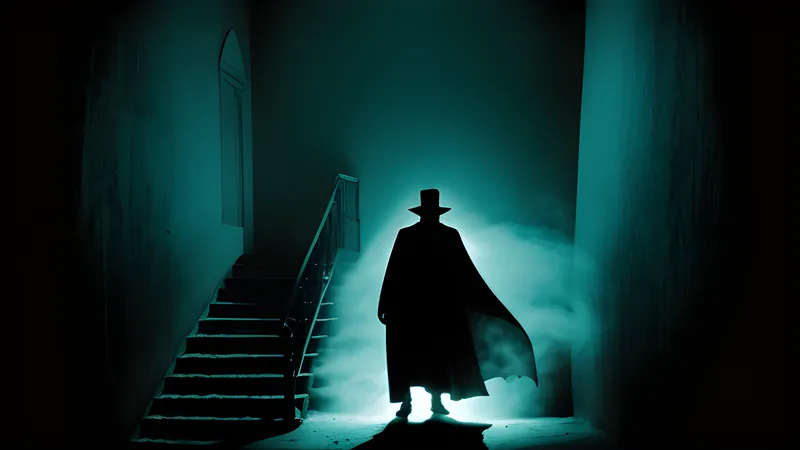
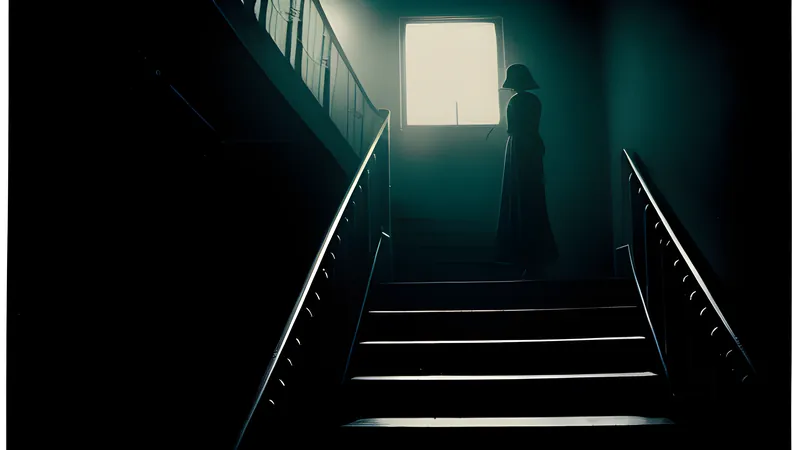
The single most quoted image in horror comes from here: Orlok’s shadow climbing the staircase, the clawed hand elongating up the wall ahead of the body. Murnau understood before almost anyone that the shadow of a monster is worse than the monster, because the shadow is what your own mind finishes. It is the same principle Val Lewton would industrialise twenty years later at RKO — suggestion doing the work the budget cannot. You can draw a straight line from this staircase to the unseen stalker of Cat People, where a bus brake stands in for a beast nobody films.
The design of Orlok also carries a layer the film’s admirers argue about to this day. Prana Film’s producer, Albin Grau, was a practising occultist, and the runic symbols and alchemical diagrams that pepper Orlok’s contract and correspondence are Grau’s genuine esoteric interests bleeding onto the screen. The rat-faced, hook-nosed, clawed vampire has also been read, uncomfortably, against the antisemitic caricatures circulating in Weimar Germany — a reading later scholars take seriously rather than dismiss, because horror has always encoded the fears of the moment that makes it, and 1922 was not an innocent year in Germany. A great film can be a beautiful thing and a document of something ugly at once, and Nosferatu asks you to hold both.
The rule the film invented
Here is the detail most people get backwards. The idea that sunlight kills a vampire is not in Stoker. His Dracula walks about London by day, weakened but perfectly ambulatory. The lethal sunrise — the vampire caught by dawn and dissolving — was invented for this film, a screenwriter’s solution to a plot problem that hardened into folklore. Every vampire that has since crumbled to ash at daybreak is quoting a piece of copyright infringement from 1922.
That is the strange power of Nosferatu. It stole a story and then rewrote the rules of the thing it stole, and the rewrite won. The pestilence that travels with Orlok — the rats pouring off the ship, the coffins, the plague spreading through Wisborg — grafts the vampire onto the older European memory of the Black Death, and it is that association, disease riding in on a foreign body, that gives the film its queasy modern afterlife. Werner Herzog understood this when he remade it in 1979 with Klaus Kinski, keeping the plague and the melancholy and turning Orlok into a figure of unbearable loneliness. E. Elias Merhige’s Shadow of the Vampire (2000) took the legend one step further and pretended Schreck really was a vampire, which tells you how completely the film has fused with its own myth.
Why the fear still lands
Silent horror asks the modern viewer to meet it halfway, and Nosferatu rewards the effort more than almost any film of its age. Part of that is Murnau’s editing, which cross-cuts between Orlok’s approach and Ellen waiting at home with a patience that turns dread into something almost tidal. Part of it is the undercranking and the negative-image trickery — the ghostly coach that races through a spectral forest in inverted colour — effects that read as genuinely uncanny rather than quaint because they were never meant to look real. They were meant to look wrong. There is a reason cinematographers still study these frames: Fritz Arno Wagner’s camera treats darkness as a substance with weight, not an absence of light, and the vampire seems to be made of the same stuff as the shadows he casts.
But the deepest reason is Ellen herself, played by Greta Schröder, who carries the film’s moral weight. Where Stoker’s Mina is rescued by a committee of men with stakes and Bibles, Nosferatu hands the ending to its heroine and lets her decide what it costs to stop the horror. I will hold the specifics below the line, because the how of it is the film’s finest and most self-sacrificing idea, and it deserves to be watched cold.
If you are building a vampire education, this is the root of the tree. From here the branches run everywhere: to the Carmilla adaptations gathered in The Vampire Lovers, to the aching tenderness of Let the Right One In, and outward into the whole argument about what the monster has always meant, traced in the vampire as sexual metaphor across a century. If you want the shape of the entire lineage in one sitting, the vampire cinema canon starts, inevitably, with a rat climbing off a ship. For the same year’s other great experiment in dread-through-suggestion, Vampyr is the essential companion piece.
The verdict is not really in doubt after a hundred years. Nosferatu is the film that taught cinema how to be afraid of a shape moving in the dark, and it did so while being, technically, a crime. Watch the best restoration you can find — the Kevin Brownlow-supervised versions with the original tintings restore the intended blue-for-night, amber-for-lamplight scheme that the plain black-and-white bootlegs flatten. It is the closest thing horror has to an origin myth, and like all origin myths it is truer than the facts around it.
Spoilers below
The ending is the whole moral architecture of the film. Ellen reads in the vampire’s book that Nosferatu can be destroyed if a woman pure of heart keeps him at her side past the crowing of the cock — if she gives herself to him willingly and holds him there until sunrise. She sends her husband Hutter away, opens her window to Orlok, and lets him feed on her through the night. Absorbed in her, he loses track of the dawn. When the cock crows he tries to flee and cannot; the sunlight strikes him and he simply fades, a puff of smoke where the monster stood, his hand clutching at his heart as he dissolves.
It is worth stressing how radical this is. Ellen is not saved; she saves. She weaponises the very thing the vampire wants — her body, her purity, the desire he cannot resist — and spends her own life to end the plague on Wisborg. She dies as the sun comes up, and the film gives her a final reunion with Hutter before she goes, but there is no undoing it. The horror is stopped by a woman who understood the monster’s appetite better than any of the film’s men and used it against him.
This is why the sunlight rule matters beyond the trivia. Murnau’s invention is not a mere weakness bolted onto the creature; it is the mechanism of a bargain, and the bargain requires a human sacrifice to trigger it. The vampire is undone by love and daylight together, and neither works without the other. Herzog, remaking the film in 1979, kept this structure almost intact but let the pessimism curdle — in his version stopping one plague does not stop the disease of the world. That darker reading is only available because Murnau built the sacrifice so cleanly the first time. The staircase shadow gets the posters; the woman at the window is why the film is a tragedy.
Related Content