Nobuhiko Obayashi: Beyond Hausu
The ad man who made the most demented horror film of the seventies and then spent forty years on the bomb
Contents
Most Western viewers know exactly one Nobuhiko Obayashi film, and they know it as an anomaly: the deranged Japanese haunted-house picture where a piano eats a girl and a severed head bites a bottom and the whole thing looks like a cosmetics advert having a seizure. Hausu plays at midnight, the audience shrieks, everyone goes home delighted, and the director gets filed as a one-off lunatic who got lucky with Toho’s money in 1977.
He made more than forty features. Hausu is the seventh most peculiar of them and by some distance the most conventional thing in his late period. He worked for another forty-three years, finished his last film while dying of lung cancer, and spent the majority of that career making pictures about the atomic bomb using precisely the same box of tricks — the same chromakey, the same painted skies, the same refusal to let an image pretend to be real. Understanding why that is one project rather than two is the whole business of reading Obayashi.
The child with the projector
He was born in Onomichi, in Hiroshima Prefecture, in 1938. He was seven years old in August 1945, close enough to the city that classmates and family friends did not come back. He said for the rest of his life that this was the fact underneath everything he shot, and there is no reason to doubt him, because the films say it too.
The family had a hand-cranked projector. Obayashi started making films as a small boy by painting directly onto celluloid — no camera involved, just pigment and a lamp — and that origin is the technical seed of his entire aesthetic. A boy who begins by drawing on film learns the medium first as a strip of plastic he can put pigment on. The idea that a shot is a window onto something real arrives later, as a convention he is free to take or leave, and he mostly left it.
He carried on through the fifties and sixties making 8mm and 16mm personal films — Complexe, Emotion, Confession — in the Japanese experimental scene, alongside a generation of self-financing amateurs who had no access to the studio system and no interest in it.
The commercials
Then the money arrived from an unexpected direction. Obayashi became one of Japan’s most successful television-commercial directors during the sixties and seventies, at the exact moment Japanese advertising was importing Western stars. He directed Charles Bronson for a men’s cologne. He directed Kirk Douglas, Sophia Loren and Catherine Deneuve. Hundreds of spots, each thirty seconds long, each requiring a complete world built and destroyed in a week.
This is where the visual grammar comes from, and it deserves more than a footnote. A commercial has no time to establish reality, so it establishes mood by force: matte, chromakey, wipe, painted backdrop, jump cut, colour pushed until it hums. Obayashi spent a decade being paid to make artifice seductive at maximum speed, and when Toho eventually handed him a feature he simply applied the whole toolkit to a horror film at feature length, which nobody had done and which is why Hausu looks like nothing else on earth. The Japanese ad industry produced other directors who brought that surplus into features — the candy-coloured chaos of Survive Style 5+ comes from the same commercial pipeline a generation later — and Obayashi is the source of the tradition.
Hausu itself was developed with his eleven-year-old daughter Chigumi, who supplied the ideas: what if a mirror ate you, what if a mattress attacked you. Toho sat on the script for two years because nobody at the studio could work out what it was. When they finally released it, the critics were appalled and the young audience was not, and it made money.
Onomichi
Then he went home, and made the films that Japan actually loves him for.
The Onomichi trilogy — I Are You, You Am Me (Tenkosei, 1982), The Girl Who Leapt Through Time (1983) and Lonely Heart (1985) — are teenage films shot in the steep, cat-ridden, staircase-laced port town where he grew up. Tenkosei is a body-swap comedy between a boy and a girl that turns startlingly sad; The Girl Who Leapt Through Time adapts Yasutaka Tsutsui’s time-travel novel and became a national touchstone, remade and re-adapted repeatedly since. They are gentle, nostalgic and locally beloved in a way that has almost no Western profile at all.
They are also, technically, doing the Hausu thing. The artifice is quieter but it is present in every reel — a painted sky, a frame that goes suddenly monochrome, a character addressing the camera, a season changing in a cut. Obayashi made no distinction between a possessed piano and a memory of a hillside. Both are things that did not happen, and both should look like it.
The best of the middle period may be The Discarnates (Ijintachi to no natsu, 1988), in which a divorced screenwriter meets his parents, who died when he was twelve and who are the age he is now, and spends a summer having the meals he never got to have. It is devastating, and if the premise sounds familiar it is because Andrew Haigh adapted the same source novel in 2023 as All of Us Strangers.
Why it works
The mechanics are the point, so name them.
Obayashi refuses the invisible cut and every other convention designed to make a film feel like a window. His backgrounds are visibly painted. His composites have visible edges. His actors are matted into skies that no sky ever resembled. He iris-wipes, he freezes, he tints a frame at random, he lets a cartoon effect crash into a live-action scene without apology. On a first viewing this reads as incompetence or as camp, and there is a whole audience who enjoy Hausu on exactly that basis.
Watch the late war films and the reason arrives with real force. Obayashi believed that photographing atrocity realistically is a lie — that the smooth, well-lit, professionally staged war scene tells the audience that this is how it looked, when the truth is that no camera was there and no image can carry it. So he does the opposite. He builds the firebombing of a city out of obvious painted flame and cardboard and superimposition, and the visible fakeness becomes an act of honesty: this is a reconstruction, made by a man who was seven, and you are being shown a memory rather than a record. That is the argument. Once you have it, the piano eating the girl and the burning city are the same shot.
The J-horror tradition that followed him went the other way entirely, chasing the grain and the flat realism of a video camera; the flourishes of the body-horror wing, from Tetsuo onward, share his taste for assault while keeping the pretence of the real. Obayashi’s nearest relatives are outside Japan — the Central European animators who film objects as if they were people and never once ask you to forget the puppet.
The last four films
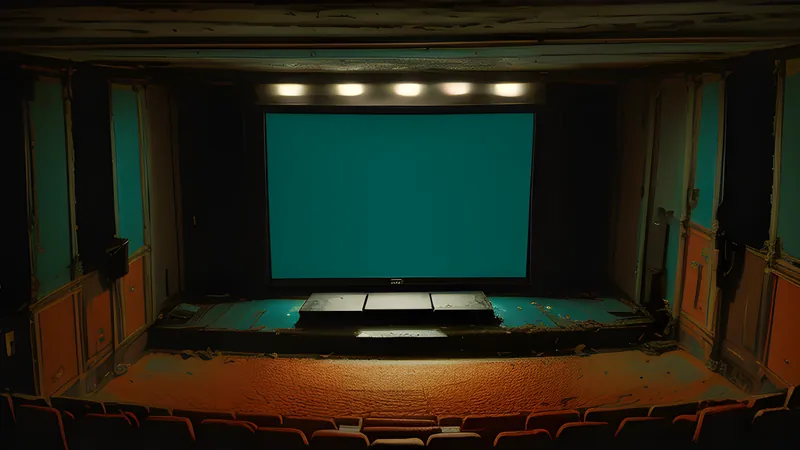
He was diagnosed with lung cancer in 2016 and given months. He made three more features. Casting Blossoms to the Sky (2012), Seven Weeks (2014) and Hanagatami (2017) form a loose war trilogy — the last from a script he had wanted to shoot since 1975 and finally made at seventy-nine, a delirious, three-hour, chromakeyed account of doomed students in 1941. Then Labyrinth of Cinema (2019), in which an audience is sucked into the screen of a closing Onomichi cinema and dragged through every war Japanese film has ever staged, ending at Hiroshima.
He died on 10 April 2020, the day Labyrinth of Cinema had been scheduled to open in Japan. He was still cutting into his final months.
The outsider, and the case against
One structural fact explains a great deal of the resistance he met. Japanese studio directors served long apprenticeships as assistant directors — years of carrying equipment for a master before being allowed a picture. Obayashi did none of it. He arrived at Toho from the advertising industry as a complete outsider, in his late thirties, and was handed a feature, which broke a norm the crews took seriously and left him working with technicians who had earned their place the hard way and resented that he had not. He responded by shooting Hausu with a great deal of his own equipment and a cast of near-amateurs: models and television faces, given names in the script that are simply their functions — Gorgeous, Fantasy, Kung Fu, Melody, Prof, Mac, Sweet — and directed to perform at the pitch of a commercial. The rock band Godiego supplied a score with one love theme that recurs until it becomes an instrument of torture. Every element was chosen against the studio grain, and Toho’s crew were largely correct that he had no idea what he was doing by their standards. He was doing something else by his.
The case against him is easy to make and worth making honestly. The sentimentality is real, and in the Onomichi films it is applied with a trowel — an Obayashi ending will reach for your throat with a swelling string arrangement and a freeze-frame and feel no shame whatsoever. The late films are extremely long and structurally chaotic; Hanagatami and Labyrinth of Cinema both run past three hours and neither builds in any recognisable direction. The pacifism, which is entirely earned by his biography, is stated and restated at a volume that a viewer may find preachy. And a technique that refuses realism has no fallback when an idea fails — a bad chromakey composite in a film committed to visible artifice is simply a bad shot, and there are many. Anyone who tells you the late work is uniformly great is selling.
Where to start
Take Hausu first if you have not seen it, and take it seriously on the second viewing. Then The Girl Who Leapt Through Time, for the tenderness under the trick. Then The Discarnates, which will take your legs out. Hanagatami and Labyrinth of Cinema are the summit and demand patience — three hours of unrelenting artifice from a dying man — and they are among the most ambitious things any Japanese director attempted this century. The lunatic who made the piano eat the girl spent his whole life on one subject, and got to finish.
Related Content