Nirvana: The Italian Cyberpunk Road Movie
Gabriele Salvatores follows an Oscar with a game designer, a self-aware character, and the best-looking future Italy ever built
Contents
A game designer sits down to check his work before the Christmas release and finds that the protagonist of his game has woken up. The character knows he is a character. He knows he is in a loop, that he has died in this loop many times, and that he will keep doing it forever once the product ships. He asks the designer to delete him.
Nirvana was released in 1997, written and directed by Gabriele Salvatores, and it is one of the most expensive films the Italian industry had ever mounted. It was a substantial domestic hit. Outside Italy it is essentially unknown, and the reason is a matter of two years: The Matrix arrived in 1999, absorbed the entire cultural bandwidth for this material, and everything that preceded it got filed as anticipation rather than achievement.
That is an injustice worth correcting, because Nirvana is doing something the Wachowskis were not interested in. It is a film about the ethics of authorship, and its emotional engine is guilt.
Salvatores had just won an Oscar and did this instead
The context matters. Salvatores took the Academy Award for Best Foreign Language Film in 1992 for Mediterraneo, a gentle, sunlit comedy about Italian soldiers stranded on a Greek island who quietly decide to stop participating in the Second World War. It is a lovely, humane, entirely conventional picture.
Five years later he spent an enormous budget on a rain-drenched cyberpunk film about a suicidal software construct. Directors do not usually cash Oscar capital this way. The move is closer to what Salvatores had always been doing — his 1980s and 1990s work is preoccupied with people trying to leave a system they are embedded in — and Nirvana is that theme rebuilt in neon.
Christopher Lambert plays Jimi Dini, the designer, and he is a genuinely peculiar piece of casting that works. Lambert had spent a decade as a fantasy-action leading man of variable persuasiveness; here he is asked to play a man who is tired, quiet, in mourning for a woman who has left him, and doing something borderline self-destructive out of a moral conviction he cannot fully articulate. He is very good. The film’s other half is Diego Abatantuono as Solo, the game character — a broad Italian comic actor of long standing, playing a man discovering that his wife, his job, his memory of a street he grew up on and his own death are all set dressing. Abatantuono plays it without a trace of camp, and the performance is the film’s spine.
The Agglomerate is the point
Here is the craft argument, and it is the reason to see the film in the best transfer you can find.
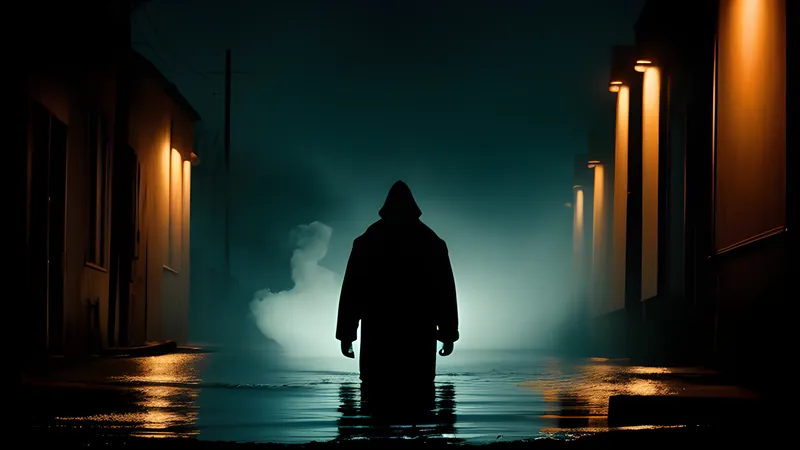
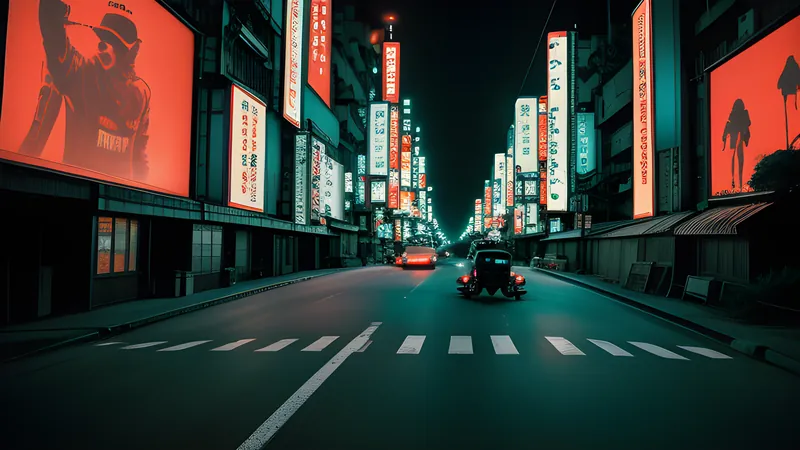
Salvatores and his designers built the Northern Agglomerate: a vast unregulated urban zone with named districts — a Marrakesh quarter, a Bombay City — where the film’s second act takes place. It is a market. It is stacked with pirated hardware, black-clinic prosthetics, food, cabling, rain and people. And the crucial choice is that everything in it is being sold.
Contrast Blade Runner, whose Los Angeles is monumental — Scott’s future is architecture, pyramids and rain falling from an implied height, a city you look up at. Salvatores’ Agglomerate has no vertical axis at all. You never see above the second storey. It is a souk, shot at hand height, and the entire future is legible at the scale of a stall selling something. That is a proposition about the twenty-first century: the technology will not arrive as cathedrals; it will arrive as tat, in a market, unregulated, cheap, in the rain, sold by somebody’s cousin.
Thirty years on that reads as the more accurate forecast, and it reads that way because Salvatores was working from a European experience of cities rather than an American one. The Agglomerate looks like a real place because its ancestors are real places. It has more in common with the ruined-industrial Britain of Richard Stanley’s Hardware than with anything from a Hollywood art department, and it achieves at expense what Stanley achieved on nothing.
The film’s other visual discipline: the interior of the game world is deliberately worse-looking than the real world. Solo’s Milan is flat, bright, clean and slightly cheap. Salvatores is a decade ahead here, refusing the assumption that a virtual space should look more spectacular than a physical one. The game looks like a game.
What it does that The Matrix does not
The comparison is unavoidable and the difference is the interesting part.
The Wachowskis’ film is about a man discovering his world is false and then acquiring the power to break it. It is a liberation narrative and it ends in mastery. Nirvana has no interest whatsoever in that trajectory. Solo cannot escape, cannot be freed, and cannot be improved. There is no red pill in this film. The only mercy available to him is deletion, and the entire plot is Jimi trying to get close enough to the corporate network to grant it.
That inverts the moral position. In The Matrix the protagonist is the prisoner. In Nirvana the protagonist is the author — the man who built the loop, wrote the wife who dies, designed the street, specified the deaths. Jimi’s journey through the Agglomerate is a penance. He is a creator confronted with the fact that his creation can suffer, and the film treats that as a straightforward ethical emergency rather than a philosophical puzzle to be admired.
Oshii had reached related ground two years earlier in Ghost in the Shell, and Alex Proyas would do it in the same year as the Wachowskis with Dark City. What separates Nirvana from all of them is that it is fundamentally a road movie. Jimi has a destination, a deadline — the Christmas ship date — and a series of encounters along the way with people who help him for their own reasons: Sergio Rubini’s Joystick, a burnt-out hacker who has had his eyes replaced, and Stefania Rocca’s Naima, a thief with a memory problem. The film moves the way a journey moves, and the science fiction accumulates as scenery.
The Italian genre tradition it breaks with
There is a collector’s point to make here, because Nirvana sits at the end of a long and slightly embarrassing lineage.
Italian genre cinema built its post-war reputation on rapid, unapologetic imitation. An American hit landed, and within eighteen months Cinecittà and its cheaper neighbours had produced a version with a smaller budget, a pseudonymous director and often a better eye. The peplum cycle, the spaghetti western, the giallo, the zombie boom that followed Romero, the post-apocalyptic wasteland films that followed Mad Max — the model was to chase and, occasionally, to surpass. Mario Bava had already shown in 1968 with Danger: Diabolik that an Italian genre picture could take an imported form and out-design everyone, on money that would have embarrassed a Hollywood second unit.
Nirvana declines the model entirely. It was not chasing an American cyberpunk hit, because in 1997 there was no American cyberpunk hit to chase — Johnny Mnemonic and Strange Days had both failed commercially two years earlier, and the genre was widely understood to be finished at the box office. Salvatores went in anyway, with the largest budget of his career, into a form the market had just rejected. That is the opposite of the industrial habit, and it explains the film’s confidence: nobody was holding a template up against it.
The case against
It is baggy. The middle hour has episodes that exist because the Agglomerate was expensive and Salvatores wanted to shoot in it, and at least two encounters could be cut with nothing lost. The English-language dub, which is how most non-Italian viewers meet it, is poor enough to flatten Abatantuono’s performance into nothing — seek the Italian audio, and accept subtitles.
The Lisa material — Emmanuelle Seigner as the woman Jimi has lost — is undercooked, and the film leans on it for emotional weight it has not earned. And the technology is dated in the usual 1997 ways: the network is visualised, there are goggles, there is a scene of someone typing meaningfully.
None of that touches the central mechanism. Nirvana asks what you owe a thing you made that can want, and answers it with an act of destruction performed as kindness. That is a harder and stranger question than the one the more famous film asked two years later, and an Italian director with an Oscar on his shelf spent a fortune to ask it, in a market in the rain, with the man from Highlander. It deserves better than a footnote.
Spoilers below
Jimi’s route to Solo runs through Okosama Starr, the corporation that owns both the game and effectively the city, and the reason he cannot simply delete the file from his desk is corporate: the code has already been passed upstream, and only the company’s central network can erase it before the Christmas release. So the film becomes a heist. Joystick and Naima are recruited to get Jimi’s identity inside a system that would otherwise refuse him, which requires him to be erased first — the designer has to delete himself from the record in order to reach the thing he needs to delete.
That symmetry is the screenplay’s best move, and it is where the guilt reading pays off. Jimi’s crime, the film quietly establishes, is Lisa: the memory of the woman he lost is the source material he strip-mined for Solo’s dead wife. He wrote his own grief into a character and then sold it as an entertainment product, and the loop he built has been executing his worst day, indefinitely, for money. The rescue mission is restitution.
The parallel structure is what makes the ending land. Solo, inside the game, is running his own investigation — testing the boundaries of his Milan, finding the seams, working out how far the world extends. Abatantuono plays these scenes with a rising, awful calm. He is the only character in either strand who fully understands his situation, and what he does with that understanding is ask, politely, to stop existing.
The film grants it. Jimi reaches the network, and Nirvana ends on a deletion presented as an act of love rather than a defeat — which is why the Wachowskis’ film could never have ended this way and why this one has stayed with me for twenty-odd years. There is no awakening here and no chosen one. There is a man who made something that could hurt, understood what he had done, and went to enormous personal cost to switch it off.
Related Content