Nightmare City: Lenzi's Running-Zombie Precursor
The film that had the fast dead twenty-two years early and squandered every second of the lead
Contents
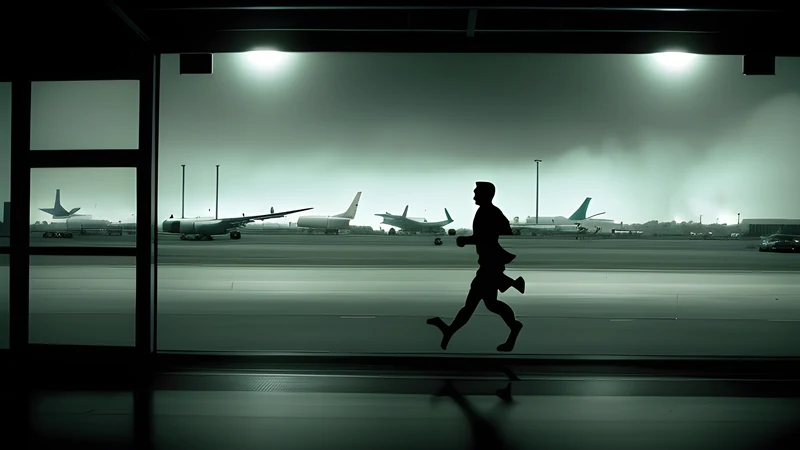
An unmarked military transport plane lands at a city airport without clearance. The authorities surround it. The hatch opens. And what comes out of it does not shamble.
That sequence happens in the first ten minutes of Nightmare City, released in Italy in 1980 as Incubo sulla città contaminata, and it is twenty-two years ahead of the film that gets the credit for it. Danny Boyle’s 28 Days Later arrived in 2002 and the received wisdom is that it invented the running dead. Zack Snyder’s Dawn of the Dead remake in 2004 sealed the idea. Umberto Lenzi was there in 1980, and he did it with more nerve and infinitely worse make-up.
What Lenzi was actually making
He would not have called them zombies, and he was insistent about it for the rest of his life. In interview after interview Lenzi maintained that the creatures in Nightmare City are contaminated people — victims of a radiation leak, alive, sick, transformed. He regarded the zombie label as a marketing imposition, and on the film’s own internal logic he has a case.
His contaminated are fast. They are also intelligent. They use knives. They pick up guns and fire them. They drive vehicles. They plan an attack on a television studio and execute it. They drink blood, because the radiation has destroyed their own. This is a specification sheet with almost nothing in common with what George Romero had built.
That distinction is the film’s genuine contribution, and it is the reason the zombie walk versus the zombie run is a more complicated argument than it looks. Romero’s dead are slow because slowness is the thesis: they are inevitable, they are us, and the horror is arithmetic. Lenzi’s contaminated are fast because speed is his thesis — they are a weapons accident moving at the speed of an emergency, and the fear he is chasing is the fear of a thing going wrong faster than the state can respond to it.
Watch it against Zombie Flesh Eaters, which had made a fortune the year before and is the reason this film got financed. Fulci’s dead are archaeological — rotted, ancient, rising out of soil. Lenzi’s are industrial, and they came off a plane.
The real ancestor is Romero after all — the wrong Romero
Everyone reaches for Dawn of the Dead because of the date and the money. The actual ancestor of Nightmare City is The Crazies, Romero’s 1973 film in which a military bioweapon contaminates a small town’s water supply and ordinary people begin behaving with lucid, organised violence while the army seals the perimeter and fails.
Line the two up and Nightmare City is The Crazies relocated to an airport and a European city. The contamination is military. The infected keep their motor skills and their capacity to use tools. The state’s response is incompetent and secretive. The scientist knows and is ignored. The journalist tries to broadcast the truth and is blocked by his own network. That is Romero’s 1973 film almost beat for beat, and it is a far better key to what Lenzi is doing than anything in Romero’s dead cycle.
The film’s politics follow from that ancestry and are surprisingly coherent. The contamination is a nuclear accident that a government hides. The general in charge lies. The broadcaster suppresses the warning. Lenzi’s monsters are a consequence of institutional cowardice, and the film keeps cutting to the men in offices deciding not to tell anyone. For a picture with make-up this bad, the anger underneath is real.
The make-up, and the honest problem
We have to talk about the faces. The contaminated in Nightmare City look as though someone has pressed porridge onto the actors and let it dry. There is no articulation, no depth, no wetness — just a matte grey-brown crust that sits on the performers like a mask made of Weetabix, which is roughly the material the internet has spent two decades accusing it of being.
This is not a small aesthetic complaint. It is the central failure of the film, and it is why the good idea did not travel. A running ghoul is terrifying when you believe it. Lenzi’s contaminated sprint at the camera with faces that read, in every close-up, as a bad afternoon in the make-up trailer, and the audience’s belief drops out from under the sequence. The film had the twenty-two-year lead and lost it on the one department that could not be faked.
The frustrating part is that the wide shots are genuinely good. When Lenzi keeps his distance — the tarmac, the television studio, the amusement park — and lets the contaminated move as a fast, coordinated mass, the film is frightening. The choreography is real. There is a sequence of them pouring across open ground that Boyle would have been happy with. Then the film cuts in tight and the porridge arrives and it is over.
What Lenzi gets right
The pacing is relentless in a way almost no Italian horror of the period was. Once the plane opens, the film essentially does not stop. There is no second-act regrouping, no long stretch of characters standing in a room discussing the crisis. Lenzi cuts from siege to siege — airport, hospital, studio, suburbs, amusement park — and the structure gives the film a genuine sense of a country collapsing on a timetable.
Stelvio Cipriani’s score is doing an enormous amount of the work. Cipriani was a real composer with a real range, and what he supplies here is a driving, synth-forward pulse that behaves like an alarm. It gives the running its momentum. Watch the tarmac sequence with the sound down and it is men jogging; put Cipriani back and it is an emergency.
And Hugo Stiglitz, as the journalist, is a better anchor than the film’s reputation allows. Stiglitz was a Mexican star with a long career at home, and he plays the part with a stone-faced exhaustion that suits a man watching the state lie in real time. Mel Ferrer and Francisco Rabal — both serious actors with serious CVs — turn up and take it seriously, which was standard practice in the Italian industry and still surprises people.
The television studio is the film in miniature
The sequence worth isolating is the assault on the TV station, because it contains everything Nightmare City does well and everything it does badly inside four minutes.
The setup is a dance troupe rehearsing under studio lights for a live broadcast — a room full of spectacle being manufactured for a public that is about to be eaten. Lenzi shoots the rehearsal straight, with the flat over-lighting of actual Italian variety television, and the joke is that the format is already slightly grotesque before anything goes wrong. Then the contaminated come through the doors, and the film’s smartest instinct kicks in: they go for the equipment. They know what a transmitter is. They are cutting the country’s ability to warn itself, and the film lets you work that out without a line of explanation.
That is a real idea, staged with real craft — the coordination reads as strategy because Lenzi keeps the camera wide enough to show the pattern. Then he cuts to a close-up, and there is the porridge, and the room full of dread becomes a room full of extras. The whole film’s tragedy is legible in that one edit.
The honest case against it
The dialogue is dreadful, and the dubbing makes it worse. The film is a Spanish-Italian-Mexican co-production shot with a polyglot cast and post-synched into English by people being paid by the reel, and the performances arrive in a flat, mismatched register that undercuts every attempt at gravity.
The female characters are handled with the casual contempt the Italian industry of 1980 specialised in. The contaminated have a marked and unpleasant habit of going for women’s chests with knives, and the film returns to it often enough that the alibi of accident stops working.
And the loop ending, which we will come to, is the laziest possible exit from a film that had spent eighty minutes earning something better.
Where to find it
Arrow’s restoration is the version that finally makes the case — the wide shots have depth and Cipriani’s score gets room, and the film looks like the professional production it actually was. It is a fixture of any serious argument about why zombies keep changing what they mean, and it belongs in the zombie canon as a matter of record even if it is nobody’s favourite.
The verdict: Nightmare City is the most consequential film almost nobody credits. Lenzi worked out in 1980 that the terrifying dead are the ones who can run and think and pick up a rifle, and he was right, and the entire genre proved him right two decades later without acknowledging him. He lost the argument to a make-up department. Watch it anyway, and watch the wide shots.
Spoilers below
The ending is a dream. After eighty minutes of collapse — the studio overrun, the hospital taken, the amusement park sequence with the ferris wheel, the helicopter — Dean Miller wakes up in bed. It was all in his head. Then he goes to the airport on the assignment that opened the film, and the unmarked plane lands, and the title card tells us the nightmare becomes reality.
It is the cheapest ending available and Lenzi took it. Everything the film had built — the contamination as a state secret, the broadcaster’s complicity, the general’s lie — is retroactively converted into a man’s bad night, which is precisely the move that lets an audience file the politics under “nonsense” and go home.
And yet. The loop does one thing the straight ending would not have. By restarting the film at the exact moment it began, Lenzi makes the catastrophe structural — it is going to happen, it is happening, the plane is always landing. The nuclear accident is not an event with a beginning and an end; it is a condition with a schedule. That is a legitimately unsettling idea, and it is buried under a “it was all a dream” card that the audience of 1980 had already been trained to jeer at.
The amusement park climax is the sequence to watch for the film’s real quality. The ferris wheel, the open ground, the contaminated moving in a coordinated wave across a space designed for pleasure — Lenzi stages it in wide, sustained shots and it is genuinely well made. It is also, on any honest accounting, the moment where the film’s ambition and its make-up department are in the same frame, and you can see exactly what Nightmare City was supposed to be.
Related Content