Night of the Eagle (Burn Witch Burn): Academic Witchcraft
A sociology lecturer writes 'I do not believe' on the blackboard, burns his wife's charms, and finds out
Contents
The best scene in Night of the Eagle is a lecture. Norman Taylor stands at a blackboard in front of a hall of medical students, chalks up the words “I do not believe”, and proceeds to dismantle superstition as a psychological artefact — the neurotic’s mechanism for evading responsibility. Peter Wyngarde plays it with the easy authority of a man who has given this talk many times and enjoys giving it. The camera holds the blackboard. The film then spends eighty minutes proving him wrong, and the phrase stays on that board like a bill coming due.
This is the second film made from Fritz Leiber’s 1943 novel Conjure Wife, and the only good one. Universal had already turned it into Weird Woman in 1944, one of the Inner Sanctum programmers, with Lon Chaney Jr looking baffled. In 1962 an independent British outfit shot it at Beaconsfield with a script by Charles Beaumont and Richard Matheson, and produced the sharpest film British horror made between Hammer’s arrival and The Innocents.
Two Twilight Zone writers go to an English college
The pedigree explains the film. Beaumont and Matheson were the two finest writers on The Twilight Zone, and their shared speciality was the ordinary person whose ordinary world develops a fault. George Baxt did the British localisation, moving Leiber’s American campus to Hempnell Medical College, and the transposition is the film’s masterstroke: American academic politics are ambitious, and English academic politics are murderous.
Because the plot is departmental. Norman Taylor is up for a chair. So is Lindsay Carr. The wives of the faculty circle each other at bridge evenings with the manners of a Jacobean court, and the film’s supernatural conflict is conducted entirely through committee positions, dinner invitations and who is being considered for what. When Norman discovers that his wife Tansy has been protecting his career with charms — spiders in jars, graveyard dust, a wax figure, tokens hidden all over the house — the horror is initially social. He is a rationalist and she has been doing witchcraft in the airing cupboard, and his first response is embarrassment.
Janet Blair plays Tansy as a woman who has been terrified for years and has developed a functioning system for managing it, which is a much more interesting reading than hysteria. She knows precisely what the charms are for. She has the receipts, in the form of a career that has gone suspiciously well. And when Norman gathers every charm in the house and burns them in the grate — his big rational gesture, the film’s hinge — she watches her husband destroy the only defences either of them has, and Blair’s face does the whole scene.
The mechanics of a run of bad luck
What makes the film work is that the retaliation is deniable. Nothing overtly supernatural happens for a long stretch. A student accuses Norman of assault. A colleague’s testimony turns. His driving becomes erratic. The telephone rings in the dead of night. Every event has a mundane explanation available, and Norman reaches for it every time, so the audience gets to watch a clever man construct increasingly elaborate rationalisations while the noose draws in. Sidney Hayers directs this middle stretch with real restraint, and Reginald Wyer’s black-and-white photography keeps the college corridors flat and institutional, which is exactly right — the horror is a staffroom.
The tape recorder scene is the point where the film turns. Norman plays back a recording of his own lecture and hears, underneath his voice, Tansy’s, calling him. It is a small effect — a sound cue, a man alone in a room — and it lands harder than anything with a monster in it, because it is the first piece of evidence he cannot argue with, delivered by the most impeccably rational instrument in the building. His own equipment betrays his own thesis.
That same year British horror was working the identical seam elsewhere, and the film’s true sibling is Jacques Tourneur’s Night of the Demon, which puts a professional sceptic against a charming warlock and rides on the same tension between what a man believes and what is walking toward him. Both films are adapted from literary sources by people who understood that a rationalist protagonist is the best delivery system for supernatural dread, since he does the audience’s resisting for them. The ancestor of the whole idea is M.R. James, and its most durable modern descendant is any horror film in which an academic is destroyed by a subject he was studying.
The eagle, and the American prologue
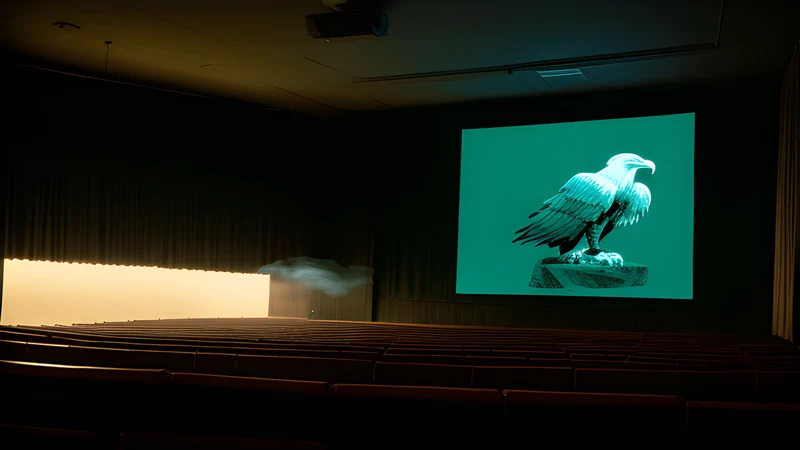
Hempnell has a stone eagle over its entrance, and the title tells you what it is for. William Alwyn’s score keeps the bird in the audience’s ear long before it moves — a screech motif that appears in the main titles and then recurs whenever the film wants you looking up. The climactic sequence, with Norman pursued through the college by the animated statue, is the one part of the film where the ambition outruns the resources of a small British production in 1962, and it is a testament to everything preceding it that the sequence works anyway.
The American release added a gimmick. AIP retitled it Burn, Witch, Burn! and stuck a spoken prologue on the front, delivered by Paul Frees, in which the audience is protected by an incantation against the evil about to be shown. It is pure William Castle showmanship bolted onto a film of genuine sophistication, and there is something perfect about a picture whose entire subject is the failure of scepticism being sold to Americans with a magic spell. British audiences got the film with its own title and no charm, which is arguably the crueller joke.
Wyngarde is the last piece. He would become a television star within a few years as Jason King, the peacock, and the performance here draws on the same instrument — vanity, charm, and complete self-assurance — while using it as the character’s fatal flaw. Norman is destroyed by exactly the quality that makes him attractive.
Where to go next
Night of the Eagle sits at the front of the British witchcraft cycle, before The City of the Dead had quite established the template and years ahead of The Blood on Satan’s Claw and everything that has since been filed as folk horror. What separates it from all of them is the setting: this is witchcraft in a staff common room, practised by respectable women in cardigans with the specific goal of professional advancement, and it is far more plausible than any coven in a field.
Leiber’s novel got a third go in 1980, when Witches’ Brew played the material as broad comedy and confirmed by inversion how precisely the 1962 version had calibrated its tone. The book has now been filmed as a programmer, a thriller and a farce, and only the thriller survives.
The verdict is a matter of construction. Ninety minutes, one effect too many at the end, and a script by two writers who understood that the most frightening thing you can do to a rational man is give him evidence. Nobody has improved on the blackboard.
Spoilers below
Flora Carr is the witch, and the film plays fair — she has been in almost every scene, pouring tea. Margaret Johnston plays her as a faculty wife of formidable competence, and her motive is entirely mundane: she wants the chair for her husband. Her method is the graveyard working, the wax figure, and finally Tansy’s own body, which she takes over completely; Blair plays the possessed Tansy with a change of voice and posture and no makeup at all, and the effect is genuinely disturbing in a way the eagle never quite manages.
The tape is what saves him, which is the film’s cleanest irony. Norman survives the eagle’s pursuit through the college by getting to his office and playing the recording — the counter-spell captured on the machine he uses to record his lectures on why spells do not work. The rationalist is rescued by technology performing magic. Hayers lets the joke sit without underlining it.
Then the ending arrives and it is savage. The working recoils on Flora. The stone eagle comes down on the woman who raised it, crushing her on the college steps, and the film cuts to the aftermath: the faculty gathering, the body, the ordinary business of an accident on college property. And in the last beat, the fire that has consumed the Carrs’ house and Flora with it is written up as exactly that — an accident — while the surviving academics stand about discussing it in the reasonable tones of men who will never know what happened, and the blackboard in Norman’s lecture hall still reads “I do not believe”. Beaumont and Matheson leave the words up there. Everyone in the film who has learned better is dead, mad or married to Norman, and the institution simply carries on teaching.
Related Content