Nicolas Roeg: The Fractured Image
The cinematographer who broke time and made the cut the star
Contents
Most directors want you to forget you are watching a film. Nicolas Roeg wanted you to feel the seams — the join between one shot and the next, the gap where a scene should reassure you and instead unsettles. He came up as a cameraman, and he never stopped thinking like one, but the thing that made him singular was not the framing. It was the way he refused to let a story run in a straight line. Time, in a Roeg film, folds back on itself. A shot of something innocent rhymes with something terrible three reels later. By the time you understand why, the film has already got inside you.
He was born in London in 1928, and he learned cinema from the bottom up — clapperboard, focus puller, camera operator, then director of photography. That apprenticeship matters, because it explains everything that followed. Roeg shot for other people before he shot for himself: second-unit work on Lawrence of Arabia, cinematography on Roger Corman’s The Masque of the Red Death and on Truffaut’s Fahrenheit 451 and John Schlesinger’s Far from the Madding Crowd. He had spent fifteen years watching how images could be made beautiful. When he finally got to direct, he spent the rest of his life pulling that beauty apart.
The editor disguised as a director
The received wisdom is that Roeg was a great visual stylist, and he was, but the label undersells him. His real instrument was the cut. He co-directed his first feature, Performance (1970, made in 1968), with Donald Cammell, and the film is a riot of collision — a gangster and a faded rock star bleeding into one identity through a barrage of jump cuts, superimpositions and match-on-action edits that link two people who should never overlap. Warner Bros. sat on it for two years, baffled. Watched now, it plays like a thesis statement for everything Roeg would do alone.
The method has a name in the cutting room: associative montage. Roeg would take an image and answer it later with its echo, so that the film built meaning sideways rather than forward. A gesture, a colour, a sound would recur, and each recurrence tightened the knot. He was working the same territory the great paranoia films of the decade were mapping through sound and surveillance — the frayed, watched, unreliable reality you find in Coppola’s The Conversation — except Roeg located the paranoia inside the edit itself. You cannot trust the order of things.
Walkabout (1971) proved he could do it with almost no dialogue. Two English children stranded in the Australian outback, an Aboriginal boy on his initiation journey, and a landscape that Roeg — shooting it himself — renders as both Eden and abattoir. The film cross-cuts the natural world against the civilised one until the contrast becomes an argument. He photographs a lizard, a butcher, a road, a body, and lets the juxtapositions carry a grief the script never states aloud. It is a nature documentary that keeps flinching.
The technique looks improvised and is anything but. Roeg came out of the most disciplined branch of the craft — the camera department, where a mistake costs a day’s light and a fortune in stock — and he brought that rigour to editing rooms famous for chaos. He storyboarded loosely and cut ruthlessly, and he liked to work with editors who would fight him. The apparent freedom of a Roeg film is the product of enormous control, which is the same paradox you find in the best jazz: the looseness is earned by musicians who could play it straight in their sleep. He simply chose never to play it straight.
The cut as premonition
Then came the film that fused his two obsessions — the beauty of the image and the treachery of time — into something nobody has matched. Don’t Look Now (1973) is the purest distillation of the Roeg method, and I have written about its mechanics at length in Don’t Look Now: editing as premonition. The short version: Roeg edits the film as though it can see its own ending. Water, the colour red, breaking glass, a small figure in a coat — these recur across the runtime like a warning the characters cannot read but the film keeps issuing. The famous love scene, intercut with the couple dressing afterwards, does the same thing on an intimate scale, dissolving the boundary between before and after so that even tenderness feels haunted.
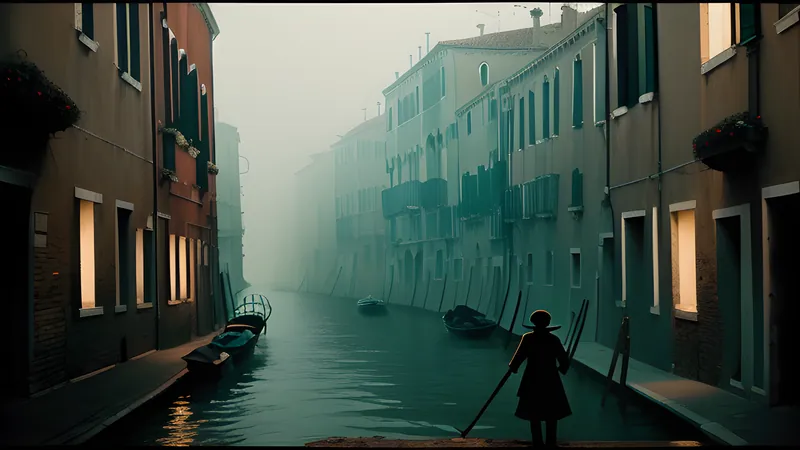
What makes it work is restraint underneath the flamboyance. Roeg’s Venice is a maze of dead ends and cold canals, and he shoots it in the off-season, drained of tourists, so the city itself feels like a premonition of loss. The horror never arrives as spectacle until the last possible second. Everything before it is atmosphere, rhyme, and dread — the sense that the film knows something you don’t. That is editing as clairvoyance, and it is why Don’t Look Now still terrifies people who could not tell you a single plot point afterwards. The feeling outlives the story.
Fame, gravity, decay
Roeg’s next move was to hand his camera to a man who already looked like he had fallen out of the sky. The Man Who Fell to Earth (1976) cast David Bowie as an alien marooned on Earth, and Roeg built the whole film around Bowie’s uncanny stillness. The fractured chronology is here too — the alien’s memories of his dying home planet erupting into the present, time collapsing as he is slowly corrupted by television, alcohol and human appetite. It is a science-fiction film with almost no science-fiction furniture, because Roeg was never interested in the hardware. He was interested in dislocation: what it feels like to be permanently out of sync with the world around you. Bowie, exhausted and otherworldly, embodied it without seeming to act at all.
The casting was itself a Roeg move. He had a gift for finding performers who carried dislocation in their bodies before they said a word — Bowie the alien, Mick Jagger the burnt-out star of Performance, Art Garfunkel the emotionally absent lover of Bad Timing. He preferred musicians and non-actors to trained ones precisely because they could not hide behind technique; the camera caught them being watched, which was the very sensation his films were about. A conventional leading man would have smoothed the strangeness away. Roeg wanted the strangeness left in.
That became the recurring Roeg subject — a person unmoored, watching their own life from a slight distance. Bad Timing (1980) turned the technique on a love affair, cross-cutting a passionate, destructive romance against the medical aftermath of an overdose, so that seduction and autopsy sit in the same sentence. The film’s own distributor, the Rank Organisation, reportedly disowned it as sick and repellent. It is certainly cold. It is also one of the most honest films ever made about how memory reorders desire, arranging the past to protect us from what we did.
The strange, warm coda
Here is the surprise in the Roeg filmography: the man who made the bleakest films of the 1970s made one of the best children’s films of the 1990s. The Witches (1990), adapted from Roald Dahl and produced by Jim Henson, gave Anjelica Huston a grand-guignol turn as the Grand High Witch and used practical creature effects to genuinely frighten a generation of kids. Dahl himself objected to the softened ending, and he had a point, yet the film carries unmistakable Roeg fingerprints — a child’s-eye view of an adult world that is arbitrary, cruel and full of hidden monsters. He had been making films about exactly that for two decades. He just aimed this one lower and hit harder for it.
The later work thinned out. Insignificance (1985), Track 29 (1988) and Eureka (1983) have their defenders and their genuine pleasures, but the culture had moved on from the associative freedom the 1970s allowed him. Roeg’s grammar needed a viewer willing to do half the work, and mainstream cinema was busy standardising the opposite. He kept working into the 2000s and died in 2018, by which point a generation of directors raised on his cutting — Danny Boyle and Christopher Nolan among the most obvious — had turned his private syntax into common vocabulary.
Why the fractured image lasts
Roeg’s influence is everywhere now, which is precisely why it is easy to miss. Every prestige drama that opens on a flash-forward, every thriller that withholds the meaning of an image until its echo lands, every horror film that plants a visual rhyme to pay off later — that is Roeg’s inheritance, laundered into house style. What almost nobody reproduces is his nerve. He would let a cut mean something you could not yet name and trust you to carry the unease until the film explained itself, or declined to.
The throughline across the whole career is a single conviction: that film’s true subject is time, and that the cut — the place where two moments touch — is where a movie actually thinks. He learned it as a cameraman staring at light, and he spent thirty years proving that the most frightening thing a film can do is remember the future.
If you are starting, start with Don’t Look Now and let it work on you before you read a word about it, then follow it with The Man Who Fell to Earth. Watch the second thinking about the first, and you will start to see the whole architecture — a body of work built, shot by shot, out of the spaces between images.
Related Content