Naked Lunch: Cronenberg Adapts the Unadaptable
How David Cronenberg turned an unfilmable novel into a film about writing itself
Contents
For decades the received wisdom on William S. Burroughs’ Naked Lunch was that it could never become a film. The 1959 novel has no plot to speak of, no continuous narrator, and a catalogue of images — talking sphincters, drug-market atrocities, government agents made of insect matter — that would earn any literal transcription a ban in every territory that showed it. David Cronenberg reportedly said that a faithful version would cost more than the entire budget of a small nation and would be confiscated at the first border. So in 1991 he did the only sane thing a serious adapter of an unadaptable book can do: he adapted the writing of it instead.
The result is one of the strangest studio-adjacent films of the early nineties, and one of the purest examples of a director metabolising an author into his own body of work. If you come to it expecting Burroughs on screen you will bounce off it. Come to it as a Cronenberg film about the cost of making art out of your own life, and it becomes one of his richest.
The book everyone said couldn’t be filmed
Burroughs assembled Naked Lunch from a mass of manuscript pages written in Tangier during the mid-fifties, published first in Paris by Olympia Press and then, after an obscenity fight, by Grove Press in the United States. The book is a hallucinated satire of control — addiction, bureaucracy, sexual and political domination — routed through the “Interzone”, a fictional free port modelled on the Tangier International Zone where Burroughs was living and using heroin.
Cronenberg’s screenplay does something a lesser writer would never dare. It takes fragments of the novel’s imagery and threads them through a fictionalised version of Burroughs’ own biography, in particular the killing of his wife Joan Vollmer in Mexico City in 1951, shot during a drunken party game. That single autobiographical wound becomes the film’s engine. Peter Weller plays Bill Lee, an exterminator in a drab 1953 New York whose bug powder turns out to be a narcotic, and whose slide into addiction and paranoia produces the “reports” that will become a book. Judy Davis plays his wife and, later, a doubled figure in Interzone. Ian Holm, Julian Sands and Roy Scheider fill out a cast of handlers, rivals and doctors who may be real, may be the productions of a poisoned mind, or may be both at once.
The move is quietly radical. Cronenberg treats the novel as a symptom and goes looking for the disease. He is asking where a book like Naked Lunch comes from, and his answer is that it comes from guilt, dependency, and the writer’s monstrous willingness to convert catastrophe into copy.
Interzone built on a Toronto soundstage
There is a good production-history reason the film feels so hermetic, so cut off from any recognisable real place. Cronenberg and producer Jeremy Thomas had intended to shoot in Tangier. The 1990–91 Gulf War made location work in North Africa impossible, and the production retreated to soundstages in Toronto. Interzone, as a result, is almost entirely a set — a jaundiced, amber-lit warren of cafés and rented rooms with no sky and no exit.
That constraint is the making of the film. A real Tangier would have grounded the fantasy in geography and tourism. The built Interzone floats free, a mental space rather than a city, which is exactly right for a story happening inside a writer’s addicted head. The palette runs to sickly ochres and browns, the light always looks like late afternoon in a room where the curtains stay shut, and Howard Shore’s score — with Ornette Coleman’s saxophone skittering across it — gives the whole thing the woozy, sourceless anxiety of a fever that will not break.
The creature effects come from Chris Walas, who had won an Oscar for Cronenberg’s The Fly a few years earlier, and they are deliberately handmade and glistening. This is a film committed to practical, tactile disgust — everything drips, pulses or secretes — and its refusal of anything sleek is part of its argument. Addiction here is wet, organic and humiliating.
The typewriter that talks back
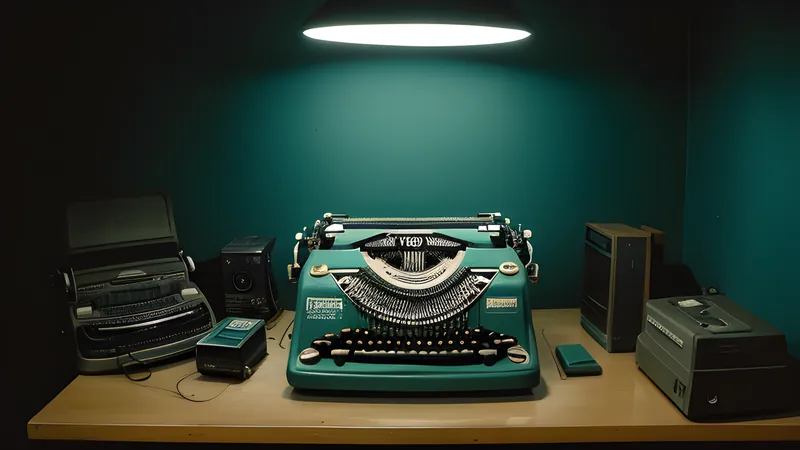
The central invention, the image everyone remembers, is the typewriter. Bill Lee’s machine sprouts into a fleshy insect that speaks to him through a sphincter-like organ on its back, dictating his mission and his prose. When a rival writer’s machine appears, the two typewriters fight like territorial animals. It is grotesque and very funny, and it is the smartest metaphor in the film.
Here is why it works. A writer’s tools are supposed to be inert. The typewriter is where you sit down and exert control over language. Cronenberg’s gag is to make the tool alive, appetitive and manipulative — the instrument of writing turns into a parasite that feeds on the writer and tells him what to think. Anyone who has ever felt a project take on its own demands, dictating terms the author never chose, recognises the horror under the joke. The bug powder, the reports, the handlers who insist Lee is a secret agent: all of it dramatises the way an obsessive book colonises the person writing it until the person exists to serve the book.
Cronenberg had been circling this idea his whole career. In Videodrome the television grows a mouth and reprogrammes its viewer; in ExistenZ the game pod plugs into the spine and dissolves the border between world and simulation. Naked Lunch runs the same current through the specific machinery of authorship. The talking typewriter is the exterminator’s bug given a keyboard, and it belongs to the same lineage of Cronenberg objects that turn on their owners.
Where it sits, and who it’s for
Let me be honest about the reach of this thing. Naked Lunch is a cold film, and it wants to be. It withholds the sensory pleasures that made The Fly a heartbreaker and offers instead a dry, deadpan tour through one man’s disintegration. Weller plays Lee with a flat, insectile calm that keeps the audience at arm’s length, and Cronenberg refuses to signpost which scenes are real. Some viewers find that airlessness alienating, and I understand the complaint.
I would defend it anyway. The film is doing something almost no literary adaptation attempts: it dramatises the writing process as a form of possession, and it is willing to be difficult in order to stay truthful to a difficult book. It sits at the centre of Cronenberg’s run of body-horror-into-psychology films, alongside the twinned dread of Dead Ringers and the meat-and-love tragedy of The Fly. Watch those three close together and you can see him moving from the flesh outward toward the mind, from the terror of the changing body to the terror of the changing self.
For where to watch: it has circulated through the Criterion catalogue and turns up on the arthouse streaming services that carry Cronenberg’s early-nineties run. Track it down there, give it a patient evening, and go in expecting an essay on authorship dressed as a hallucination.
Spoilers below
The film’s structural masterstroke is the William Tell routine. Early on, Lee and his wife Joan perform a party trick — she balances a glass on her head, he shoots, and he misses low and kills her. It is a direct restaging of Burroughs’ own killing of Joan Vollmer. Crucially, Cronenberg has the act repeat. Late in the film, in Interzone, Lee shoots a second Joan-figure in the same way, and the recurrence reveals the whole nightmare as a loop the writer cannot escape. The book he produces is a machine for re-enacting the murder that made him a writer, over and over, in coded form.
The handlers pay this off. Interzone Incorporated, Dr Benway, the reports Lee is compelled to file — the espionage plot that seems to run the second half turns out to be the addict’s rationalisation, a story the mind tells to justify what it is doing to itself. Fadela is revealed to be Benway in disguise, controlling the Mugwumps whose secretions feed the whole economy of the zone. Every conspiracy folds back into the single fact Lee cannot face.
And then the ending clarifies everything. Lee reaches a border crossing into “Annexia”, is asked by the guards to prove he is a writer, and can only prove it by producing Joan once more and killing her again on demand. The camera holds off; the shot happens off-frame; Lee weeps. Writing, the film concludes, is the perpetual sacrifice of the thing you loved, restaged for an audience that wants proof of your vocation. It is the bleakest reading of the artist’s life Cronenberg has ever filmed, and it is why Naked Lunch remains, three decades on, the definitive answer to the question of how you film a book that cannot be filmed. You do not film the book. You film the wound that produced it.
Related Content