Motel Hell: The Fritters Are Made of People
Kevin Connor, Rory Calhoun and the 1980 film that got to the joke first
Contents
The sign outside the motel reads MOTEL HELLO, and the O has a fault. It gutters. Every so often it drops out and the sign says something else, and the film cuts to it whenever it wants you to remember what you are watching. That gag is in the first minute, it is the title of the picture, and it tells you the entire artistic position of Motel Hell before a word of dialogue: this is a film that has decided to be funny about something genuinely appalling and has thought carefully about how.
It came out in 1980, six years after The Texas Chain Saw Massacre, into a market that had spent the intervening period taking backwoods horror extremely seriously. The commercial logic was obvious — another rural cannibal picture, the drive-ins will take it — and what United Artists got instead was a comedy with a rotten heart and a British fantasy director at the wheel.
The setup
Farmer Vincent Smith and his sister Ida run a motel and a smokehouse on a quiet stretch of road. Vincent’s smoked meats are locally famous. Vincent is a pillar of the community, a man with a soft voice and a philosophy about the land, and he is played by Rory Calhoun, who had spent the fifties as a Western lead and arrives here with thirty years of accumulated American decency in his face. His sister, played by Nancy Parsons, is the enthusiastic one.
The motel takes guests. Some of the guests do not leave. There is a garden behind the property. That is as far as I will go above the line, because the film’s first act is structured around exactly how much you have worked out and when, and it is worth arriving with the gaps intact.
Why the tone holds
Horror comedy fails when the film starts winking, and the general problem is laid out in the tightrope essay. Motel Hell solves it with the oldest available trick, applied with unusual rigour: the monster is sincere.
Vincent believes every word he says. He has a coherent, fully articulated worldview about meat, about waste, about the land, and about the moral standing of the people he processes, and Calhoun delivers all of it in the register of a man explaining crop rotation at a county fair. He is proud of his product. He is proud of his method. He worries about quality. There is a whole strand of the film in which Vincent’s concerns are those of a small businessman with a supply chain, and Calhoun never once signals that he knows this is funny. That casting is the film’s masterstroke — you cannot buy the accumulated goodwill of a Western star, and the film spends every ounce of it.
Nancy Parsons plays Ida on the other setting entirely: gleeful, physical, obviously enjoying herself. The pairing is the engine. Vincent supplies the philosophy and Ida supplies the appetite, and the audience is never allowed to settle into a stable attitude towards either.
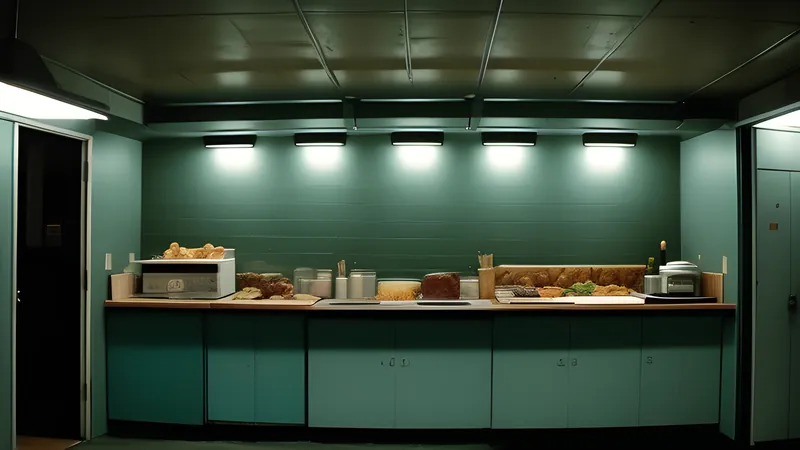
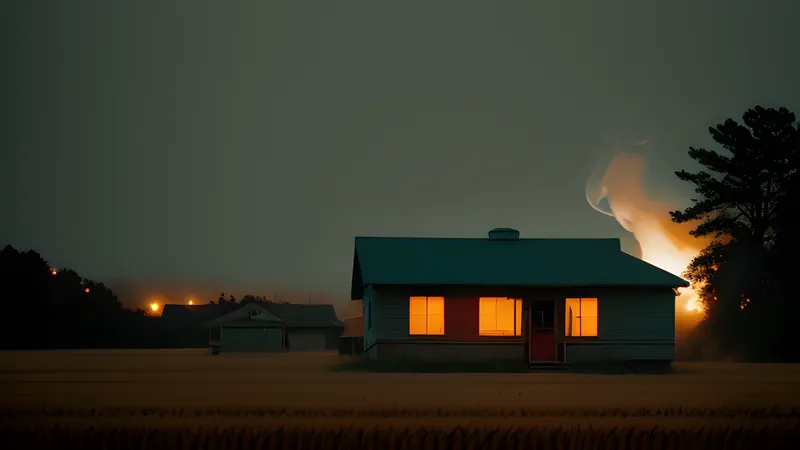
The direction is the surprise. Kevin Connor was a British film-maker whose previous decade was spent on the Amicus adventure pictures — The Land That Time Forgot, At the Earth’s Core, Warlords of Atlantis — genial, rubbery, matinee fantasy with dinosaurs and John McEnery. He arrives at American backwoods horror with no interest at all in grime. His compositions are clean, his framing is pleasant, his light is warm. The film looks like a story about a nice farm, and Connor holds that surface with complete discipline. The horror is entirely a matter of information. The pictures are the same pictures you would see in an advertisement for a country hotel.
That gap is where the comedy lives, and it is the same technique Parents would use nine years later with a fifties suburb. Shoot the horror in a beautiful room and refuse to change the lighting.
The garden
The film’s central image is one of the great ideas in American horror and I will handle it carefully, because it is introduced with real craft. The garden behind the motel is where Vincent keeps stock. What is planted there, and the specific surgical detail that makes the arrangement possible, is the single sequence people remember thirty years later, and its horror is entirely about volume and patience: this is farming, a slow business with a calendar. Vincent works to a rotation and a yield, and he thinks about next season.
Connor stages it in daylight, in wide shots, with the sound of the property in the background. There is no score sting. The camera behaves as though it is looking at vegetables, which is what Vincent believes it is looking at, and the film’s willingness to adopt his point of view for the duration of the shot is what makes it unbearable.
What Calhoun brought with him
The casting deserves a longer look. Rory Calhoun had been a contract leading man through the fifties, largely in Westerns, and by 1980 he was in the long third act that American film reserves for its former stars — television guest spots, character parts, whatever was offered. Casting him as Farmer Vincent is a piece of critical writing in itself. Calhoun carries the entire iconography of the decent American frontier male in his posture, and the film uses that as a delivery system: the audience extends him credit automatically, on the basis of thirty years of films they half-remember, and the picture spends that credit on a man with a smokehouse.
He is also, straightforwardly, good. Calhoun plays the material with the seriousness of a man who has decided this is a real part, and it may be the best work of his career. There is a particular quality to a veteran given something interesting after a decade of nothing much — an attentiveness that younger actors cannot fake — and it is all over this performance. The film would not survive a wink from him. It never gets one.
The real ancestor of this is not the film everyone names
Everyone shelves this next to The Texas Chain Saw Massacre and it is understandable — rural America, meat, a family business, a chainsaw in the last reel. But Hooper’s film is a documentary lie, shot to feel like found evidence, and Connor’s is the opposite object in every technical respect.
The truer bloodline runs through the Ed Gein material by way of the other 1974 film, Deranged, which understood before anyone that the Gein story’s real horror was domestic and procedural — a man keeping house. And further back sits Spider Baby, Jack Hill’s 1967 picture, which is the actual template: a warm, funny, affectionate film about a household of killers, in which the audience’s sympathy is engineered towards the monsters and the outsiders are the intrusion. Motel Hell is Spider Baby with a business plan.
The third ancestor is the tall tale itself. Vincent’s smokehouse belongs to the same American tradition as the roadside attraction and the tourist trap, and the film’s satire — a small producer with a famous local speciality, an authentic product, a story about the land — has become sharper with age rather than duller. The Italian cycle running at the same moment took the cannibal idea in an entirely different and considerably uglier direction, catalogued in the cannibal-cycle essay, and We Are What We Are is the modern version that plays it as tragedy.
The case against
The film is baggy. The middle act, in which Terry — the young woman who survives a motorcycle accident outside the property and is taken in — becomes the object of a romantic triangle between Vincent and his brother the sheriff, is the weakest material and it eats a lot of screen time. Nina Axelrod is given very little to play. Paul Linke’s Sheriff Bruce is a functional obstacle. The film’s attitude to its women is the standard-issue 1980 arrangement and has not improved with keeping.
There is also a real tonal wobble around Wolfman Jack’s television preacher and a couple of the guest vignettes, where the picture reaches for broad satire and lands on sketch. And the film’s pacing is genuinely odd: it establishes its great idea early and then declines to escalate for forty minutes.
What survives all of that is Calhoun, the garden, and Connor’s refusal to make the film look like a horror film. Those three things are enough. This is a picture that got to a joke first — that the folksy American small producer and the serial killer share a vocabulary — and then had the nerve to play the joke completely straight.
Spoilers below
The garden holds people. Vincent buries his stock up to the neck, severs their vocal cords so they cannot call out, feeds them, fattens them and harvests them for the smokehouse, and the film’s slogan — Vincent’s own advertising line about the variety of critters that go into his fritters — is a confession running on a hoarding by the road. The town has been eating its neighbours for years and complimenting the cook.
The climax is the film’s most famous sequence and one of the strangest images of the period: Vincent, cornered at last, arms himself with a chainsaw and puts on a pig’s head, and the final duel takes place in the smokehouse between two men with chainsaws while a giant pig’s skull watches from the top of a human body. It is ridiculous. It is also the correct ending for the film’s argument, because the mask makes literal what Vincent has believed the whole time — the distinction between the livestock and the farmer is a matter of costume.
Calhoun’s death scene is the best-written thing in the picture. Dying, Vincent makes a confession, and the sin he confesses to is a commercial one: after a lifetime of moral certainty about his produce, the thing that shames him is an admission about his ingredients. The joke is perfect because it is entirely in character. Vincent has no guilt available for the killing. He has guilt available for adulterating the product.
That is the film’s whole thesis in one line, and it lands because Calhoun plays it as genuine remorse.
Where to watch
There is a good restoration in circulation and the film needs it, since the daylight compositions are the point and a soft transfer turns the garden into mush. It rotates through ad-supported streaming. Follow it with Spider Baby to see where the affection came from, or Parents to see the same trick performed with a straight face.
Related Content