Monsters: Gareth Edwards's Tiny-Budget Wonder
A half-million-dollar road movie where the aliens are the least of it
Contents
Here is a fact that ought to be taught in every film school. In 2010 a British commercials director named Gareth Edwards made a feature about giant extraterrestrial creatures roaming a militarised zone in Central America, and he made it with a two-person cast, a small crew travelling through real countries with tourist visas, and a reported budget somewhere south of half a million dollars. He then went home and built every visual effect himself, on off-the-shelf software, on a domestic computer. The film that came out of this, Monsters, is a small miracle of resourcefulness, and the reason it works is the reason so many bloated creature features fail: it understood that the monster is more powerful the less you see it.
Four years later Edwards was handed Godzilla, then Rogue One, then the AI parable The Creator, and you can watch his whole career grow out of the discipline this film forced on him. Monsters is the calling card, and it holds up as more than a curiosity.
The premise, kept above the line
Six years before the story begins, a NASA probe returning with samples of possible alien life broke up over Mexico, and from the crash site new organisms spread across a swathe of the country now fenced off as the “Infected Zone.” Enormous, luminous, tentacled creatures live there, and the United States has built an immense wall along its southern border to keep them out. Into this setting Edwards drops the thinnest possible plot: a jaded American photojournalist, Andrew Kaulder (Scoot McNairy), is instructed by his employer to escort the boss’s daughter, Samantha Wynden (Whitney Able), back to the safety of the US. When the easy route closes, the two are forced to travel overland, through the Zone itself, toward the wall.
That is the entire machine. A man and a woman who barely know each other, thrown together on a dangerous journey, talking. The science fiction is the weather; the film is a two-hander about two guarded people slowly deciding to trust each other. Edwards cast two actors who were a couple in real life, encouraged them to improvise around a loose outline, and shot them against genuine locations — markets, ferries, jungle ruins, ordinary people who were often non-actors reacting to a camera rather than a script. The seams of the method are visible, and they read as texture instead of amateurism.
Why hiding the monster is the whole craft
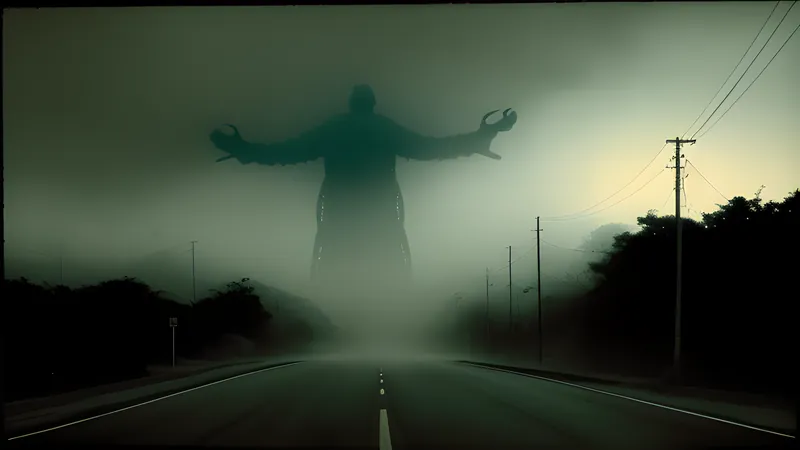
The single smartest decision in Monsters is budgetary and aesthetic at once: for most of its length the creatures are offscreen, implied, glimpsed on a distant horizon or reduced to their aftermath. A crashed jet fighter half-swallowed by jungle. A gutted petrol station. A child’s drawing of a tentacled thing on a wall. Television news in the background of a scene, delivering the war as ambient noise the characters have stopped hearing. Because Edwards could not afford wall-to-wall effects, he was forced into suggestion, and suggestion is what makes a creature feel real. Your imagination outbuilds any render farm.
The other craft decision is tonal. Edwards films the Zone as a place of ruined beauty rather than a battlefield. The photography — his own, largely available light — lingers on Mayan pyramids rising out of mist, on water and jungle and dusk, and the score by Jon Hopkins hums underneath it all in a mood closer to elegy than alarm. By the time you finally get a good look at the creatures, the film has trained you to see them as part of the landscape, a strange fauna that has colonised a country the way any invasive species might, indifferent to the humans arguing at its feet.
That indifference is the point, and it is where the film’s title turns ironic. Edwards is playing an old allegorical game. The wall, the “Infected Zone,” the migrants moving north through danger, the American impulse to fence off a threat that its own probe created in the first place — the political reading is right on the surface, and it landed harder as the years passed and the real border wall became a headline. The creatures never attack out of malice. The monstrousness, such as it is, belongs to the human architecture built to keep them out.
The films it descends from
Magpie’s habit is to name the ancestors, and Monsters has an honest lineage. Its nearest sibling is Neill Blomkamp’s alien-as-underclass parable, made the same era on a bigger but still modest budget, which turned science fiction into social diagnosis; that case is made in the alien film as apartheid allegory. Both films understand that a creature feature can carry a border argument more efficiently than any drama, because the metaphor does the arguing while the monster holds your attention.
The deeper root is the alien encounter reframed as communication rather than combat — the tradition that treats first contact as a problem of understanding, most elegantly worked out in the sci-fi film that rewires its own grammar. And for the specific virtue of doing extraordinary genre work on a shoestring, its truest cousin is the mumblecore cosmic horror of two American filmmakers who, a few years later, pulled the same trick with even less — the case for that is Lovecraft on a mumblecore budget, a film that shares this one’s faith that atmosphere is cheaper and better than spectacle.
Where the film wobbles is exactly where its improvised method leaves it exposed. The middle sags; some of the between-the-lines chemistry Edwards is banking on plays as two people waiting for something to happen. McNairy and Able are good, but the loose dialogue occasionally drifts without a scene to anchor it. None of that sinks the picture, because the ending pays back the patience with interest.
Does it work? It works as a proof of concept that became a real film — the rare debut where the constraints produced the art rather than merely limiting it. Anyone interested in how to make genre cinema with nothing should study it frame by frame. Where to find it: it lives on the streaming services and on a cheap, easily found disc; watch it in a quiet room, at night, and resist the urge to check your phone through the slow middle. The last ten minutes are the reason the film exists.
Spoilers below
The whole film has been withholding a proper look at the creatures, and the ending is where Edwards finally delivers one — on his own terms, in a register that reframes everything before it. Kaulder and Samantha finally reach the border wall and cross into an eerily deserted American town, evacuated and dark. Their journey through the Zone is over; safety, in theory, is a phone call away. They shelter in an abandoned petrol station, and it is there that the film gives up its secret.
Two of the giant creatures arrive in the night, and instead of attacking they meet. Edwards stages it as a courtship or a communion: the vast luminous forms touch their tentacles together and light passes between them in slow pulses, a display that reads unmistakably as tenderness, or awe, or a language. The two exhausted humans watch from cover, and their faces change. The things they have been taught to call monsters are revealed as beautiful, sentient, gentle with one another — creatures with an inner life, caught in a private moment that has nothing to do with the war humans have declared on them. It is the emotional inversion the entire film has been building toward. The audience, like the characters, has been braced for a kill, and receives instead a kind of grace.
The gut-punch is structural. Edwards opens the film with a scrambled, out-of-sequence prologue — a night-vision military convoy, an attack, a soldier — and it is only at the very end that you understand you have been watching the last event of the story first. The final scene reveals that the two people you have followed all the way north are about to be caught up in exactly that assault, the American military “rescue” that arrives as an attack. The romance you have invested in ends the second before catastrophe, and the film loops back to its own beginning like a closing snare.
That circular structure is the thing that lifts Monsters above its budget. It insists that the real tragedy is not the creatures at all; it is the machinery of fear and force that the humans keep running long after the evidence for it has collapsed. The wall did not keep anyone safe. The rescue was the danger. And the only moment of pure wonder in the whole picture belonged to the two beings everyone agreed to call the enemy.
For more genre cinema that treats scale and dread as an atmosphere rather than a set-piece, the arthouse end of the same tradition is worth the trip — the beautiful apocalypse of von Trier’s Melancholia works the same trick of making the annihilating force lovelier than the people fleeing it.
Related Content