Miracle Mile: The Phone Call That Ends the World
Steve De Jarnatt spent years refusing to sell his script to anyone who wanted to change it, and the film that resulted is seventy minutes of pure dread
Contents
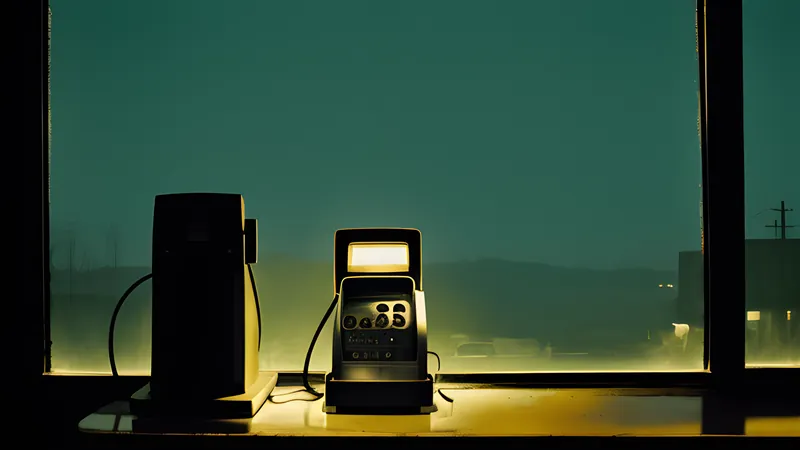
A man answers a ringing payphone outside a diner at four in the morning because it is ringing and he is standing next to it. The voice on the other end is a frightened young soldier who has dialled his father by mistake from a missile silo, and who says, before he is cut off, that the birds are in the air and there are about seventy minutes left.
That is the first four minutes of Miracle Mile. Everything after it is consequence.
The premise, kept above the line
Harry Washello (Anthony Edwards) is a trombone player. He meets Julie Peer (Mare Winningham) at the La Brea Tar Pits, and the two of them have the kind of instant, unembarrassed connection that films usually have to work much harder to sell. They arrange to meet at midnight when her shift at Johnie’s Coffee Shop ends. Harry’s alarm fails. He arrives at four.
And then the phone rings, and the film’s actual structure declares itself: Harry has roughly seventy minutes to find one woman in Los Angeles and get her out, and he has no way to know whether the voice on the phone was real. Steve De Jarnatt runs the picture close to real time, in the dead hours, across a handful of blocks of Wilshire Boulevard’s Miracle Mile district, and the tension comes almost entirely from a question the film refuses to answer for a very long time: is this happening, or has a man with no sleep and a new girlfriend just been handed a wrong number and a nervous breakdown?
The script that would not be bought
The production history is the film, so it is worth telling straight. De Jarnatt wrote Miracle Mile in the early eighties and it became one of the most admired unproduced screenplays in Hollywood — the sort of thing that circulates, gets read by everyone, and gets bought by nobody who will make it as written. Warner Bros held it for a period. The recurring note, every single time, was the ending.
De Jarnatt’s response is the most famous thing about him: he bought his own script back out of the studio’s hands to stop it being made wrong, and then sat on it for years until he could get it financed independently — it came out through Hemdale in 1988 — on the condition that the ending stayed. He directed it himself because nobody else would take it with that ending attached.
You can argue this is the behaviour of a man who could not compromise and consequently barely had a career; De Jarnatt has directed almost nothing since. You cannot argue it was wrong. The entire architecture of Miracle Mile is a machine for delivering its last ten minutes, and every note the studios gave would have converted a genuinely dangerous film into a thriller with a reassuring exhale. The film exists in its correct form because one person was stubborn to the point of career suicide, which is not a lesson Hollywood has ever wanted to learn.
Why the panic works
Here is the craft section. De Jarnatt’s central decision is to withhold verification, and to build the film’s escalation entirely out of other people believing Harry.
He tells the diner. That is the mechanism. A handful of night-shift customers and staff — including a brilliantly brittle Denise Crosby as a woman with a Rolodex of powerful contacts — overhear a panicking stranger, and one of them starts making calls. Within minutes the information is loose, and Miracle Mile becomes a study in how a rumour with no evidence behind it acquires the momentum of fact. Cars start moving. People start arming. The city begins to come apart around Harry for one reason only: he said so in a room with a telephone in it.
That is a superb structural idea, because it makes the film’s ambiguity productive instead of coy. The audience cannot verify the threat, and neither can anyone on screen, and the panic proceeds regardless — which is a much more frightening claim about civilisation than any mushroom cloud. Everything after the diner scene is the sound of a society discovering it has no immune response to a sufficiently confident four-in-the-morning voice.
Tangerine Dream do the other half. Their score is all pulse and arpeggio, cold sequenced synthesisers running underneath the whole picture like a clock that will not stop, and it does something clever: it starts before the phone rings. The music is already anxious over the film’s tender opening, over the tar pits and the flirting, which means the romance is contaminated from the first frame and the audience is uneasy before they have a reason to be. By the time the film gives them one, the score simply keeps doing what it was already doing, and the effect is of a machine that was always running and has now been noticed.
What it is really descended from
The obvious shelf is the nuclear cycle — Fail-Safe, On the Beach, the whole grim procedural tradition of men in rooms failing to stop the countdown. Miracle Mile inherits the dread and throws out the rooms. There are no generals in this film, no red telephones, no institutional access whatsoever. The apocalypse arrives as a wrong number to a man who plays the trombone.
So the real ancestor is somewhere stranger: Scorsese’s After Hours (1985), the other great film about one man, one night, a small area of a city, and an escalating series of encounters that turn increasingly deranged while he tries to accomplish one simple thing. The shape is identical — a nocturnal odyssey across a handful of blocks, each new stranger making the situation worse, comedy curdling steadily into nightmare. De Jarnatt simply put a countdown under it, and discovered that Scorsese’s structure works even better when the escalation has a deadline.
Behind that sits the rumour-panic tradition proper: the Twilight Zone mode in which a street full of reasonable neighbours destroys itself over an unverified claim. That is what the diner sequence is, expanded to feature length and given a city.
For the desk’s other apocalypses at this scale, The Quiet Earth is the same decade’s other masterpiece about the psychology of the spared, Night of the Comet runs the identical anxiety as comedy, and The Day the Earth Caught Fire is the ancestor for an ending that trusts its audience with genuine dread. Melancholia is the modern inheritor.
The case against
The film is scrappy. Its budget shows in the crowd work: Los Angeles coming apart is staged with what are clearly a limited number of extras and vehicles, and there are moments in the third act where the scale the script demands is simply beyond what De Jarnatt could put in front of a lens. A few of the supporting encounters are broad in a way that dents the naturalism the diner scene earned.
And Harry is a thin part. Anthony Edwards is very good — sweaty, decent, increasingly unhinged, entirely believable as a man whose only qualification for this night is that he was standing near a phone — but the script gives him no interior beyond his want. That works because the film moves too fast for you to notice; it stops working if you think about it afterwards.
Where it stands
It stands as the most sustained piece of dread the eighties produced, and almost nobody saw it. Miracle Mile did essentially no business, disappeared, and has been passed hand to hand ever since by people who corner you at parties about it. I am now one of them.
Watch it for the diner scene, which is one of the great sequences of that decade. Watch it for Tangerine Dream, doing the best film work of their long and uneven career. Watch it because it is seventy minutes long in the ways that count and it does not let go of your throat for any of them — and because a film-maker set fire to his own career rather than change the last reel, and the last reel is why the film is still here.
It has had loving disc restorations and turns up on the boutique streaming services; go in knowing nothing, if you still can.
Spoilers below
The call is real. De Jarnatt holds the ambiguity for a remarkably long stretch — there is a run in the middle where a rational explanation is still fully available, and the film dangles it — and then closes it off with the arrival of the first genuine confirmations, and the picture’s last act proceeds under total certainty. This is the right call. Ambiguity sustains a first act and rots a third.
Harry finds Julie. That is the thing the film gives him, and it gives it late and at enormous cost — a night of escalating carnage, a body count he is partly responsible for, a helicopter, a rooftop, and a version of Los Angeles already burning itself down over a rumour that happens to be true. The mechanism of the escape falls apart, as everything in this film falls apart, and the helicopter comes down into the La Brea Tar Pits, where the two of them met.
That is the ending the studios spent years trying to buy out of the script, and it is one of the bleakest in American cinema. Harry and Julie sink into the tar while the flash comes over the city, and the last exchange is Harry’s suggestion that the heat and the pressure will turn them into diamonds, and Julie’s agreement. Then the film cuts to black on the light.
I have never been able to decide whether the tar pits are too neat, and I have come to think the neatness is the point. The film opens at that spot with a museum exhibit about creatures that walked into something they could not see and were preserved by it for sixty thousand years. The joke — and it is a joke, delivered with total seriousness — is that Harry and Julie become the exhibit. The last two people, fossilised mid-embrace, filed among the mammoths for whoever comes next.
What makes it survive its own cleverness is Winningham. She plays the final minute with no terror at all, just tenderness and a kind of practical calm, and her acceptance is what converts the ending from a stunt into something close to unbearable. De Jarnatt fought Hollywood for the better part of a decade for the right to end a film with two people agreeing to become jewellery. He was right to. Nothing else in the picture would mean anything without it.
Related Content