Midsommar: Horror That Refuses the Dark
Ari Aster stages a breakup in the Swedish sun
Contents
Horror lives in the dark. It has always been the genre’s first tool — the thing off-screen, the corner the candle does not reach, the cut to black that lets your own imagination do the director’s work. Ari Aster’s Midsommar, from 2019, throws that tool out. It stages nearly its entire runtime under a sun that never sets, in a Swedish meadow so bright you have to squint, and it is one of the most upsetting films of its decade. Taking the dark away turns out to be scarier than any shadow, because in the light there is nowhere to hide from what people do to each other on purpose.
That is the film’s thesis, and it is why Midsommar is more than a folk-horror homage. It is a breakup film that happens to be a horror film, and the horror is calibrated exactly to the size of the wound.
A relationship already dead on arrival
Aster’s masterstroke is the prologue, which is a horror film in miniature before the sunlight ever arrives. Dani, played by Florence Pugh in the performance that announced her, suffers a family catastrophe of almost unbearable scale — the details I will leave until below — and reaches for her boyfriend Christian, who is already half out the door of the relationship and too cowardly to finish leaving. He comforts her out of obligation. She apologises for needing him. In fifteen minutes Aster establishes the real subject: a woman drowning who keeps saying sorry to the man refusing to throw the rope.
The trip to Sweden is Christian’s, not Dani’s. He and his graduate-student friends — the anthropologist Josh, the boorish Mark, and their Swedish classmate Pelle — are travelling to Pelle’s rural commune, the Hårga, for a midsummer festival that occurs, they are told, only once every ninety years. Dani invites herself along after Christian fails to mention the trip and then cannot bring himself to un-invite her. Every person in the car knows she should not be there. So does she. The film makes you feel the specific social suffocation of being tolerated rather than wanted, and then it drives that feeling into a valley of flowers where no one will ever sleep again.
Beauty as a threat
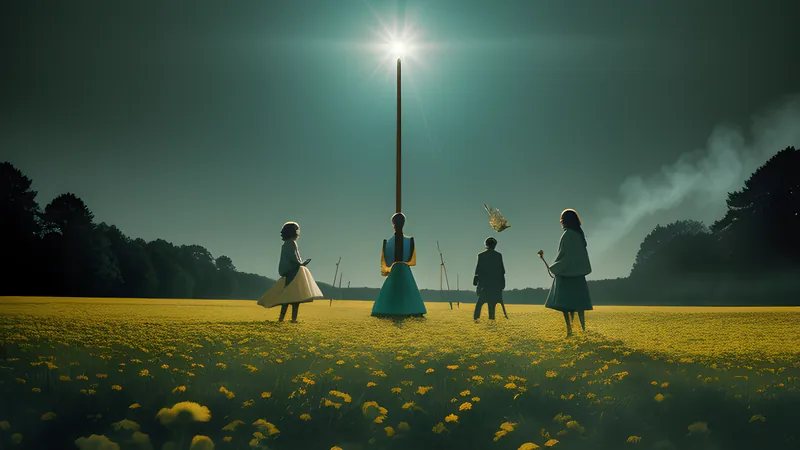
The reason Midsommar works is that its beauty is not decoration; it is the mechanism. Pawel Pogorzelski’s photography renders the Hårga as genuinely idyllic — white robes, embroidered runes, long communal tables, wildflowers woven into everything. Aster and his designers built a place you would want to visit, which is the trap. When violence comes, it comes in the same clear light, framed with the same painterly calm, and the calm is what makes it obscene. You cannot tell yourself it was hidden. The commune performs its horrors in the open, as ritual, as celebration, and the camera holds steady while they do.
The formal control is relentless. Aster uses slow, creeping zooms and precise symmetry to make the frame feel authored, arranged, inescapable — the sense that everyone in the meadow is following a script that the visitors have not read. There are subliminal touches: figures glimpsed in the treeline, murals on the walls of the sleeping quarters that diagram the entire plot if you care to read them, flowers that visibly breathe and pulse when the outsiders are dosed with the commune’s teas. The film tells you everything in advance and trusts that foreknowledge will not save you. It does not.
Florence Pugh is the reason the horror has weight rather than merely shock. She plays Dani’s grief as a physical condition — the held-breath sobs, the panic attacks she tries to swallow so as not to be a burden. Aster stages her breakdowns as full-body events and then, crucially, gives the Hårga women a ritual response to them: when Dani weeps, they weep with her, mirroring her sounds, holding her, sharing the grief as a group. It is the film’s most seductive and most sinister idea, because it offers Dani the one thing Christian never did — to be met in her pain instead of apologised at.
Where it sits in the bloodline
Midsommar is folk horror, and it knows its ancestors. The whole apparatus — outsiders drawn to an isolated community, an old belief the modern world assumes is decorative, a festival that turns out to require the visitors — descends directly from The Wicker Man (1973), which Aster has never pretended otherwise. Robin Hardy’s film ran the same trap in Scottish sunlight and paganism, and Midsommar is its most ambitious heir. The essential companion piece, though, is Robert Eggers’s The Witch: the two films are folk horror’s daylight and darkness, one a Puritan family devoured by the gloom at the edge of the wood and the other a young woman absorbed by the light at the edge of a meadow, and watched together they map the whole territory of how belief consumes the outsider.
The other indispensable pairing is with Aster’s own debut, Hereditary, released the year before. The two films are a matched set on grief: Hereditary is grief as a haunted house that closes in around a family, and Midsommar is grief as a cult that opens its arms. Aster is, across both, a director obsessed with what loss does to a person’s judgement — how mourning can make a monstrous embrace look like rescue. For the British strain of the same tradition dragged into the modern day, Ben Wheatley’s Kill List is the essential companion.
The verdict, argued
Midsommar divides people, and the division is instructive. Watched as a straight horror film it can feel airless and over-long, a two-and-a-half-hour march to a foregone conclusion. Watched as what it is — a revenge fantasy about grief, staged as folk horror, in which the “victory” is also a damnation — it is precise, cruel and quietly devastating. The film is not really asking whether the Hårga are evil. They plainly are. It is asking a harder question: what would make surrendering to them feel like relief, and it answers by showing you a woman whom the ordinary world has failed so completely that a murder cult looks like the first place she has ever belonged.
That is why it lingers. Aster gives you a happy ending and makes it the most disturbing thing in the film. Watch it in one sitting, on the largest screen you can, in daylight if you dare — the point is that you cannot look away, and the film will not let the dark do it for you.
Spoilers below
The prologue’s catastrophe is the foundation everything else is built on: Dani’s bipolar sister kills their parents and herself by carbon monoxide, taping tubes from the car exhaust into the house and into her own mouth. Dani loses her entire family in one night. Aster shows the aftermath in a single held, frozen image of the bodies, and it is this loss — total, sudden, isolating — that the Hårga will spend the rest of the film offering to replace.
Once at the commune, the deaths accumulate as ritual. The festival opens with the ättestupa, an elder-sacrifice in which two seventy-two-year-olds throw themselves from a cliff; when one survives the fall, the community finishes him with a mallet. Aster shows all of it, in full light, and uses the visitors’ horror to mark them as the outsiders they will remain until they are used up. Josh is killed for photographing the sacred texts. Mark is skinned, his face worn as a lure. The English couple, Simon and Connie, are disposed of off the edges of the story. One by one the outsiders are spent, while Dani is drawn deeper in.
The engine underneath is a breeding and replacement scheme, and Christian is its stud. He is dosed and delivered to a fertility rite, watched by a ring of naked commune women, one of them keening in rhythm with the act. Dani, meanwhile, is crowned May Queen after winning the maypole dance, dressed in a towering gown of flowers, made the centre of the community that never once made her feel like a burden. When she stumbles on Christian mid-ritual, the Hårga women surround her and scream her grief back at her, sharing it, and the film’s whole emotional argument snaps shut.
The finale is a choice, and it is Dani’s. As May Queen she is granted the selection of the final sacrifice — a commune member or Christian, now paralysed and mute inside a gutted bear-skin. She chooses Christian. He is carried with the other bodies into the yellow temple and burned alive, and Aster holds on Dani’s face as the fire takes them. Her expression moves from horror through grief and settles, at the very last, into a smile. It is one of the most contested final shots in modern horror, and the contest is the point: Dani has burned the man who failed her and been enfolded by a family that will never leave. She is free, and she is lost, and the film refuses to tell you which word wins.
Related Content