Metropolis: The Blueprint Everyone Still Steals
Fritz Lang's 1927 city, revisited — the silent film that invented the future's furniture
Contents
Fritz Lang’s Metropolis premiered in Berlin in January 1927, ran too long, cost so much it helped push the UFA studio toward ruin, and was almost immediately hacked to pieces by distributors who thought audiences would not sit through it. For eighty years the full film was assumed lost. Then in 2008 an archivist in Buenos Aires found a scratched 16mm reduction print containing nearly all the missing footage, and The Complete Metropolis restoration of 2010 finally let modern viewers watch something close to what Lang built. Watching it whole, the thing that stops you is not how dated it is. It is how much of the future you thought other people invented was already sitting there, finished, in 1927.
The story is a fable, written by Lang’s then-wife Thea von Harbou, and it is not the reason to watch. In a vast vertical city, a pampered elite lives in pleasure gardens atop skyscrapers while a faceless underclass works machines in the depths. Freder, the son of the city’s master, follows a working-class woman named Maria down into the machine halls, sees how the other half lives and dies, and the film cranks toward revolt, catastrophe and a soggy moral about reconciliation. The politics are muddled and von Harbou’s later trajectory made them worse. Ignore the message. The images are the inheritance.
The furniture of every future since
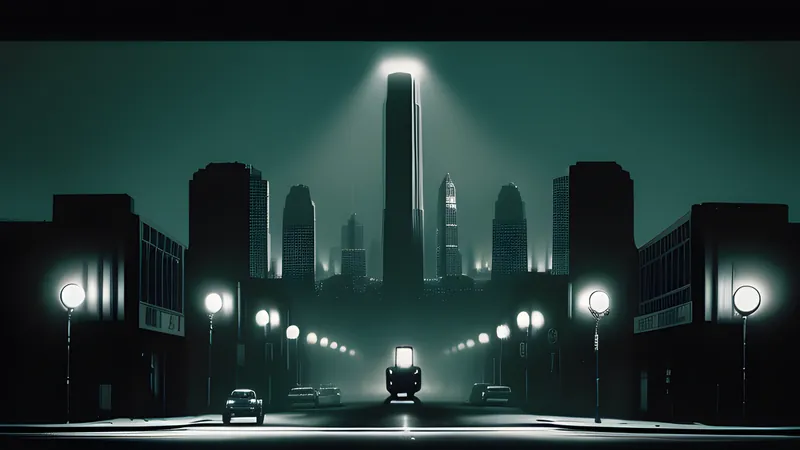
Almost every visual convention we think of as science-fictional was either invented here or given its definitive form. The city of towers wrapped in elevated roadways and aircraft, glowing against a black sky, is the direct ancestor of every neon megalopolis in the genre, and you can walk a straight line from Lang’s skyline to the rain-soaked sprawl of Blade Runner and the perpetual-night urbanism of Dark City. Ridley Scott has named Lang directly; the debt is not subtle.
Then there is the robot. Rotwang, the film’s wild-haired inventor with a mechanical hand, builds a gleaming feminine automaton — the Maschinenmensch — and this single design has been eaten and re-eaten by the genre for a century. Its sleek metal body is the reason the droids of Star Wars look the way they do, and its uncanny sexuality echoes through every seductive artificial woman on screen since. When Brigitte Helm, playing both the human Maria and her robot double, sits rigid on that throne as electricity crawls up glass rings and a human face is transferred onto steel, you are watching the birth of a genre’s most durable image. The scene has been restaged, homaged and parodied so many times that the original can feel like a greatest-hits reel, except it is the source.
Why the spectacle still works
Lang had no digital tools and a budget that terrified his backers, so he and his technicians solved the impossible by hand, and the handmade quality is exactly what keeps the film alive. The towering cityscapes were built as detailed miniatures and shot using the Schüfftan process, a trick with an angled mirror that let the camera composite live actors into a scale model in a single take, no optical printing required. It is the kind of practical ingenuity that ages gracefully, because there is a real object in front of a real lens catching real light.
The famous machine sequences work because Lang choreographs the workers like a single failing organism. Men heave on levers in unison, shifts trudge in and out with their heads bowed at identical angles, and when a great machine explodes and kills its operators, Freder hallucinates it as Moloch, the furnace mouth transformed into a devouring pagan god swallowing lines of slaves. That dissolve, industry into ancient sacrifice, is the film’s finest single idea, and it lands with a force most contemporary spectacle cannot match because it is an argument made in pure image. Lang trusts the cut to do the thinking, the same instinct Kubrick would later push to its limit in 2001.
Helm’s dual performance is the other engine. As the gentle Maria she is all softness; as the robot wearing Maria’s face she plays a mechanical thing performing humanity badly on purpose, the eyes a fraction too wide, the smile a fraction too knowing. The robot-Maria’s dance in a pleasure club, driving the city’s rich men to a frenzy, is a study in artificial seduction that every android femme fatale since has cribbed from, and Helm sells the wrongness with her body alone, no dialogue cards required.
The blueprint and its thieves
The value of Metropolis now is genealogical. Once you have seen it, the rest of the genre reorganises itself into a family tree with Lang at the root. The evil industrialist commanding a city from a tower is the template for the corporate overlords who would run RoboCop’s privatised Detroit sixty years later; Lang got there first, and Verhoeven’s OCP is his Joh Fredersen with a marketing department. The manufactured human passed off as a real one, sowing chaos among people who cannot tell the copy from the original, is the anxiety that would power an entire cyberpunk canon. Even the film’s structure — a soft-hearted protagonist descending from a clean upper world into a hidden industrial hell — recurs constantly, because it is a machine for generating unease about what a city keeps below its own floor.
There is a reason the thefts never stop. Lang built the images at the exact moment cinema and the industrial city were both new enough to feel like science fiction to their own audience, and he had the resources and the megalomania to render them at a scale nobody had attempted. The result is a set of archetypes so clean that later filmmakers reach for them by reflex, often without knowing where they came from. Watching the restored cut, you keep having the disorienting experience of recognising the future in a ninety-six-year-old silent film.
The honest verdict is that Metropolis is a masterpiece with a foolish heart. The story is naive and its famous closing motto is the kind of sentiment that solves nothing, and none of that has ever mattered, because what survives is the design language of a century of dreaming about cities and machines and manufactured people. If you have only ever seen the chopped-down public-domain versions, find the 2010 restoration with the recovered Argentine footage and the original Gottfried Huppertz score; it is a different, coherent film. After it, the natural next steps are Lang’s own children: Blade Runner for the city he built, and Aliens or RoboCop for the corporate machine he first imagined running the world.
Spoilers below
The plot resolves through a set of engineered doublings. Rotwang, the inventor, is nursing an old grief: he loved a woman named Hel who left him for Joh Fredersen, the master of Metropolis, and died giving birth to Freder. When Fredersen learns that the workers are gathering around the real Maria, a peacemaker preaching patience and the coming of a mediator, he orders Rotwang to give the robot Maria’s face so the false prophet can discredit and disperse the movement. Rotwang, still poisoned by his loss, has his own agenda, and secretly builds the double to destroy Fredersen’s city rather than save it.
The robot-Maria does her work with terrible efficiency. She whips the pleasure-district elite into lust and the workers into a suicidal riot, goading them to smash the very machines that keep the underground city habitable. They wreck the Heart Machine, the reservoirs burst, and the workers’ own subterranean housing begins to flood — with their children still down there, because in their fury they forgot them. The real Maria and Freder race to save the drowning children, hauling them up to the surface, while above them the mob, believing their families dead, turns on the false Maria and burns her at the stake. Only as the flesh chars away to reveal the grinning metal beneath do they understand they have been played.
Rotwang, unhinged, mistakes the true Maria for Hel and chases her onto the roof of the great cathedral, where Freder pursues them both. Rotwang falls to his death; Maria is saved; and the film delivers its notorious ending, in which Freder joins the hand of the foreman to the hand of his father atop the cathedral steps and the intertitle announces that the mediator between the head and the hands must be the heart. It is a fantasy of class harmony achieved by a handshake, and it papers over everything the film has just shown about who owns the machines and who dies in them. Lang himself later disowned the sentiment. What he could not disown, and what we keep stealing, is everything that came before the handshake: the towers, the robot, the flood, and the sight of a machine wearing a human face to burn a city down.
Related Content