Meshes of the Afternoon: Deren's Dream Loop
Fourteen minutes, a rented bungalow, and the film that taught American cinema how to dream
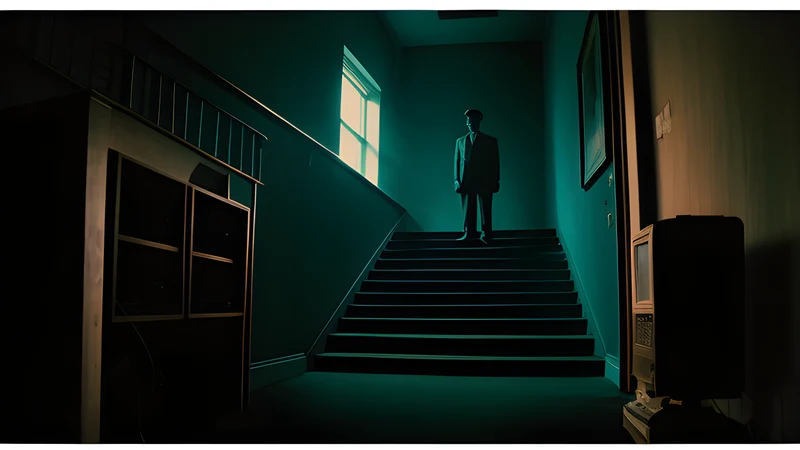
Contents
Meshes of the Afternoon was shot in 1943, in a rented bungalow in Los Angeles, on a hand-wound 16mm Bolex, by two people with no crew and a budget in the low hundreds of dollars. It runs fourteen minutes. It has no dialogue, and for its first sixteen years it had no sound at all. It is, by a wide margin, the most influential American film of its decade, and you can trace a straight line from it to every uncanny corridor and every mirror-faced figure that has appeared in commercial cinema since. It cost less than a day’s catering on the studio pictures being made a few miles away.
The two people were Maya Deren and Alexander Hammid, married at the time, and the division of labour matters. Hammid was an experienced Czech émigré cinematographer with a documentary background who knew exactly what a Bolex could do; Deren was a poet, a former assistant to the choreographer Katherine Dunham, and the person who understood what the film was about long before either of them had a word for it. Born Eleanora Derenkovskaya in Kyiv in 1917 and brought to New York State as a child, she had been renamed Maya by Hammid and had, by this point, published poetry and never made a film. She would go on to take the first Guggenheim Fellowship ever awarded for creative work in film, write the movement’s founding manifesto, found an organisation to fund other people’s work, and die at forty-four in 1961, having personally invented American independent cinema as a going concern.
The premise, kept above the line
A woman walks up a sunlit path towards a house in the Hollywood hills. She picks up a flower from the pavement. She takes a key from her bag and drops it; it bounces down the steps. She retrieves it, lets herself in, and moves through the rooms — a bread knife, a loaf, a telephone off its hook, a phonograph turning. She climbs the stairs, sits in a chair by the window, and falls asleep.
Then she sees, through the window, a figure in a dark robe walking away up the path, carrying a flower. Where its face should be there is a mirror. She goes after it. And the film begins again — the path, the flower, the key, the door — with everything very slightly changed.
That is the whole architecture, and knowing it in advance costs nothing. Deren’s structure is a loop that will not close, each pass through the same objects arriving at a different arrangement, until the passes start to overlap and the woman finds herself sitting at her own table opposite herself. All of it happens in one small house on one afternoon, with four props, and it is more frightening than most things made with a hundred times the money.
Why it works: the rule Buñuel refused
The obvious ancestor is Un Chien Andalou, and Deren had certainly seen it. The essential thing about Meshes is what she does that Buñuel had explicitly forbidden himself: she gives dream logic a form. Buñuel and Dalí’s rule was that no image be admitted if it could be rationally explained, which produced sixteen minutes that no amount of study will resolve. Deren’s film uses recognisably dreamlike material — the repeating key, the impossible geography, the double — and organises it into a rigorous structure with rhymes, escalations and a shape you can feel even when you cannot state it.
She was explicit about this in her later writing. Her position was that a film should be composed the way a poem is composed, with a vertical investigation of a moment rather than a horizontal chase after an event, and that the composition is what separates art from a recorded doodle. Meshes is the proof of concept. It feels like a dream and it behaves like a fugue, and that combination is why it seeded a tradition where Buñuel’s short mostly seeded imitators.
The practical consequence for anyone watching: Meshes rewards a second viewing in a way Un Chien Andalou does not, because there is something built in there to find.
Why it works: what the Bolex could do
The craft is the reason to keep coming back, and almost all of it is Hammid solving problems with a spring-wound camera that could only run about thirty seconds at a time.
The most-copied shot is the stairway. The woman climbs and the world tilts, throwing her against one wall and then the other, and it was achieved by rocking the camera in a rigged corridor while she moved through it — a physical, in-camera solution that no digital equivalent has ever bettered, because the wobble has the irregularity of a hand. It is now the standard grammar for a corridor going wrong, and it was invented for pocket money in 1943.
Then there is the stride, which is the single finest piece of editing in the American avant-garde. Deren takes one step, and across the cuts her foot lands on sand, then grass, then mud, then pavement, then carpet — a continuous walk stitched from five locations, matched so precisely on the swing of the leg that the body’s motion carries you across geographies that cannot be adjacent. It takes about six seconds. It says everything about dream space that a hundred dissolves could not, because the body stays continuous while the world underneath it is exchanged.
The doubling is the third trick: locked-off camera, separate passes, careful splicing, and suddenly there are three of her at one table, each aware of the others. Doing this in 1943, without an optical printer, on a camera you wound by hand, required a level of planning that gives the lie to the received idea of the avant-garde as improvisation.
The sound that arrived in 1959
Meshes was silent for sixteen years. In 1959 Teiji Ito, the Japanese-American composer who was by then Deren’s husband, wrote the score that is now inseparable from it — sparse percussion, flute, an unsettled rattle that sits somewhere between Japanese chamber music and the Haitian ritual drumming Deren had spent years documenting.
It is a fascinating case study in how much a soundtrack decides. The 1943 version is a formal exercise, chilly and hypnotic. The 1959 version is a horror film. Ito’s percussion supplies the dread that the images had been withholding, and it turned a film admired by specialists into something that could hold a room. Almost nobody now sees the silent cut, and the film’s reputation was substantially built on a score added a decade and a half after the fact, by a man who was fourteen when it was shot.
The collector’s note
The line from Meshes runs directly into Eraserhead and everything after it. Lynch’s whole method — a domestic interior that is subtly wrong, a repetition that curdles, a figure whose face is not available — is Deren’s architecture applied at feature length with a soundtrack budget; the survey at David Lynch: the dreamer of American unease is the same lineage traced forward.
The other essential descendant is Carnival of Souls, Herk Harvey’s 1962 industrial-film-maker’s fluke, which is Meshes stretched to eighty minutes and sold as horror — a woman, a loop she cannot escape, a pursuing figure, and the same conviction that cheapness and dread are compatible. For the multiplying self specifically, the survey at the doppelgänger film and the anxiety of the self starts, correctly, near here. And Repulsion is Polanski taking the house-as-mind idea and making it clinical.
The honest case against
The film’s canonisation has been rough on it. Sixty years of coursework have turned Meshes into a slide, and the standard readings — the key, the knife, the mirror as the unavailable self — are so well worn that they arrive before the images do. Deren, who spent her life insisting that her work was formal rather than symbolic, would have loathed the interpretive apparatus that grew on it.
There is also an authorship problem nobody has resolved. Hammid shot it, staged much of it, and by some accounts contributed a great deal of the structure; Deren appears in it, drove it, and took most of the credit as her reputation grew, particularly after the marriage ended. Both accounts are self-interested and neither is verifiable now. The honest position is that it is a genuine collaboration whose halves cannot be separated, and that the reflex of assigning it wholly to Deren is a convenience for people who need a single name.
The verdict, above the line
Fourteen minutes, four props, one house, and the invention of a grammar that mainstream cinema is still living off. It is the most efficient film in this desk’s whole territory, and it holds up without a scrap of allowance for its age or its budget. Watch it late, alone, with the 1959 score. Everything above this line is safe. The last minute goes below.
Spoilers below
The loops accumulate until there are three of her at the table, and one of them draws the knife. The target is the sleeping woman in the chair — herself. The blade comes down, and the film cuts, on the descending motion, to a man’s face.
He is there in the room, ordinary and unremarkable, and he wakes her, and for a moment the film offers the reading that everything has been a dream and the afternoon is over. He leads her upstairs. The flower is on the bed; when she reaches for it, it is the knife. She strikes at his face, and his face is the mirror, and the mirror breaks — and the shards fall onto a beach, into surf, in a shot that has no business existing in a film this size.
Then the final movement. The man comes up the path again, in the sunlight, the way she did at the start. He lets himself in. He finds her in the chair by the window with her throat cut, seaweed and broken glass in her lap, the sea somehow having arrived in a Hollywood bungalow.
What makes the ending permanent is that it refuses to select a reading and yet is not vague. Read one way, the dream killed her and the pursuit was suicide dressed as a chase. Read another, the man’s arrival was the last and cruellest loop, and the woman in the chair has been dead through every pass. Read a third way, the mirror-faced figure was always her, and the film is fourteen minutes of a person hunting herself around a small house on a hot afternoon and catching up.
Deren gives no key, and unlike Buñuel she does not need to insist there is nothing to find, because the structure has done the arguing. The seaweed is the tell. There is no sea near that house, and the film has spent its whole length establishing an interior that obeys dream rules — so the sea is not a symbol, it is a leak. The dream stopped being contained. Whatever was happening upstairs got out into the room where the body is, and the film ends on the evidence rather than the explanation. My verdict: the most important fourteen minutes in American cinema, and still the best demonstration that the uncanny is an architectural problem rather than a budget one. The key is still on the step.
Related Content