Martin: Romero's Modern Vampire Without Fangs
A razor blade, a syringe, and a dying steel town — the film Romero said was his best
Contents
The opening sequence of Martin is one of the most efficient in horror, and it works by taking everything away.
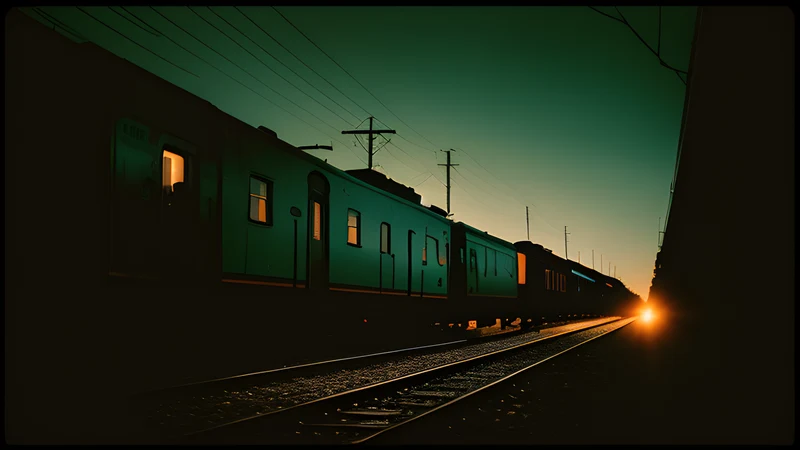
A young man boards an overnight train. He breaks into a woman’s sleeping compartment. What follows takes an agonising amount of screen time, and it is clumsy, ugly and protracted: she fights, he is not strong enough, the sedative takes far too long to work, he has to hold her down and wait. Then he opens a vein with a razor blade and drinks. Afterwards he tidies up. He arranges the compartment to look like a suicide, because the police will need something to write down.
No fangs. No transformation, no bat, no mist, no hypnotic gaze, no strength of ten men. Romero made a vampire film in 1978 in which the vampire has to do all of it by hand, and the labour is the whole point.
Braddock, Pennsylvania
Martin Madahas arrives to live with his elderly cousin Tateh Cuda in Braddock, a mill town outside Pittsburgh that was in the early stages of the collapse that would gut the American steel belt. Romero shot on location, and the town does not need dressing. Boarded shops, empty streets, a river, a mill still running and everybody aware it will not run forever.
The setting is the film’s second argument. The gothic vampire needs a castle, a village of peasants and a folklore that everyone shares. Romero puts his vampire in a place where the community has already dissolved — where the young have left, where nobody knows their neighbours, where a strange young man can move in and be invisible. Martin’s real advantage over Dracula is not power. It is anonymity, supplied free by American economic decline.
Cuda (Lincoln Maazel) greets Martin at the station with a crucifix and the word “Nosferatu”. He believes absolutely. He is going to save the boy’s soul and then destroy him, in that order, and he has told the family so. Maazel plays this old-country certainty with a rigid dignity that makes him the funniest and most frightening thing in the film.
Martin’s response is the moment the film declares itself. He takes the garlic Cuda has hung, eats a clove, and pulls off the crucifix, entirely unbothered. “There’s no real magic,” he says, more or less, again and again through the picture. “It’s just a sickness.”
Is he eighty-four years old?
Romero cuts throughout to black-and-white sequences: gaslight, a mob with torches, a woman in a nightdress, a young man in period dress fleeing across a candlelit room. They are shot like a Universal picture and they feature Martin, unaged.
The film never tells you what they are. Memory, or fantasy, or the story a lonely young man has built to explain a compulsion he cannot otherwise survive. Romero leaves it open with a discipline that most directors would have broken by the second reel, and the ambiguity is load-bearing in both directions. If Martin is eighty-four, the tragedy is that the magic has drained out of the world and left him with a razor and a bus timetable. If Martin is a disturbed young man, the tragedy is that Cuda’s superstition has handed him a script for his own illness, and that everyone around him is playing a part in a story that is killing women.
John Amplas plays him as neither. He is watchful, mumbling, socially frozen, achingly polite, and periodically capable of atrocity. What Amplas gets exactly right is Martin’s ordinariness — the boy is boring, and knows it, and the black-and-white sequences are the only place he is ever interesting, including to himself.
The device that makes this explicit is the radio. Martin starts phoning a late-night talk show to describe what he is, and the host christens him “The Count” and plays him for laughs and ratings. So the vampire’s confession becomes light entertainment, consumed by insomniacs, and Romero built this in 1978 — a full generation before the culture arranged itself entirely around the monetised confession of the lonely. It is the most prescient thing in his filmography, and that includes the mall.
Craft, and Savini
The technique is rougher than Dawn of the Dead, which Romero was working on at almost the same time, and the roughness is load-bearing. Handheld, available light, real houses, long unglamorous takes of a young man walking. Romero’s editing is the star — he cuts the black-and-white flashes in hard, sometimes mid-action, sometimes for a single frame, so that the past intrudes on the present the way an intrusive thought does.
Tom Savini did the effects and also plays Arthur, Christine’s boyfriend. The gore is sparse and deliberately unspectacular. Savini’s razor work here is the opposite of what he would do at the mall: no arterial theatre, just the plain sight of a blade in skin and how much of it there is and how long it takes. Romero and Savini both understood that the horror of Martin had to be procedural. Our piece on the practical-effects tradition covers the showman’s side of Savini’s work; this is the other side, and he was arguably better at it.
Christine (Christine Forrest, who later married Romero) is the film’s conscience — the cousin who treats Martin as a person and is leaving Braddock anyway, because everyone with sense leaves Braddock.
Romero shot a much longer cut, reportedly running well past two and a half hours with more of the black-and-white material, and the 95-minute release version is the one that has survived. It circulates now in a proper restoration and turns up in Romero retrospectives; the boutique editions are worth the money for the Braddock location work alone.
The ancestor and the descendants
The real ancestor of Martin is not Lugosi. It is Peeping Tom — a shy, damaged young man with a technique, a ritual, and a piece of apparatus, filmed with enough sympathy to implicate the audience. Powell got destroyed for that. Romero did it with a razor and a syringe and got ignored instead, which in 1978 amounted to the same thing.
Downstream, everything sad about vampires comes through here. Let the Right One In is Martin with snow and a friend. A Girl Walks Home Alone at Night is Martin with a skateboard and a better soundtrack. Both of them inherit the discovery that a vampire deprived of glamour becomes an argument about loneliness. The vampire canon places it in the line; our Romero career piece explains why he kept calling this one his favourite.
The verdict: Martin is the best film George Romero directed, and the zombie pictures are why nobody says so. It is a film about the specific horror of being young, poor and unmiraculous in a town with no work, and the vampirism is the least interesting thing in it. Watch it beside Season of the Witch, his other film about a person trapped in a role somebody else wrote for them, and Romero looks less like a horror director and more like a social realist who kept getting handed monsters.
Spoilers below
The last act belongs to Cuda, and Romero springs the trap with brutal economy.
Martin’s life improves. He gets a job on Cuda’s delivery round, a routine, a place in the town. He begins an affair with Mrs Santini (Elyane Nadeau), a bored, unhappy married woman on his route, and it is the first time Martin touches anyone who is awake and willing. Amplas plays those scenes with a bewildered gentleness that makes the rest of the film retroactively worse. He does not need the razor with her. The sickness, whatever it is, is in remission.
Then Mrs Santini kills herself. Her marriage, her isolation, her own private despair — Romero shows enough to make it legible and gives it nothing to do with Martin. She dies of Braddock.
Cuda finds out. Cuda has spent the entire film waiting for permission, and a dead woman connected to Martin is all the permission he requires. He does not investigate. He does not ask. He hammers a stake through Martin’s heart while the boy sleeps, and buries him in the garden, and the film gives us no struggle and no last words.
That is the film’s verdict, and it is savage. Cuda kills an innocent man for a death he did not cause, using a folklore the film has spent ninety minutes demonstrating to be false, and he is not punished. The last thing we hear is the radio talk show, where the host is wondering aloud what became of The Count, and taking calls, and moving on to the next segment.
Romero’s joke is complete. The vampire is dead. The superstition that killed him was always wrong. And the only mourners are strangers on a phone-in who thought he was a character.
Related Content