Marketa Lazarová: The Medieval Czech Fever Epic
Two years in the snow to make the least comfortable great film ever shot about the Middle Ages
Contents
In 1998 a poll of Czech film critics was asked to name the greatest Czech film ever made. They chose Marketa Lazarová, and they were not close to being wrong. What is remarkable is that the film they chose is close to unwatchable on a first pass — a fragmented, narratively hostile, black-and-white medieval epic that refuses to tell you who anyone is, where you are, or what is happening, for the better part of three hours.
František Vláčil made it in 1967, and the received wisdom is that it is the Czech Andrei Rublev. That is a useful handle and a bad description. Tarkovsky was making an argument about faith and art with a medieval setting as its vehicle. Vláčil was doing something more literal and more insane: he was trying to make the thirteenth century happen to you.
The problem he set himself
The source is Vladislav Vančura’s 1931 novel, and Vančura is the first obstacle. He wrote in a deliberately artificial archaic Czech — a constructed literary language that never existed, dense, ironic, addressed by a narrator who mocks the reader for wanting a story. It is one of the most admired and least tractable objects in Czech literature.
Vláčil’s response was to keep the narrator, keep the difficulty, and translate the artificial archaism into an artificial medieval world — one built from scratch on the same principle Vančura used for the prose. What is on screen is not a reconstruction of the thirteenth century as historians describe it. It is a thirteenth century invented with the same rigour and strangeness as the language, and it has the enormous advantage of being unfamiliar to everyone in the audience, which is exactly what the real one would have been.
The setting is Bohemia during the long, incomplete Christianisation — a country where the king’s authority is a rumour, where robber clans hold the forest, and where people who cross themselves also leave things out for older powers because it costs nothing and might help. Two clans, Kozlík’s and Lazar’s, feud in the snow. Kozlík’s son Mikoláš takes Lazar’s daughter Marketa, who was promised to a convent. A German nobleman’s son, Kristián, is taken hostage. The king’s men come to end the clans. That is the plot, and reciting it does no good at all, because Vláčil has gone out of his way to prevent you from following it.
The hostility is deliberate
The film withholds standard orientation with a consistency that reads as policy. Characters are introduced mid-scene without names. Sequences begin after their inciting event. The narrator interrupts to comment drily on people you have not met yet and occasionally tells you what will happen to them, removing suspense on purpose. Time skips without notice. Two part-titles arrive and clarify nothing.
The effect is disorientation, and disorientation is the intended experience. Vláčil’s proposition is that the Middle Ages were not a period with good production design. They were a condition of not knowing — no maps, no news, no reliable account of what was over the hill or who was coming or why. Every convention of historical cinema that makes a period legible is a lie about how it felt to be inside it. So he removed them.
Whether that is genius or self-indulgence is a real argument, and I will concede the case against cleanly: for the first hour this film is a punishing experience with no handhold, and a viewer who gives up is not a philistine. The film asks for something close to blind trust before it has earned any. What it does with that trust is why it survives.
Two gods, no contradiction
The single richest thing in the film is the way it handles belief, and it is handled almost entirely by staging rather than by dialogue.
Nobody in Marketa Lazarová is torn between paganism and Christianity. They hold both, simultaneously, without discomfort. A man will invoke the Christian God and then observe an older custom in the next breath, and the film presents this as unremarkable, because for the people living through that long overlap it was unremarkable. The idea that a person must pick one cosmology and defend it is a much later habit of mind, imported backwards onto the period by films that need a conflict.
Vláčil declines the conflict and gets something far more unsettling: a world where the sacred is simply ambient, available in several incompatible flavours, none of which reliably works. Marketa is pledged to a convent by a father whose piety is entirely genuine and entirely compatible with robbing travellers. That is not hypocrisy as the film sees it. It is a functioning arrangement, and the film’s coldest joke is that the thing which eventually ends the clans is neither God nor the old powers. It is the king’s administration.
Weather as cinematography
Bedřich Baťka’s photography is the reason the film is a physical event rather than an intellectual one.
The material was shot over roughly a year and a half, largely on location, in genuine Central European winter, and the production’s ordeal is legible in every frame. Faces are wind-burned. Breath is constant. Hands are wrong colours. Nobody looks like an actor in a costume, because after that long in that cold nobody was capable of looking like anything except a person who is extremely cold.
Baťka shoots it in wide black-and-white compositions in which the human figure is routinely small and the sky is routinely enormous, and the whites blow out into blank paper so that the snow stops reading as ground and starts reading as absence. Then he puts the camera in it — handheld, low, moving with the horses, hunting through the trees. The film oscillates between an inhuman distance and a nauseating closeness with nothing in between, which is a precise description of how threat works in open country.
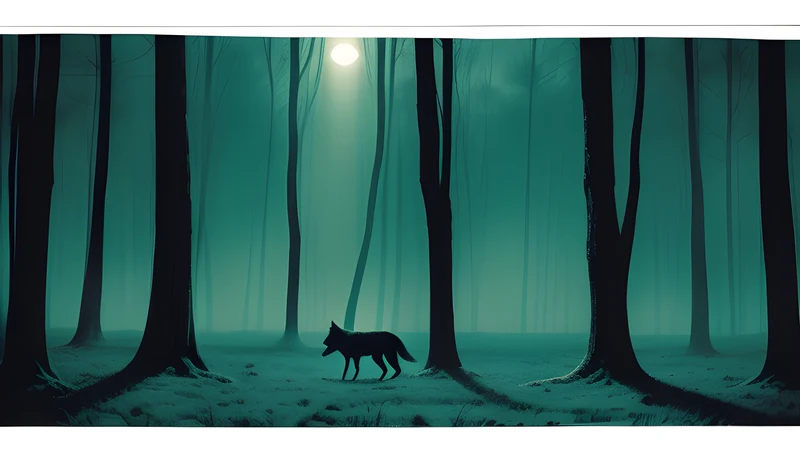
And the wolves. They are used sparingly and they are the film’s tuning fork: a line of animals at the edge of the trees, waiting, entirely indifferent to which clan wins. Vláčil never makes them symbolic. He makes them present, and their presence is what keeps the human politics of the film at its correct scale, which is small.
Liška’s noise
Zdeněk Liška’s score is, for my money, the greatest ever written for a European film, and the reason is that it is barely a score.
He builds it from choral fragments — Latin, liturgical in shape, sung with a purity that keeps sliding into something wrong — layered over vocal textures that are not singing at all: breaths, whispers, cries, sounds that could be a congregation or could be a wood full of animals. It arrives in slabs, cuts off mid-phrase, and refuses to follow the drama. When something terrible happens, the music frequently does nothing. When two people ride across a field, it detonates.
This is the same composer who scored The Cremator two years later with a funeral organ that hums like a fairground. The range is absurd. Here he supplies the sound of a world in which the church and the forest are making the same noise and nobody can tell them apart, which is the film’s actual thesis delivered through the ears while the eyes are busy being lost.
The collector’s cross-reference: watch this before November, the Estonian film that films the same pagan-Christian double-book-keeping in the same silver monochrome fifty years later, and the debt becomes plain. And watch it against Stalker for the other great Eastern European use of duration as a moral instrument — Tarkovsky uses time to induce patience, Vláčil uses it to induce exposure.
If you want the neighbouring rooms, they are The Hourglass Sanatorium and Valerie and Her Week of Wonders — three films from the same decade and region, all of which decided the way to reach a viewer was to stop explaining.
Where it sits
The restoration is superb and the film circulates on disc; it screens in Czech-cinema retrospectives and in the “greatest films you have never seen” strands that repertory programmers cannot resist. Watch it on the largest screen you can find, with the sound loud enough that Liška’s choir has room, and — this matters — watch it twice.
The first pass is weather. You will not follow it and you should not try. Let the cold and the noise and the wolves happen. The second pass is when the architecture appears, and it turns out to have been rigorous all along: every one of those withheld introductions and mid-scene entries is placed. The film is not chaotic. It has simply declined to hold your hand while being extremely precise, and the reward for the second viewing is discovering how much of the first one was designed.
Spoilers below
The clans lose. That is the shape, and Vláčil never pretends otherwise — the narrator tells you early that these people are finished, which drains the suspense and leaves only the watching.
Kozlík’s people are hunted down by the king’s men, and the film’s account of it is squalid rather than tragic. There is no last stand worth the name. There is cold, and a broken assault, and men dying of wounds in the mud because there is no medicine and no help coming and no reason for any of it beyond the fact that the king has decided the forest belongs to him now.
Mikoláš dies. He dies badly, after an attempt to reach his father that fails on its own terms, and the film gives his death no music and no glory. What it gives him instead is Marketa — the woman he took by force, who came to him, who by the end is carrying his child. Vláčil refuses to sentimentalise that and equally refuses to flatten it into a modern verdict. She was abducted. She was pledged to God and taken from it. She chose him anyway. The film holds all of that at once and declines to arbitrate, and the refusal is the hardest thing in it.
Kristián, the hostage, is broken completely — the one character who arrives from a civilised, Christian, orderly world, and the one the forest destroys most thoroughly. His ruin is the film’s clearest statement about which order actually governs here.
The ending goes to the narrator, and it goes to the children. The clans are gone, the feud is settled, the king’s law extends over the trees, and the film’s last act is to tell you calmly what became of the infants born out of all this violence — the next generation, growing up inside the world the killing produced, none of it their doing. Vláčil ends a three-hour epic of slaughter on a bureaucratic footnote about survivors. The wolves are still at the treeline. They were never in the story. They were waiting for it to finish.
Related Content