Mario Bava: The Father of Italian Horror
The cameraman-magician who built a genre out of coloured light
Contents
Almost everything that Italian horror became, Mario Bava did first. The giallo murder mystery with its black-gloved killer — his. The body-count structure where a masked figure works through a cast of victims — his, more than a decade before American slashers made it a formula. The idea that horror could be built from saturated, unreal colour rather than shadow and restraint — his above all. And he did it while regarded, for most of his life, as a talented technician rather than an artist, a man who fixed other directors’ films and never quite got his due. The reappraisal came late, and it has to run up against Bava’s own modesty, because he genuinely seemed to think of himself as a craftsman doing a job.
Bava was born in 1914 in Liguria, the son of Eugenio Bava, a sculptor and one of the pioneering cinematographers of Italian silent film. He grew up in the trade, learning optical effects, matte painting and camera trickery at his father’s side, and he spent the 1940s and 1950s as one of Italy’s most sought-after cinematographers and effects men. This is the foundation for everything: Bava the director is inseparable from Bava the magician of the camera, a man who could conjure a castle, a storm or a ghost from a sheet of glass, a mirror and a coloured light.
The reluctant director
His path to directing ran through rescue work. He completed films other directors abandoned, most famously the 1957 I Vampiri, Italy’s first sound horror film, when Riccardo Freda walked off, and he shot its effects uncredited. Given his own picture at last, he made Black Sunday (1960), also known as The Mask of Satan, and it is one of the great horror debuts. A gothic tale of a resurrected witch, shot in luminous black and white, it made an icon of Barbara Steele and announced a visual imagination beyond anything else in the genre at the time. The film was banned in Britain for years, and its influence on the gothic revival was immediate.
The invention of the giallo
Then Bava did the thing that reshaped the genre. The Girl Who Knew Too Much (1963) sketched the template of the giallo — an ordinary person witnesses a murder and is drawn into investigating it, mystery laced with style. A year later he perfected it. Blood and Black Lace (1964) is the true birth of the form, and arguably the birth of the slasher’s grammar too: a faceless, mannequin-blank killer in a mask and gloves murders a series of beautiful models in a fashion house, and Bava films each killing as a set piece of colour and design, the violence choreographed and aestheticised, the plot almost beside the point. Everything Argento would later be praised for is already here, and so is the structure that Halloween and Friday the 13th would monetise fifteen years on.
The mannequin-blankness of that killer is itself an idea worth pausing on. By stripping the murderer of a face, Bava turned him into a pure agent of design, a moving shape in the composition rather than a psychology, and that abstraction is exactly what makes the masked slasher so portable across decades and cultures. The direct line from Blood and Black Lace runs through Argento’s colour-drenched gialli and out into the slasher boom. When we trace the films that invented the slasher, Bava is at the head of the queue, and the giallo’s fingerprints on the modern slasher are, in large part, his fingerprints.
Colour as a weapon
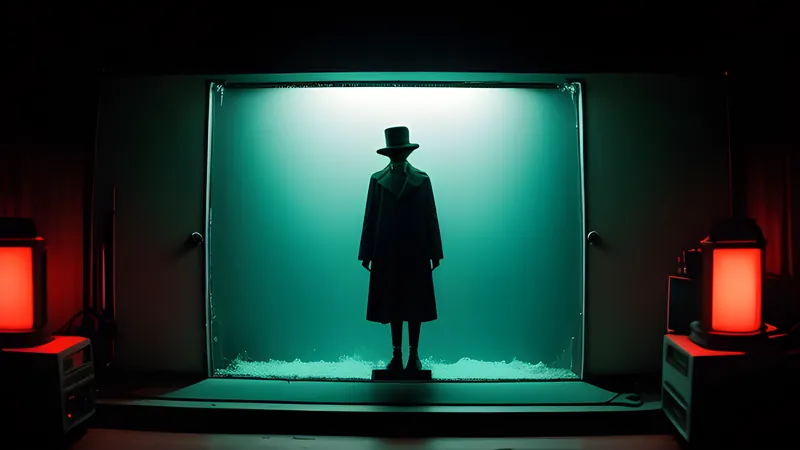
The single most important thing Bava contributed to horror is the use of colour as an emotional and psychological force. Working often as his own cinematographer, he flooded his frames with unmotivated reds, greens and purples — light that has no realistic source and exists purely to unsettle. Black Sabbath (1963), a three-part anthology, and Kill, Baby… Kill! (1966), a ghost story about a spectral child, are masterclasses in this, the second film in particular using colour and a famous recursive-room sequence to induce genuine disorientation. Its recursive-room set piece, in which a character keeps walking through the same door into the same room, is a genuine feat of practical editing and staging that still disorients on a modern screen. Martin Scorsese has praised Kill, Baby… Kill!, and its dream imagery was borrowed directly by Federico Fellini.
This is the Bava legacy that outlived the plots. The tradition of expressive colour-timing in horror runs straight from him through Argento’s Suspiria and on to the neon palettes of contemporary directors. When a modern horror film bathes a scene in impossible red, it is speaking Bava’s language whether it knows it or not.
Range beyond horror
Bava was never only a horror director, and the range is part of the argument for his artistry. Planet of the Vampires (1965) is a gorgeous, fog-bound sci-fi horror made for almost nothing, its derelict-spaceship-and-dead-giant imagery a clear ancestor of Alien. And Danger: Diabolik (1968) is a pure pop-art delight, a comic-book heist fantasia bursting with colour, wit and invention, proof that the same eye that made gothic dread could make joyful spectacle. That Bava made Diabolik on a shoestring and it still looks like a fortune is the whole story of his genius: the effects were tricks, mirrors and matte paintings, and they are dazzling.
It helps to picture the working conditions, because they explain the aesthetic. Bava shot fast, often finished ahead of schedule, and treated a lack of money as a design problem to be solved with wit. When he needed a vast alien landscape for Planet of the Vampires, he built it from two plastic rocks he kept repositioning and a great deal of coloured fog. When he needed a crowd or a cityscape for Diabolik, a glass painting supplied it. He belonged to the last generation of filmmakers who did their trickery entirely in the camera, in front of the lens, in the moment of shooting, and there is a warmth to those analogue illusions that digital perfection has never reproduced. The wonder is that you can often half-see how it was done and still fall for it.
The proto-slasher and the late work
In 1971 Bava made A Bay of Blood, also known as Twitch of the Death Nerve, and with it he effectively wrote the slasher rulebook. A group of characters is murdered one by one around a lakeside property in a series of increasingly inventive and graphic set-piece killings, several of which the Friday the 13th films would later lift almost shot for shot. The film has barely a plot, and does not need one; it is a machine for delivering imaginative death, and it invented a genre by accident.
The later career is uneven, as budgets shrank and the industry changed. Lisa and the Devil (1973) is a dreamlike, personal film that its producer butchered into an Exorcist cash-in called House of Exorcism, a genuine tragedy of interference. Rabid Dogs (1974), a lean, nasty crime thriller, went unreleased for decades because of a financial collapse. Shock (1977) was his last completed feature. Bava died in 1980, just as the horror world he had seeded was reaching full bloom, and just as a younger generation was beginning to name him as its source.
The influence on Argento is the clearest inheritance, but it runs wider than one disciple. Bava’s gothic monochrome shaped the Hammer-adjacent Euro-horror of the 1960s; his colour experiments licensed a whole continent of stylists to stop pretending horror had to be realistic. His son Lamberto Bava carried the trade into the 1980s, and the father’s Bay of Blood killings were reincarnated so faithfully in the American slasher that you could screen the two side by side as a lesson in unacknowledged debt. Few directors have been so thoroughly plundered while so rarely credited on the marquee.
Why it works
Bava’s method is the triumph of imagination over money. He came from the effects trade, so he never confused expense with wonder, and he built his images from the cheapest possible means — a painting on glass held before the lens, a mirror angled to double a set, coloured gels swapped in real time. This forced ingenuity gives his films a hand-made, dreamlike quality that no lavish production can buy, because the seams are part of the spell. He understood before almost anyone that horror is a matter of design — of what colour, what shape, what light — and that a beautiful image can be more disturbing than an ugly one.
Where to start
Begin with Black Sunday to see the gothic imagination in monochrome, then jump to Blood and Black Lace to watch a genre being born in colour. If those land, Kill, Baby… Kill! is the connoisseur’s choice for pure atmosphere, and Danger: Diabolik is the palate-cleanser that proves his range. Bava spent his life being called a technician by people who could not see that the technique was the vision. He was the father of Italian horror in the most literal sense: nearly everyone who came after was working in a house he built.
Related Content