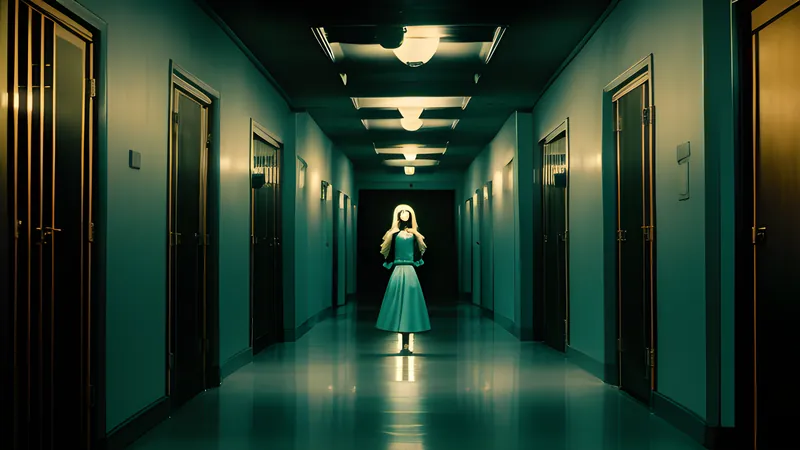
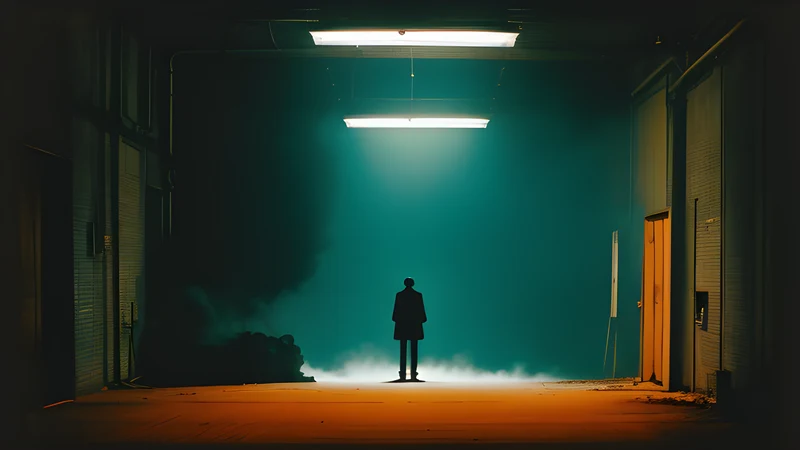
Marebito: Shimizu's Underground Vampire Descent
The DV film Takashi Shimizu shot in a week between Ju-on productions is his strangest work
Contents
By 2004 Takashi Shimizu had made Ju-on four times. Two direct-to-video films, two theatrical features, and then Sam Raimi’s people came calling and he made it a fifth time in Tokyo with Sarah Michelle Gellar. That is a lot of the same haunted house. Somewhere in the gap between the Japanese productions and the American one, Shimizu took a digital camera, a script by Chiaki Konaka, and roughly a week, and made something that has almost nothing in common with any of it.
Marebito is a hollow-earth pulp story about a man with a camera who goes looking for fear. It is also the only film I can think of where the lead is played by another horror director, and where that casting is the whole argument.
A cameraman, a suicide, and a hole under Tokyo
Masuoka is a freelance cameraman. He shoots footage for a living and he watches it obsessively at home, which is the film’s opening position: a man whose relationship with the world is entirely mediated. He is present at a suicide in a subway station, and he films it. What stays with him is not the death. It is the expression on the man’s face — an expression of terror so complete that Masuoka becomes convinced this person saw something worth seeing.
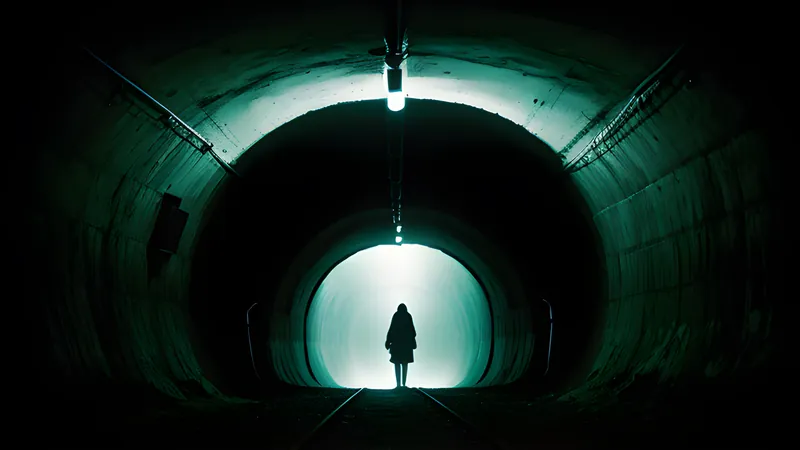
So he goes looking. He takes his camera into the tunnels under Tokyo and starts descending, and the film follows him down through maintenance passages, disused infrastructure, and eventually into geography that stops making sense. He finds a young woman down there, naked, feral, mute. He brings her home in a bag. He names her F. And then he has to work out what she eats.
Shinya Tsukamoto plays Masuoka, and the casting does an enormous amount of unspoken work. Tsukamoto directed Tetsuo: The Iron Man in 1989 — a film made by a man with a camera, obsessively, at close quarters, about the body turning into machinery. Putting him in front of Shimizu’s lens as a cameraman who cannot stop filming is a piece of casting criticism. Tsukamoto is the Japanese cinema’s most famous one-man-band, and here he plays what that costs.
Why it works: DV as the correct format
Marebito looks cheap. It was shot on digital video in about a week, and the film has no interest in disguising either fact. That is the point, and it is the reason the film works when it should not.
The image is grainy, video-noisy, poorly lit, and constantly wrong. When Masuoka films, we see his footage. When Masuoka is filmed, we see roughly the same quality of image. The film flattens the distinction between the camera he holds and the camera watching him, so that after twenty minutes you have stopped being able to tell which layer you are in. That is not achievable on film stock. The whole conceit depends on the medium looking degraded and provisional, and 2004 DV looked exactly that way for free.
Shimizu shoots the descent with a discipline that surprised me on rewatch. There is no map. The tunnels are lit only by what Masuoka carries, and the film never gives you a wide shot to establish how deep he has gone, so the descent has no measurable length. It could be a hundred metres. It could be a mile. The sequence goes on long enough to become genuinely disorienting, and because the light source is diegetic, every frame contains its own explanation for why you cannot see. The film’s underground is the best thing in it, and it is made entirely of a torch and a refusal to cut away.
The apartment sequences do the opposite job. Once F is in the flat, the film becomes static, domestic, almost dull — a man and a mute girl in a small Tokyo room, and a feeding problem. The tonal drop is deliberate. Shimizu spends the underground on dread and the apartment on tedium, so the horror can arrive through routine.
The timing explains a lot. 2004 sits at the peak of the J-horror boom and at the moment consumer digital video became good enough to shoot a releasable feature for the price of a used car. Both things are visible in every frame. Japanese horror had become an export product with a house style — long hair, blue grade, a curse that spreads — and the same technology that let studios churn out that style cheaply also let a director with a week off make something nobody had commissioned. Marebito uses the boom’s tools against the boom’s grammar. It has no curse, no vengeful woman, no tape, and no rules. Shimizu had spent four films establishing that a haunting obeys a logic you could diagram; here he made a film where nothing can be diagrammed at all, using the equipment the success of those films had put in his hands.
Chiaki Konaka’s fingerprints
The script is by Chiaki Konaka, and if you know his work the film reorganises itself instantly. Konaka wrote Serial Experiments Lain, the 1998 anime about a girl dissolving into a network, and his abiding subject is the boundary between the recorded and the real, and what happens when it fails. He is also a working Lovecraftian who has spent a career importing weird-fiction architecture into Japanese genre television.
Marebito is dense with that material. The film reaches directly for Richard Shaver’s “Shaver Mystery” — the 1940s pulp claim, published in Amazing Stories as fact, that a degenerate race called the Deros live in caverns beneath the earth and beam malice at the surface. Konaka drops the Deros into the script by name. He also reaches for hollow-earth theory generally, and for the title: a marebito is, in Japanese folklore as Kunio Yanagita catalogued it, a visitor from elsewhere who brings blessing and must be received with care. Naming the girl in the bag after that concept is a joke with a knife in it.
The collector’s cross-reference
The ancestor everyone reaches for is Lovecraft, and the ancestor that actually fits is Nigel Kneale. Quatermass and the Pit is the master text for “dig under a modern city, find the thing that has been shaping us all along”, and Marebito is that story with the scientists removed and a single obsessive left holding the torch.
The other ancestor is Peeping Tom, Michael Powell’s 1960 film about a cameraman who films what terror looks like. Masuoka is Mark Lewis with a MiniDV camera and a subway system. Powell’s film ended his career; Shimizu made his in a week between franchise instalments.
Within Shimizu’s own work, the contrast with Ju-on: The Grudge is the reason to watch this. Ju-on is architectural, formal, built out of a house and a cursed floor plan. Marebito is a first-person spiral with no structure at all. The year after, he went back to producer Takashige Ichise’s J-Horror Theater line and made Reincarnation, which is a far more conventional film. Marebito is the one he made when nobody was supervising. It sits, awkwardly and permanently, in the corner of our Japanese horror essential ten conversation.
The case against
It is a mess, and admirers who deny that are not helping the film.
The last act abandons narrative coherence in a way that reads, at least partly, as a shooting schedule running out. Threads about Masuoka’s family and about a woman who claims F is her daughter are introduced with real weight and then dropped down the same hole as everything else. The film’s ambiguity is genuine in places and simply unfinished in others, and telling the two apart is impossible.
The Konaka material is also load-bearing in a way that penalises the uninitiated. If you do not know the Shaver Mystery, the Deros arrive as noise. The film assumes a reader of 1940s American pulp magazines, which in 2004 was an audience of approximately nobody.
And F is a problem. A mute, naked young woman kept in a flat and fed is an image the film handles with more interest than care, and the queasiness is not always doing critical work.
The verdict
Marebito is a minor film with two or three major ideas in it, made fast enough that the ideas survived the process. Watch it for the descent, for Tsukamoto’s face, and for the sight of a franchise director sprinting away from his franchise for eighty-odd minutes. It floats around the cult streaming services and turns up on the specialist labels; any transfer is fine, because the film is supposed to look bad.
Pair it with Peeping Tom and be unwell for an evening.
Spoilers below
The film’s central move is that the camera never stops lying, and Shimizu never resolves it.
F drinks blood. Masuoka discovers this by trial, and the trial escalates: his own blood first, then animal, then — once the arithmetic gets away from him — other people’s. The murder sequences are shot with the same flat DV indifference as the rest, which is the point. He is procuring groceries. The film’s horror is entirely logistical, and it never once treats the killings as dramatic.
Then the ground gives way. A woman appears claiming F is her missing daughter. Masuoka’s own footage begins to show things he does not remember filming. The film starts implying that Masuoka has a wife and a child, that F may be his own daughter, and that the man in the subway station may have been him. Every one of these is offered and none is confirmed. Shimizu leaves the film’s foundation deliberately unpoured.
The ending returns him underground. He descends again, and the last images place him back in the dark he went looking for, in a position that suggests the entire journey was a return rather than a discovery. Whether the caverns and the Deros and F are real, or whether a man broke while watching his own footage and built a mythology out of the wreckage, the film declines to say.
That refusal is either the boldest thing in it or the sound of a week running out. I have watched it four times and I still could not tell you which, and the fact that I keep going back is probably the answer.
Related Content