Madman: The Camp-Counsellor Legend
The film that lost Cropsey to The Burning and invented a bogeyman in a fortnight
Contents
Madman (1981) opens with the single best scene in the camp-slasher cycle, and then spends eighty minutes failing to be it.
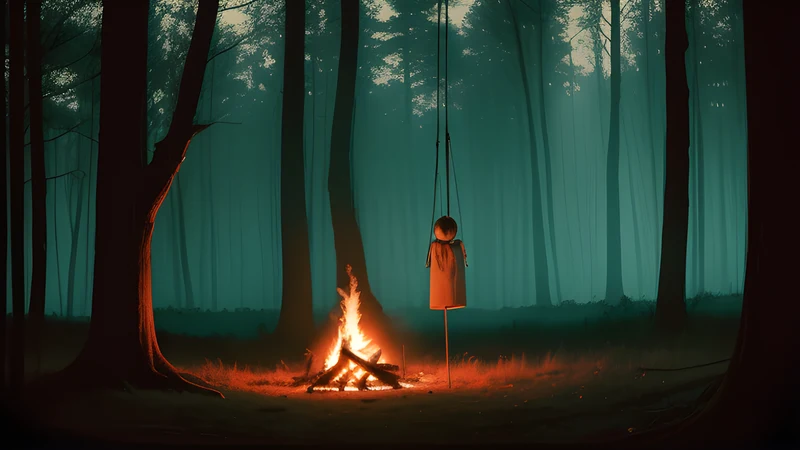
A campfire. Counsellors and kids. The head counsellor tells the legend: there was a farmer, Madman Marz, who killed his family with an axe; the townspeople hanged him from a tree; the body was gone in the morning. He lives out there now. Say his name above a whisper and he comes.
A boy says it. Loudly.
That is a perfect horror scene. It has the correct folkloric shape — a prohibition, a transgression, a consequence — and it does something that almost no slasher bothers with: it makes the legend a rule, and it makes a character break the rule on purpose, in front of witnesses, out of nothing more than adolescent bravado. Everything that follows is the bill arriving.
The Cropsey problem
The production history explains more about this film than any amount of criticism.
Madman was developed as a film about Cropsey — the real, genuinely told, north-eastern American summer-camp legend of a maimed caretaker in the woods. That was the whole point. Then The Burning went into production with the same source, and Joe Giannone’s team discovered that the folk tale they had built a picture around was being filmed by somebody else, at the same time, with Tom Savini doing the effects.
So they changed it. Cropsey the burned caretaker became Madman Marz, a hanged farmer, and the film shot with a bogeyman invented under duress in a hurry.
Two 1981 films, one campfire story, and the loser had to make up a folk legend from scratch. That is the most instructive fact about the slasher boom I know — the machine was consuming American folklore faster than America had produced it, and by 1981 there was a queue.
The odd part is that the invention worked. Marz has no burns, no mask, no gimmick, no tool with a story. He is a large hairy man in the trees. And yet the film’s ballad — an actual folk song, sung over the picture, narrating the legend — does a job that most slashers never attempt: it gives the killer a tradition. Marz feels old. He feels like something that was being sung about before the film started, which is precisely the illusion Cropsey would have supplied for free.
Why it works: the legend as a structural device
The thing Madman understands, and most of its contemporaries do not, is that a bogeyman needs a rule.
Michael Myers has no rule. He walks; he kills; nothing summons or dispels him. That works because Carpenter’s film is about the arbitrariness. Jason has no rule either, beyond geography.
Marz has a rule. Say the name above a whisper and he comes. That single mechanic converts the audience into a participant, because from the campfire scene onwards every viewer is watching a group of people who have been told exactly how to stay safe and are failing to do it. It also gives the film a moral engine that the cycle usually fakes. These characters did something — a specific, deliberate act of disrespect towards a story — which is a far more interesting transgression than the sex-and-drink ledger the slasher normally audits.
The other real virtue is the woods themselves. Giannone shoots a great deal of this film in genuine dark, and the darkness is not the stylised blue murk of a studio night shoot. It is New York state in the cold, lit sparsely, with faces disappearing at the edge of the frame. There is a texture here that money would have removed.
Gaylen Ross is in the cast, credited as Alexis Dubin, three years after Dawn of the Dead — see the mall as the real monster for the film that should have made her a genre fixture. Paul Ehlers plays Marz, and plays him with a slowness that reads as patient rather than lumbering, which is more than the makeup deserves.
The ballad, and why a song beats a mask
The folk song deserves its own section, because it is the most unusual formal choice in any slasher of the period and the one that most nearly rescues the film.
Marz has a ballad. It plays over the picture — a sung narration of the legend, verse by verse, in a plain acoustic folk register with none of the synthesiser dread the cycle had standardised by 1981. It tells you who he was, what he did, what the townspeople did to him. It is, structurally, a murder ballad, which is a form several centuries older than cinema and which exists for exactly this purpose: to keep a killing alive by making it singable.
Set that against how every other film in the cycle establishes its monster. Halloween uses a mask and a psychiatrist. Friday the 13th uses a location and a mother. Both are cinematic solutions — image and exposition. Madman uses the oldest available technology for transmitting a crime across generations, and the effect is that Marz feels inherited in a way that a character invented under production pressure two weeks before shooting has no right to feel.
It is also why the film’s failure is so frustrating. The ballad tells us Marz was a farmer, that he had a family, that a town hanged him and lost the body. That is a complete folk narrative with a grievance at the centre. The film never once connects Marz’s motive to anything the counsellors have done beyond the shouted name. He is a wronged man killing strangers, and the song keeps insisting there was a wrong.
A better picture would have made the town the subject. This one plays the ballad, gestures at three hundred years of murder-ballad tradition, and then goes back to the hot tub.
The collector’s cross-reference
The ancestor is not a film. It is the campfire, and Madman knows it — the opening scene is a transmission of folklore being filmed, which puts the picture in a small and interesting category alongside the handful of horror films that are about the act of telling.
Generically, the parents are Halloween for the shape and Friday the 13th for the setting, and Madman is honest about the debt in a way that its defenders sometimes are not. The camp, the counsellors, the isolation, the pattern of dispatch: all inherited, none improved.
The sibling worth watching alongside it is Sleepaway Camp, two years later, which took the same setting and found the one thing in it nobody had touched. Between them they mark the boundaries of what the camp slasher could be — Madman going backwards into folklore, Sleepaway Camp going sideways into something the cycle had no vocabulary for. For the full survey, the twelve films that invented the slasher.
The case against
Everything after the campfire.
The film establishes a rule and then does nothing with it. Marz arrives; the rule is never invoked again, never tested, never used as a source of tension. Nobody tries to whisper. Nobody works out that they might be able to manage him. The mechanic that makes the opening scene great is treated as an origin story rather than a system, and the film reverts immediately to standard stalk-and-kill with the legend forgotten.
The characters are the weakest in any camp slasher I can name, and that is a competitive field. The film’s most notorious sequence involves a hot tub and a romantic interlude of such interminable length that it has become the thing people remember about the picture — a slasher stopping dead for several minutes of sincere, badly-scored romance while a killer waits somewhere off-camera, presumably checking his watch.
The kills are flat. Giannone had no Savini and it is visible in every one; the murders are staged to conceal rather than to display, and after The Prowler and The Burning in the same year the comparison is merciless.
And Marz’s makeup is poor. He is glimpsed, mercifully, but the glimpses do not flatter.
Watch it anyway, and watch it for the first ten minutes and the last fifteen. A film that contains one perfect scene and one genuinely eerie ending has given you more than most competent films manage.
Where to find it
It has had a boutique restoration and turns up on the horror streaming services. The dark scenes need the good transfer — on tape, most of this film was a black rectangle with occasional screaming.
Spoilers below
The ending is where the film finally remembers what it is.
Betsy — Gaylen Ross — goes to the farmhouse, which is the correct instinct and the fatal one, and the last movement takes place inside Marz’s actual home. It is the only sustained sequence where Giannone’s interest in the legend resurfaces: the house is a ruin with a history in it, and the film lets you read the story off the walls rather than delivering it as dialogue.
The confrontation ends with Marz burning, and the film pointedly declines to confirm the kill. That is standard cycle grammar by 1981 and would be unremarkable, except for what follows.
The coda returns to the campfire. Another group. Another telling. And the film reveals that everything we have watched is now itself part of the legend — the massacre has been folded into the story that gets told round the fire, which is exactly what happens to real folklore, and which the film arrives at without appearing to notice how good the idea is.
That closes a loop the film opened and forgot for an hour. Marz cannot be killed because Marz is a story, and the events of the film have made the story stronger. Every counsellor who died is now a verse. The kid who shouted the name in the first scene did not summon a man; he added to a body of material, and the film’s final position is that the tradition is the monster and the tradition is fed by exactly the kind of night we have just watched.
The Burning got Cropsey and the effects budget and Savini. Madman got the better idea about what a bogeyman is, and stumbled into it in the last two minutes of a film it had already lost.
Related Content