Lucio Fulci: The Poet of Gore
The Italian journeyman who turned splatter into dream logic
Contents
The nickname arrived as an insult and became a verdict. “The Godfather of Gore,” the fanzines called Lucio Fulci, and for years that was the whole reputation — a man who filmed eyeballs being punctured and maggots raining from ceilings, a schlockmeister trading in the wet and the vile. Look closer and a stranger artist appears: a former medical student and film critic, prickly and depressive, who at his best made horror films that abandon plot the way dreams do and run instead on pure associative dread. The gore is real and it is extreme. It is also, in the four or five films that matter, the surface of something closer to poetry.
Fulci was born in Rome in 1927 and trained in medicine before turning to journalism and then film. He spent two decades as a working professional, grinding out comedies, musicals, crime pictures and spaghetti westerns, a director-for-hire with no signature and no auteur cachet. This long apprenticeship matters, because when Fulci finally found horror he brought a craftsman’s efficiency and a total absence of pretension, and that combination is exactly why the snobs underrated him and the films endure.
The giallo years
Before the zombies came the thrillers, and they are the strongest evidence that Fulci was more than a butcher. One on Top of the Other (1969) is a Hitchcock-inflected San Francisco mystery. A Lizard in a Woman’s Skin (1971) is a hallucinatory giallo full of drug-dream imagery and one notorious set piece involving vivisected dogs so convincing the effects artist had to produce the props in court to prove no animals were harmed. And Don’t Torture a Duckling (1972) is the one to press on anyone who thinks Fulci had nothing to say — a giallo set in a poor southern village where children are being murdered, and a savage indictment of Catholic hypocrisy, superstition and mob violence. Its most famous sequence, a woman beaten to death with chains in a cemetery while a pop song plays, is horror as social fury.
These films sit in the giallo tradition that Mario Bava founded and Dario Argento perfected, and Fulci’s contribution to it is the meanness — a willingness to point the knife at the Church and the village rather than the usual black-gloved outsider. Where Argento pursued beauty and colour, Fulci pursued discomfort, and Don’t Torture a Duckling remains one of the angriest films the genre produced.
The range across those decades is worth remembering, because it complicates the schlockmeister story. Fulci directed slapstick vehicles for the comic duo Franco and Ciccio, a well-regarded literary western in Four of the Apocalypse (1975), and a brutal Jack London adaptation, White Fang, that was a commercial hit. He could shoot anything the Italian industry demanded, and did, which is why his sudden authorial force in the horror films reads less like a discovery of talent than the moment a seasoned professional finally cared about the material. The apprenticeship taught him speed and coverage; horror gave him something to be angry and frightened about.
The Gates of Hell
Then came 1979 and the film that changed his career and Italian horror’s fortunes. Zombi 2 — released to ride the wake of Romero’s Dawn of the Dead, which had played Italy as Zombi — was a surprise international hit, and it contains the two images that made Fulci famous: a zombie fighting a shark underwater, and an eye slowly, unbearably impaled on a splinter of wood. The shark scene is genuinely astonishing practical filmmaking. The eye trauma became his motif, returning film after film with the persistence of a compulsion.
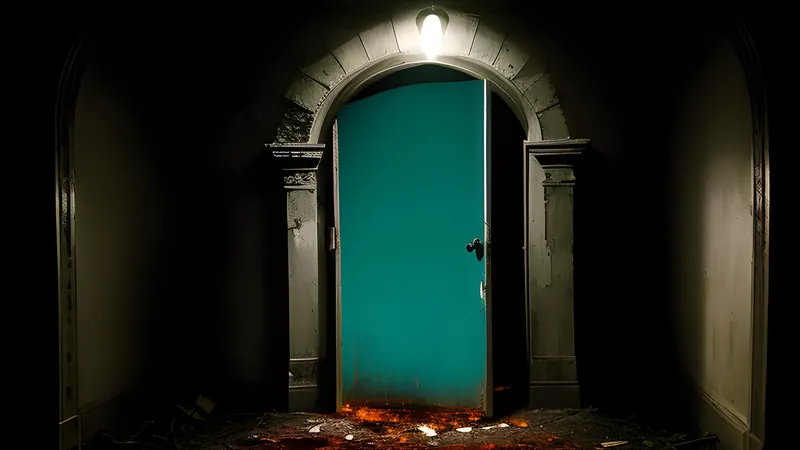
Zombi 2 opened the floodgates for a run of supernatural horror that is Fulci’s true legacy. City of the Living Dead (1980), The House by the Cemetery (1981) and the centrepiece, The Beyond (1981), form the loose “Gates of Hell” cycle. The Beyond is the purest distillation of the Fulci method — a Louisiana hotel built over a doorway to the dead, a story that makes almost no narrative sense and does not try to, a film that proceeds by dread-image after dread-image until it arrives at an ending of pure existential horror. It is also worth watching for how much it wrings from almost no money. The Italian genre film of this era ran on tiny budgets and borrowed time, and Fulci’s crews conjured their apocalypses from fog machines, offal, and a few good locations. The poverty is part of the texture — a hand-made, tactile ruin that no polished production could counterfeit. Watching it is closer to a nightmare than to following a plot, and that is the achievement, deliberately engineered.
The eye deserves its own paragraph, because no other director has been so faithful to a single wound. Across Zombi 2, City of the Living Dead, The Beyond and beyond, Fulci returns compulsively to the violation of the eye — splinters, thumbs, shards of glass, the slow approach of something toward the one organ we most instinctively protect. Critics have read it as a comment on the act of watching horror itself, the audience’s gaze punished on screen, and the medical student in Fulci surely knew exactly how to make the anatomy convincing. Whatever the meaning, the repetition turns it from a shock effect into a genuine motif, the visual signature of an artist working through the same fear again and again.
Nightmare logic as method
Here is the argument for taking Fulci seriously as a stylist. Conventional horror builds suspense through cause and effect: the monster has rules, the threat can be understood, survival is a matter of solving the puzzle. Fulci at his peak throws the puzzle away. In The Beyond and City of the Living Dead, characters die for reasons the film never explains, geography folds in on itself, and the dead appear because the dead appear. This frustrates the viewer looking for a coherent story and rewards the viewer willing to surrender to atmosphere. The films run on the logic of a bad dream, where the terror comes precisely from the absence of rules.
The craft that makes this work is threefold. Fulci’s collaboration with cinematographer Sergio Salvati produced a heavy, fog-wrapped, amber-and-shadow look that feels rotten and humid. The scores by Fabio Frizzi — droning, funereal, synth-and-choir dirges — are as responsible for the dread as any image, and Frizzi’s Beyond theme is one of the great horror soundtracks. And the gore itself, engineered by artist Giannetto De Rossi, is filmed slowly and in close-up, held far past the point of comfort, so that violence becomes contemplative rather than shocking. A Fulci killing does not startle you. It sinks in.
The decline
The honest career read has to include the fall. After the early-1980s peak, ill health and the collapse of the Italian genre-film industry ground Fulci down. The New York Ripper (1982) is a genuinely nasty giallo whose misogyny many find indefensible, though it has its defenders as a study in urban rot. Manhattan Baby (1982) is muddled. The later films — cheap, rushed, sometimes barely finished — are mostly for completists, and Fulci spent his final decade in poor health and financial trouble, working on projects that fell apart. He died in Rome in 1996, days before a planned collaboration with Argento that never happened, his reputation only beginning its long rehabilitation.
That rehabilitation is deserved and it should be honest about the range. Fulci made perhaps a dozen films worth your time out of more than fifty, and four or five of those are the work of a real artist. The rest is the output of a jobbing professional in a collapsing industry, and pretending otherwise does him no favours.
Ancestors and heirs
Fulci descends from the Italian gothic tradition of Bava and the giallo of Argento, and he pushed both toward the visceral extreme. His influence runs straight through the modern splatter film and the whole aesthetic of dream-logic horror. Michele Soavi’s Cemetery Man inherits the Italian zombie as a vehicle for something stranger than survival, and the entire tradition of the meaningful undead traces back through Fulci to Romero’s social allegory — though Fulci stripped the politics out and left the pure dread behind. Quentin Tarantino, Nicolas Winding Refn and a generation of extreme horror directors have cited him. The eye-trauma motif alone has more descendants than most directors’ entire filmographies.
Where to start
Begin with The Beyond — it is the fullest expression of the nightmare method, and it teaches you how to watch him, which is to stop asking “why” and start feeling. If the surrender works on you, go back to Don’t Torture a Duckling for the anger and the craft of his giallo period, and you will see a director capable of meaning as well as menace. Skip the late films until you love him. Fulci earned the “poet of gore” title the hard way — by proving, in a handful of fevered, illogical, beautiful horror films, that splatter could be a language and that a nightmare could be composed.
Related Content