Long Weekend: Nature's Revenge on the Beach
Colin Eggleston made a monster movie in which the monster is everything, so he never has to show you anything
Contents
The image that carries Colin Eggleston’s Long Weekend is a dead animal on a beach, and the thing it does is move.
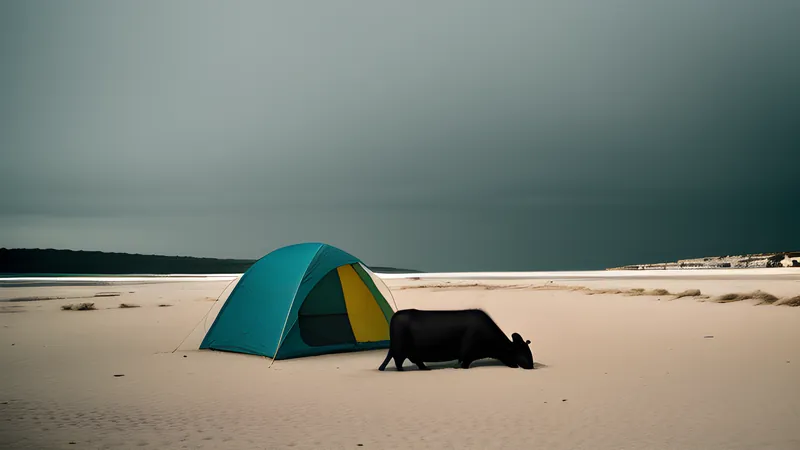
A dugong — a sea cow, harmless, slow, a creature whose entire evolutionary strategy is to eat seagrass and bother nobody — washes up dead near a couple’s campsite after the husband shoots it, having decided at a distance that it was a shark. Over the following days it gets closer. Not dramatically. Nobody films it lurching. It is simply further up the sand each time the film looks at it, until it is near enough to be a presence at the camp, and by then you have stopped asking how, because the film has trained you out of that question.
That is the whole method of Long Weekend, and it is why a low-budget Australian picture from 1978 with two people and a beach in it remains more frightening than most things made with a creature department.
The marriage is the machine
Peter (John Hargreaves) and Marcia (Briony Behets) drive out to a remote stretch of coast for a long weekend, ostensibly to repair a marriage that has been comprehensively broken. There has been an affair. There has been a termination that Peter did not want and will not stop referencing. They are cruel to each other in the fluent, economical way of people who have had the argument several hundred times and know exactly which syllable does the damage.
And on the way, and once they arrive, they wreck things. Peter runs down a kangaroo in the dark and drives on. He flicks a lit cigarette out of the window. He fells a tree for no purpose whatsoever, having brought an axe. He fires a rifle at sounds. He sprays insecticide. Marcia finds an eagle’s egg and smashes it, casually, in the middle of a sulk. They leave rubbish where they drop it.
Here is what elevates the film above its shelf. The vandalism is never staged as villainy. It is staged as marital behaviour — the axe comes out because Peter needs to hit something, the egg gets smashed because Marcia needs to break something, and neither of them registers what they have done because they are both entirely occupied with each other. De Roche’s screenplay makes the environmental cruelty and the domestic cruelty the same gesture, performed by the same people, in the same mood. They are not a couple who happen to litter. Littering is what their marriage produces when it is pointed at a landscape instead of at itself.
That is the film’s real argument, and it is why it survives the decade’s eco-horror cycle intact. Frogs and Day of the Animals had to be about pollution, because they needed an inciting cause. Eggleston needs no cause. The bush is not retaliating for an environmental crime. It is retaliating for these two specific people.
A monster movie with no monster
The craft here is almost entirely in the mix, and it repays a rewatch with headphones.
Eggleston has no creature. He has bush noise: insects, surf, wind in scrub, birds, the sounds any Australian campsite makes continuously and which nobody hearing them in life would find sinister. What the film does is promote that ambience to the status of a score. It comes up in the mix at moments of tension and stays up through moments of nothing, so the audience loses the ability to read it. In a conventional horror film the sound design tells you when to be afraid. Here the sound is constant, which means it tells you nothing, which means you have to be afraid the whole time.
Layered on top is the film’s use of unattributed point of view. The camera repeatedly takes up a position in the scrub and watches the campsite, holding for a beat too long, in the visual grammar that has meant something is out there since at least the 1950s. And then it never cuts to a thing. There is no reverse. The film cashes that cheque exactly zero times across ninety minutes, and rather than feeling like a cheat it accumulates, because a threat that never resolves cannot be discounted. Point at nothing often enough, in the right register, and the audience builds the monster themselves out of surf and cicadas.
The dugong deserves its own paragraph, because choosing it is the single smartest decision in the film. Eggleston and De Roche needed an object to carry the accumulated menace, and every instinct in the genre says to reach for something with teeth. They picked a sirenian: a placid marine herbivore with no defensive capability, a creature so inoffensive that sailors historically mistook them for mermaids. Then they killed it before it appears. The result is a threat that cannot be fought, because it is already dead; cannot be justified, because it never did anything; and cannot be dismissed, because it keeps arriving. Peter’s error was to shoot at a shape he had decided was dangerous, and the film’s punishment is to make him live beside the proof that he was wrong, at a distance that shortens every day. A shark on that beach would have been an adventure. A dead sea cow is an accusation, and you cannot have a fight with an accusation.
Steven Spielberg arrived at a version of this through pure necessity three years earlier — the shark did not work, so he shot around it, and the result was a masterclass in the monster you barely see. Eggleston’s variation is more radical, because Spielberg still had a shark to eventually deliver and Eggleston has committed to never delivering. The dugong is the closest the film comes to a monster, and the dugong is dead, and the horror it produces is entirely a matter of its position on the sand from one scene to the next.
The real ancestor is The Birds, minus the birds
Everybody shelves this with the seventies revenge-of-nature cycle, and by production history that is where it sits. The lineage is Hitchcock.
The Birds (1963) is the founding text of motiveless-nature horror, and its most famous quality is the one Hitchcock had to fight for: no explanation. Nothing caused it. There is no scientist scene that holds up. Hitchcock’s picture is about a woman arriving somewhere she is unwelcome and a landscape declining to accommodate her, and the birds are the medium rather than the message.
Eggleston does the same thing and takes one further step, which is the step that makes Long Weekend the more frightening film. Hitchcock still had to show the birds. He needed the schoolhouse, the phone box, the attic, and the moment you show a bird pecking a woman, you have named the antagonist and given the audience something to look at, which is a mercy. Eggleston shows a possum, an eagle, some ants, a dead sea cow, and the ordinary bush — every one of which is unremarkable in isolation. He never assembles them into a thing. His nature has no schoolhouse scene.
The Australian company here is Wake in Fright, which had already established that the landscape is a moral condition rather than a setting, and Picnic at Hanging Rock, which had established that Australian cinema could refuse a resolution and be taken seriously for it. Long Weekend takes both lessons and spends them on a caravan and a bad marriage, which is a far more vulgar and far more useful application.
De Roche
A word for the writer, because he is the reason so much of this era is worth your time. Everett De Roche wrote Long Weekend. He also wrote Patrick the same year, and went on to Road Games, Razorback and Link. He is the connective tissue of the entire Ozploitation run, and his signature is visible in all of it: a genre premise stated in one sentence, executed without apology, and quietly loaded with a domestic grievance underneath. Directors get the credit for that period. De Roche wrote it.
The case against
The film is slow, and some of the slowness is undisciplined rather than designed. There are passages in the middle where Peter and Marcia’s bickering is repetitive without deepening, and Eggleston lets scenes run past the point where they have delivered their information. Hargreaves and Behets are both excellent — Hargreaves in particular plays a specific kind of Australian masculinity, aggrieved and armed, that the film would collapse without — and they are asked to carry stretches with nothing to play.
The bigger structural complaint is that the film’s method has a ceiling. A horror picture that never shows you its threat also never escalates in the way an audience is trained to expect, so Long Weekend has to end by simply concluding, and the deaths when they arrive feel administrative. That is arguably correct — nature does not do climaxes — and it does mean the film’s final movement generates less than its middle.
Jamie Blanks remade it in 2008 with Jim Caviezel, faithfully, and the remake is instructive: it does everything the same and lands softer, because a modern mix cannot resist telling you when to be scared. Watch the original, at night, loud.
Spoilers below
The escalation is administrative on purpose. There is no siege and no last stand. What happens is that the bush stops cooperating in ways that would each be plausible alone: the car will not start, the road is no longer findable, the compass and the map become useless, and the couple’s competence — never much — evaporates. An eagle, whose egg Marcia broke, attacks Peter’s head repeatedly, and the film keeps that attack legible as a bird defending a nest, which is the only motive it ever concedes.
Marcia goes into the bush and does not come out. Eggleston shoots her death obliquely and it is genuinely hard to reconstruct afterwards, which people sometimes complain about and which is the point: the film is not going to hand you a cause of death, because a cause of death implies a killer, and there is no killer.
Peter’s end is the joke the whole film has been building. Having survived the bush — having been pecked, harried, starved and driven out of his mind by an antagonist that never once appeared on screen — he finds the road. He staggers onto it, and he is hit by a truck, whose driver never sees him. The only thing in Long Weekend that actually kills a human being is a piece of human machinery, driven by a human, on a human road.
Which is the argument, made in one shot. The bush never needed to do anything to them. It only had to stop helping, and let them do to themselves what they had spent the entire weekend doing to it.
Related Content