Logan's Run: The Domed City and Carrousel
The last big-studio future before Star Wars, built out of a Dallas shopping centre
Contents
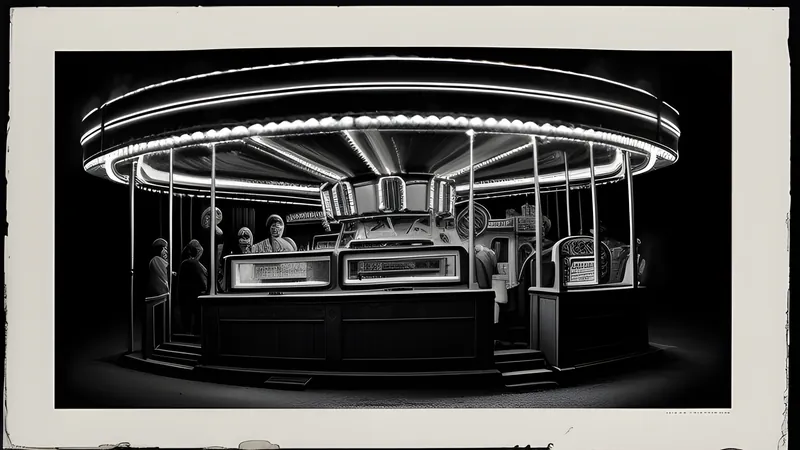
A crowd fills an arena. In the middle, figures in white robes and blank masks rise into the air, spinning, drifting upward towards a red glow, while everyone below chants and cheers and holds their hands out to them. The crowd is ecstatic. The people going up are hopeful. It is a religious ceremony, a public entertainment and a civic function all at once, and the city calls it Carrousel.
Logan’s Run is a ridiculous film. It is also the last time a Hollywood studio built a whole future out of miniatures, matte paintings and optical effects and pointed it at an idea, and it came out in 1976, roughly a year before Star Wars made everything about it look prehistoric. Watched now, it plays as a beautiful piece of terminal architecture: the final building in a style nobody was permitted to work in again.
The city is a shopping centre
The film’s production design is its great joke and its great achievement. Michael Anderson and his team needed a hedonistic domed utopia of white walkways, water features, plazas and glass, and rather than build one they went to Dallas and Fort Worth and filmed the ones that were already there. The city’s interiors are shopping centres and a trade mart. Its public spaces are a municipal water garden. Its transport system is an existing monorail.
This should be a shortcut and it is a thesis. The society of Logan’s Run is a mall: climate-controlled, consequence-free, endlessly diverting, with everything provided and nothing produced. The citizens shop, take drugs, and use a device that summons a stranger to their flat for sex the way you would summon a lift. Nobody works. Nobody makes anything. The retail architecture is not standing in for a utopia — it is an argument that the utopia would be retail architecture, and 1976 supplied the sets ready-made.
The exteriors are miniatures, and they are magnificent: a domed complex under weather, shot with the patience that pre-digital effects demanded. The film won a Special Achievement Academy Award for its visual effects, and the domes have aged into a strange dignity. You can see that they are models. You can also see that a great many people spent a great many months making them beautiful.
The lifeclock
Everyone carries a crystal set into the palm of their hand. It changes colour as you age, and on your thirtieth birthday it blinks red, and then you go to Carrousel. Those who refuse are Runners, and the Sandmen — the city’s police, of whom Michael York’s Logan 5 is one — hunt them down and kill them.
The idea is beautifully economical and it is on the actor’s body at all times. No exposition required, no dossier, no chip in the neck: a light in your hand that everyone can see, including you. The film’s best directorial instinct is to keep cutting to hands. A palm in a crowd. A palm across a table. It turns a science-fiction premise into an involuntary tic, and every character in the film is checking their own hand the way a smoker checks a pocket.
The novel by William F. Nolan and George Clayton Johnson set the limit at twenty-one. The film raised it to thirty, which is a commercial decision — you cannot cast a studio picture with actors under twenty-one — and which quietly wrecks a chunk of the book’s logic while producing a better film. Twenty-one is an abstraction. Thirty is a number the audience can feel arriving, and in 1976, aimed at a youth culture that had spent a decade telling itself not to trust anyone over it, thirty was a joke with teeth.
Carrousel as spectacle
The set piece works because it is staged as a fairground. The crowd’s ecstasy is the point: this is not an execution people submit to, it is an event they enjoy, with a stadium and a chant and family members cheering. Anderson shoots it as sport — reaction shots, the crowd’s faces, the rising bodies as an aerial display — and lets the cheering do the horror.
That is the film’s one genuinely sophisticated move, and it belongs to the same decade as Rollerball, which likewise understood that a society disposing of people will do it in an arena with a public that has bought tickets. The difference is that the Rollerball crowd knows what it is watching. This one thinks it is attending a resurrection.
Jerry Goldsmith’s score is doing serious work throughout, and it splits the film in two: cold electronic textures for the city, orchestral warmth the moment the story leaves it. Goldsmith is scoring an argument about what is natural, and the transition is the loudest editorial the film makes.
The last of its line
Set Logan’s Run among its immediate family and the pattern is clear. The early-70s American studio dystopia was a settled form — a concept, a soundstage, a name actor, and a bleak reveal in the last reel. Soylent Green has the reveal everyone can quote. Westworld has the malfunctioning attraction. Logan’s Run has the domes and the palm crystal, and all three share a conviction that the future’s problem will be a system that has been running smoothly for so long that nobody remembers what it is for.
Its immediate descendant in production terms is The Black Hole, which three years later tried to combine the old model with the new post-Star Wars expectations and came apart doing it. Its thematic ancestor is Fahrenheit 451, the other great film about a comfortable society that has abolished something essential in the name of everyone’s happiness — and Truffaut’s is the deeper film, because his citizens chose it. Logan’s city inherited a system nobody alive designed, which is a softer and more forgiving idea.
The case against
The script is thin and it gets thinner as it goes. The first act is genuinely strong; the second becomes a chase; the third is a series of encounters strung together with rope. The dialogue is functional at best and the philosophy is delivered in single sentences by characters who then stop talking.
Michael York is game and slightly lost, playing an awakening he has not been given the material for. Richard Jordan is much better as Francis, the friend and hunter, and the film wastes him. Jenny Agutter’s Jessica has to be conscience, love interest and exposition in rotation. Farrah Fawcett appears briefly, immediately before her television career detonated, and is given nothing whatsoever.
And it is silly. The costumes are tunics. The city’s population appears to be about two hundred people. The film’s ideas about how a society sustains itself will not survive a moment’s thought, and its answer to every logical problem is to cut to a matte painting. Anyone requiring rigour from their science fiction should stay away.
The verdict
Logan’s Run is carried entirely by production design, one hell of a premise, and a set piece that no amount of clumsiness can spoil. Its reputation as a camp curiosity is earned and incomplete: underneath the tunics is a real idea, delivered with total conviction, about a society that has solved every problem except the one it invented to solve the others. The film cannot argue its way through that idea. It can photograph it, and photographing it turns out to be enough.
A television series followed in 1977, ran a single season, and is chiefly interesting as evidence of how little of this premise survives being stretched: the idea is a sprint, and the moment you have to generate a new predicament every week the lifeclock stops meaning anything.
Watch it as the last big dumb beautiful pre-Star Wars future, made by people who had no idea the ground was about to move. And watch the hands.
Spoilers below
Logan’s assignment is the inciting device and it is a good one: the city’s computer, investigating a shortfall of Runners who have escaped rather than died, orders him to infiltrate them — and to make the cover convincing, it takes four years off his lifeclock without asking. The hunter is made prey by his own employer as a matter of administrative convenience. The film’s best joke follows: Logan learns from the computer, flatly and in passing, that Sanctuary is real enough to be a security problem, and that renewal at Carrousel has never once occurred. Nobody has ever come back. The city’s central promise is a crowd-control measure, and the machine says so in the tone of a clerk.
The escape with Jessica gives the film its most beloved detour: Box, a robot in an ice cavern voiced by Roscoe Lee Browne, who has been freezing Runners as food for a city that no longer collects it and has kept on working anyway. Box is the film in miniature — a system still executing its instructions long after the purpose evaporated.
Outside, they find the ruins of Washington, overgrown, silent, warm. And in the Senate chamber, surrounded by cats and half-remembered poetry, an old man played by Peter Ustinov: the first person either of them has ever seen with lines on his face. Ustinov plays him as gentle, rambling and entirely unremarkable, and that is the masterstroke. The great forbidden thing the whole society is built to prevent turns out to be a pleasant old bloke who talks too much about his parents. Agutter and York touching his face is the only moment the film’s emotion fully lands.
The ending is a demolition, and its logic is pure 1976: Logan returns, is interrogated by the computer, and reports the truth — there is no Sanctuary. The machine cannot process an answer it has no category for and destroys itself and the domes with it. The final image is the citizens streaming out into daylight, touching an old man, standing in weather for the first time. It is glorious, and it does not survive five minutes of thought about how any of them will eat. The film does not care, and by then neither do you.
Related Content