Lifeforce: Tobe Hooper's Space-Vampire Excess
Cannon Films handed the director of The Texas Chain Saw Massacre twenty-five million dollars and a Henry Mancini score, and this is what came back
Contents
There is a particular kind of film that only exists because someone with money briefly lost their grip on the wheel, and Lifeforce is the imperial example. Menahem Golan and Yoram Globus, running Cannon Films at the absolute peak of their appetite, gave Tobe Hooper a reported twenty-five million dollars — enormous for them, enormous for the genre, roughly forty times what he had spent on The Texas Chain Saw Massacre — and told him to make a science-fiction blockbuster. What Hooper delivered destroys itself in the third reel, and it is one of the most interesting things anybody made in 1985.
The premise, kept above the line
A joint European-American mission, the Churchill, flies into the coma of Halley’s Comet and finds something parked in it: an ark, miles long, crystalline, ancient. Inside are the desiccated husks of enormous bat-like creatures and three naked humanoids in glass caskets, perfectly preserved. The crew do the only thing crews in these films ever do. They bring them home.
Back in London, the woman in the casket — Mathilda May, in a performance conducted almost entirely without clothes, which is the fact the film has never escaped — wakes up, walks out of a research facility, and begins to drain people. Not blood. Energy, life, the lifeforce of the title, leaving behind a shrivelled husk that must feed within two hours or crumble. Colonel Tom Carlsen (Steve Railsback), the Churchill’s survivor, turns up in Texas with no memory and a psychic tether to her. Colonel Caine of the SAS (Peter Firth) is assigned to catch her. Dr Hans Fallada (Frank Finlay) works out what she actually is.
That is the top of a film that ends with London on fire.
The script nobody expected
The credits are the first surprise. Lifeforce adapts Colin Wilson’s 1976 novel The Space Vampires, and the screenplay is by Dan O’Bannon and Don Jakoby — O’Bannon being the man who wrote Alien and, before that, co-wrote and starred in Carpenter’s student-film space comedy. Wilson loathed the result. He was right that the film discards most of his book’s philosophical apparatus, and wrong that this made it worthless, because what O’Bannon and Jakoby replaced it with is a piece of pure Nigel Kneale engineering.
The second surprise is Henry Mancini. The composer of Moon River and the Pink Panther theme wrote the score for a film about a naked space vampire draining Londoners into dust, and he wrote it entirely straight: a huge, brassy, romantic main theme with an ascending fanfare that sounds like it belongs over a David Lean title card.
This is the craft argument, and it is the single most important decision in the picture. Mancini refuses to score the film’s camp. He scores its scale. Every time the images tip toward absurdity — and they tip constantly — the orchestra is playing awe, and the friction between what you are seeing and what you are hearing produces something no ironic score could: a film that believes itself. Hooper’s images and Mancini’s brass are not in on the same joke, and the gap is where Lifeforce generates its genuine, deranged grandeur. Put a knowing synth score under this material and you have a Cannon quickie. Put Mancini under it and you have a folly, which is a much rarer object.
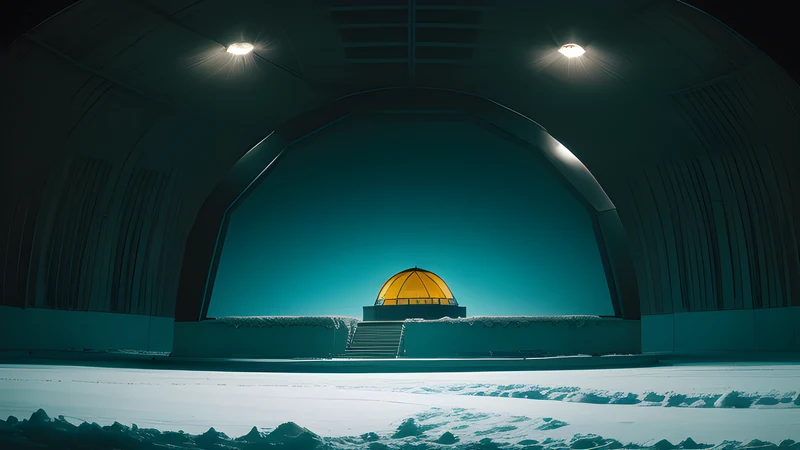
John Dykstra, who built the effects on the first Star Wars, supervised the visual work, and the ark sequences hold up better than anything else in the film. The interior is enormous and wet and vaulted like a cathedral, shot in shafts of light through fog — a genuinely great piece of production design that the picture leaves behind after twenty minutes and never returns to.
What it is really descended from
Here is the collector’s note, and it is not a vampire film.
Lifeforce is a Quatermass picture. Nigel Kneale’s serials — and the Hammer features drawn from them, beginning with the studio’s first science-fiction hit — established the exact machinery this film runs on: a British institutional response to an alien intrusion, told through scientists and soldiers in corridors, with a rational investigation that gradually discovers our folklore was reportage. Quatermass and the Pit is the direct parent. Its Martians explain why humans fear horned figures and psychic disturbance; Lifeforce’s space vampires explain why we have vampire legends at all. Fallada is Bernard Quatermass with the name filed off, right down to being the only man in the film who correctly identifies the threat and is ignored until it is far too late.
Once you see it, the film’s structure stops looking incompetent and starts looking inherited. The mid-section — Carlsen and Caine driving around England interviewing people, tracing a possession from body to body — is pure Kneale procedural, and it is the best-behaved stretch of the film.
It is also where the casting quietly pays off. Two years before The Next Generation made him a household face, Patrick Stewart turns up as Dr Armstrong, the head of a psychiatric hospital in Yorkshire, and gets the film’s single best sequence: a long interrogation in which the thing inside the comet is speaking through him. Stewart plays it with no vocal trickery and no monster business, just a man being worn like a coat and perfectly aware of it, and for four or five minutes Lifeforce is as good as any British horror film of the decade. The picture was shot at Elstree, and this stretch has the sealed, fluorescent, institutional texture that British studios have always done better than anyone — corridors, forms, doctors being reasonable while the world ends outside.
The sideways cousin is Japanese: Goke, Body Snatcher from Hell got to the space-vampire premise in 1968 with a fraction of a per cent of the budget and a bleaker heart. And for Hooper’s own trajectory — the man who made the most frightening film of the seventies and then spent a decade being handed the wrong keys — the desk’s career read on him is the necessary context, with The Funhouse as the last time he was working at a scale that suited him.
The case against, which is substantial
It does not work. Let us be adults about this.
Steve Railsback plays Carlsen at a permanent, eye-bulging ten, which might have been a deliberate choice about a man psychically enslaved and is more likely a performance nobody was directing. Peter Firth is excellent and in a different, better film. The tonal management is nonexistent: the picture swerves from institutional procedural to gothic possession to disaster spectacle without ever establishing a register, and Hooper — whose gift was always for grinding, sustained, unbearable pressure — has no apparent instinct for the plotted momentum a film this size needs.
And the nudity is a problem. The shock wears off inside ten minutes; the monotony never does. Mathilda May is naked in essentially every scene she appears in, and the film’s fixation flattens what is genuinely a clever piece of casting. She has real, unnerving stillness. She moves like something wearing a body it has read about. All of that is available in the performance and the camera is too busy to notice it, which is the exact failure of imagination the film’s own premise is supposedly about.
The theatrical cut runs about 101 minutes; a longer version restores structure and Mancini and makes the film more coherent without making it better. Both are worth having. Neither is good.
Where it stands
It stands as the best bad film of its decade, and I mean that as high praise. Lifeforce is what happens when a genuine artist is handed resources that do not fit his talent and refuses to make the safe thing with them. Hooper could have delivered Cannon a competent creature feature. He delivered an English apocalypse with a Mancini fanfare over it, a cathedral in a comet, and a third act that abandons all sense in favour of scale — and the sincerity of the attempt is why people still watch it and Cannon’s competent films are gone.
Watch it for the ark. Watch it for Mancini, who is doing the most interesting work of anyone involved. Watch it for the moment you realise you are watching a Quatermass serial with a Hollywood budget and no supervision, which is a thing that happened exactly once.
The longer cut is the one to find; any transfer that holds the ark’s blacks and the fog is doing its job.
Spoilers below
Fallada’s discovery is the film’s best idea and it arrives with about forty minutes left. The husks are not corpses. A drained body is a vampire — it must feed within two hours or disintegrate, and whoever it feeds on becomes one too, which turns the whole thing into a geometric contagion rather than a monster hunt. The escalation is the point: London does not fall because a creature is loose, it falls because arithmetic.
The other reveal is the theological one, and it is where the film cashes the Kneale inheritance. The visitors are the origin of every vampire legend humanity has, having harvested this planet before and left the myth behind as residue. The bat-creatures in the ark are the form the story remembered. This is Quatermass and the Pit’s central move performed at Cannon scale, and it is the only moment when the film’s budget and its idea are pointed the same direction.
Carlsen’s psychic tether pays off as possession rather than romance. He is not chasing her; he is being reeled in, and Railsback’s overheated performance retroactively acquires a defence — the man has not been himself since the comet. The film is honest that its hero has no agency, which is a genuinely strange thing for a 1985 blockbuster to be honest about.
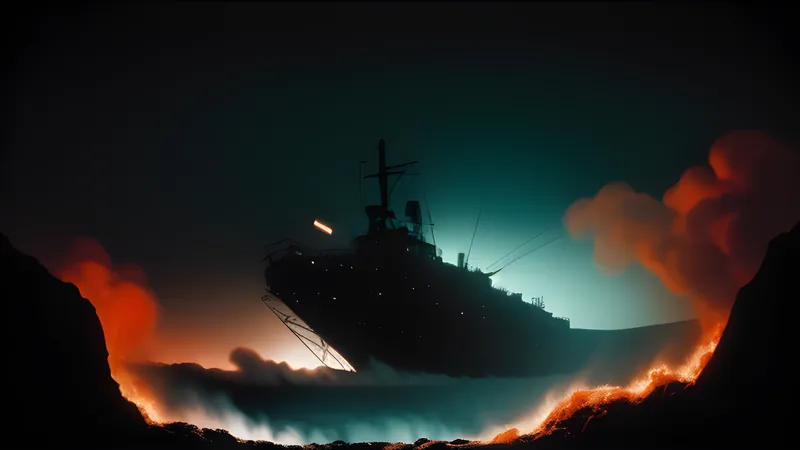
Then the third act simply detonates. London is a plague zone, energy beams fire from St Paul’s into the sky, and the film abandons character entirely for a spectacle of national collapse that Hooper stages with real conviction and no coherence whatsoever. The ending — Carlsen and the woman impaled together with an iron sword, the leaded-glass ecstasy of it, the lifeforce beam still climbing — is either a consummation or a killing, and Hooper deliberately shoots it as both. Love and feeding are the same act. The film has been arguing that since Halley’s Comet, in its way, and it needed to burn a city down to say it.
I do not think it earns the ending. I think Mancini’s brass almost carries it there anyway, which is the most honest sentence anyone can write about Lifeforce.
Related Content