Les Diaboliques: Clouzot's Bathtub Shocker
A wife, a mistress, a drowned headmaster, and the film Hitchcock wanted
Contents
The story goes that Alfred Hitchcock wanted the rights to Celle qui n’était plus, the 1952 novel by Pierre Boileau and Thomas Narcejac, and that Henri-Georges Clouzot got there first — by hours, in the most-repeated version. It is the kind of anecdote that has been polished by seventy years of retelling, and the important part is verifiable regardless: Clouzot made the film, Hitchcock did not, and Boileau and Narcejac subsequently wrote D’entre les morts, which Hitchcock did film, as Vertigo. Two of the most influential thrillers ever made came out of the same writing partnership, and the loser of the race got the better novel.
Les Diaboliques (1955) runs a shade under two hours. It is Clouzot’s follow-up to The Wages of Fear, and it is meaner than that film, which is a genuine achievement. It ends with a title card asking the audience not to spoil it for people who have not seen it. That card worked. It is still working.
I first saw it on a late-night television broadcast as a teenager with no idea what it was, and I have never had a better introduction to a film in my life, because nobody had told me anything. If you are in that position, stop reading and go and watch it. The rest of this piece stays above the line until it says otherwise, but you deserve the clean version.
The school
The Delassalle boarding school outside Paris is a squalid institution: bad food, damp walls, a filthy swimming pool, boys who are cheerfully feral, and a staff of exhausted men taking wine at lunch. It is owned by Christina (Véra Clouzot), a frail Venezuelan woman with a heart condition and the money. It is run by her husband Michel (Paul Meurisse), who is a sadist. He humiliates her in front of the staff. He rations the food. He also has a mistress on the teaching staff, Nicole (Simone Signoret), whom he beats — she arrives in an early scene wearing dark glasses over the evidence.
The premise is what made the film notorious. The wife and the mistress become allies. They plan to kill him. That is the setup, delivered in the first act with no coyness, and Clouzot’s interest is entirely in what two frightened women actually do when they commit to something like this and then have to live inside the following week.
Signoret is magnificent and she is the engine. Nicole is practical, contemptuous, chain-smoking, and completely certain. Véra Clouzot — the director’s wife, who died of a heart attack five years later at forty-six — plays Christina as a woman being physically consumed by her own conscience, and the performance is agonising to watch in the best sense.
Why it works: squalor as suspense
The craft argument here is about texture, and it is the reason the film survives when so much 1950s suspense has calcified.
Clouzot shoots the school as a real, disgusting place. Armand Thirard’s photography gives you damp plaster, stained tiles, cold rooms and a swimming pool the colour of tea. The suspense is built out of plumbing, laundry, keys, timetables, delivery vans and the school caretaker’s schedule. Every beat of the plot is a logistical problem, and every logistical problem is being solved by two women who are terrified and improvising, in a building full of children and staff who might walk in at any second.
This is the technique that Hitchcock took and refined: the ordinary object loaded with consequence. Clouzot’s version is dirtier. He denies you glamour completely, and the denial is what makes the dread physical. You are watching two people try to get something done in a building where the taps are unreliable.
The second mechanic is the pacing of information. Clouzot withholds far less than you would expect from his reputation. He shows you the plan. He shows you a great deal of the execution. What he withholds is the significance, and he does it by letting scenes run past the point where a normal film would cut. The camera stays on a face after the line, and the extra two seconds are where the film hides everything. It is a discipline the modern thriller has almost entirely abandoned, and the slow zoom and other lost camera moves covers the wider extinction.
Charles Vanel arrives late as Inspector Fichet, a retired policeman with nothing to do, and he is the third mechanic: an amiable, shabby, relentless man who investigates by simply refusing to go home. He is the direct ancestor of every rumpled detective who has irritated a guilty party into confessing since.
The real ancestor, and the descendant
The ancestor is the roman policier tradition and Clouzot’s own Le Corbeau (1943), a poison-pen thriller about a French town eating itself, made under the Occupation for a German-controlled company, which got Clouzot banned from filmmaking after the Liberation. That history matters. Les Diaboliques is made by a man who had already filmed a community discovering it was full of informers, and the school here is that town in miniature.
The descendant is the whole modern genre. Hitchcock made Psycho five years later, and the debts are structural: a bathroom set piece, a violent tonal rupture in the middle of the picture, a corpse-disposal sequence played for the audience’s complicity, and — famously — a no-late-admission policy in cinemas modelled on the way European exhibitors handled Clouzot’s film. The twist ending and the economy of the reveal traces the tradition; Les Diaboliques is close to the top of it.
The film that most obviously inherits its exact temperature is Eyes Without a Face — the other French picture of the era that treats horror as a clinical, unglamorous, domestic problem. And for the ambiguity-of-perception lineage, The Innocents took Clouzot’s central trick and pointed it at a ghost story.
The case against
The middle act drags. Clouzot lets the school routine run long, and there is a stretch of perhaps twenty minutes in which the film is marking time waiting for its plot to be ready, and modern audiences raised on tighter cutting will feel it.
More seriously: the film’s treatment of Christina is close to sadistic in ways that go beyond the character. Clouzot was notorious for what he put actors through, and the fact that the woman being physically destroyed on screen by a heart condition was his own wife, who then died of a heart condition, hangs over the picture in a way that some viewers find unbearable and others find irrelevant to the work. I do not think you can make it irrelevant. It is in the frame.
There was a 1996 American remake with Sharon Stone and Isabelle Adjani. It is instructive in the way a controlled experiment is instructive — see the remake as cultural translation — and there is no reason to watch it.
Where to find it, and what next
Restorations are widely available on boutique physical media and it turns up on classic-film platforms regularly. Watch it in one sitting, at night, and if there is anyone in the house who has not seen it, make them sit down too.
Then: Out of the Past for the American register of the same fatalism, and The Others for the most successful modern application of Clouzot’s structural con.
The verdict: seventy years on, this remains the most efficient nasty film ever made, and it is nasty in the specific way that matters — it is nasty about people, in a real building, with wet floors. The final ten minutes are still, by an unembarrassing margin, the best of their kind.
Spoilers below
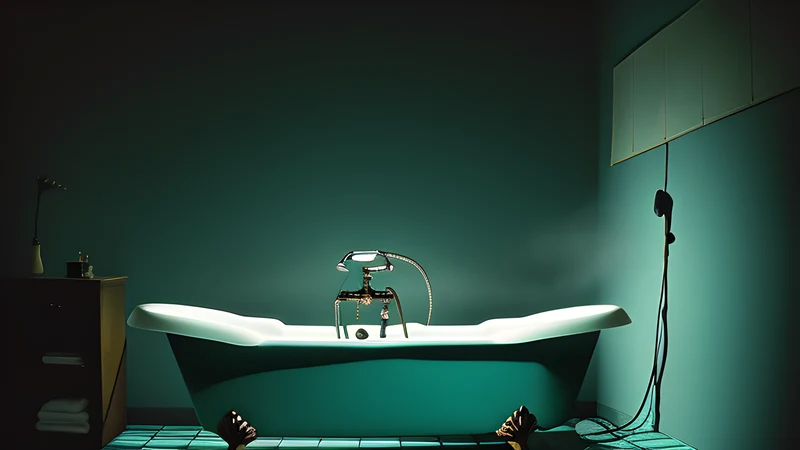
Nicole and Christina drug Michel with whisky, drown him in a bathtub at Nicole’s flat in a distant town, drive the body back to the school in a wicker laundry basket, and tip him into the swimming pool at night. The plan requires the body to be found, in the pool, as an apparent accident.
Then the pool refuses to cooperate. Days pass. A boy loses a slingshot in the water and claims he saw the headmaster. The pool is drained in front of the whole school, and it is empty. Michel’s suit comes back from the cleaners. A school photograph shows a figure at a window. Christina’s heart is failing in real time and Clouzot films her decline like a slow poisoning.
The reveal is that Michel and Nicole were the conspirators the entire film. The drowning was theatre — a drug that mimicked death, a performance for the benefit of a woman with a fatal heart condition. The plan was to frighten Christina to death and inherit the school, and it very nearly works twice. The bathroom sequence at the climax, with the corpse rising from the water, eyes rolling white, is the shot everyone carries for life, and it kills her.
Then Vanel’s inspector, who has been pottering about being ignored for an hour, closes it. Fichet, the shabby retired man nobody took seriously, is the one who was never fooled.
And then the coda, which is the reason the film keeps its grip: a boy claims Christina gave him back his confiscated slingshot after her death. Clouzot delivers this as the last note and gives you nothing else. Either the boy is lying, in which case the film ends on an ordinary schoolboy’s fib, or Christina came back, in which case a rationalist thriller has just handed you a ghost in its final thirty seconds and shut the door.
The correct response is that the ambiguity is the whole design. Clouzot has spent two hours running a con on a woman with a bad heart, and then he runs the same con on you. The film’s real subject is how easy it is to make a frightened person see something. Then it asks whether you just did.
Related Content