Le Doulos: Melville's Informer Puzzle
A film built so that you cannot know who anybody is until it decides to tell you
Contents
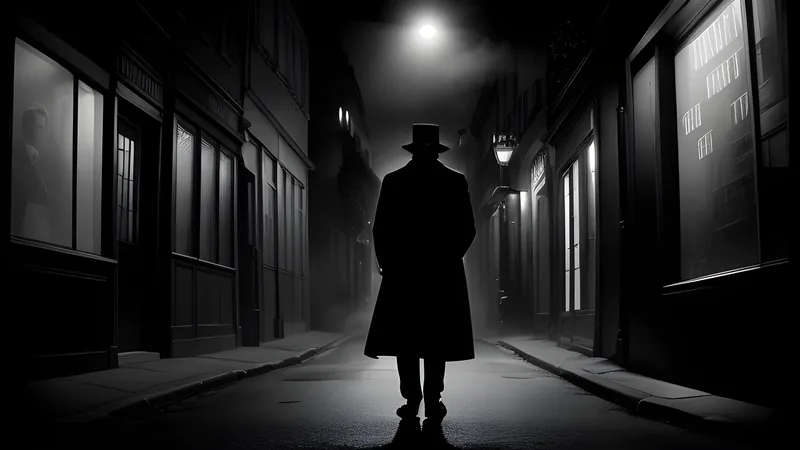
Le Doulos opens with a definition, and the definition is the film. In French underworld argot, a doulos is a hat. It is also, by extension, an informer — the police narks of a certain era being identifiable, apparently, by their headgear. Melville puts the double meaning on screen before the story starts, and then spends ninety minutes making sure you never know which men are wearing the hat and which men are the hat.
This is Melville’s fourth crime film and the one where his method locks into place. He had already made Bob le flambeur in 1956 and established the register — the trench coats, the fedoras, the nocturnal Paris that is really a Paris of the mind, assembled from American films Melville had watched during the Occupation. Le Doulos is where he discovered that the register could carry a structure, and the structure he chose is a withholding so aggressive that the film has been irritating a certain kind of viewer for sixty years.
What you are allowed to know
Maurice Faugel (Serge Reggiani) comes out of prison. He walks a long way under a railway viaduct, in a magnificently gloomy opening tracking shot, to visit a man he has business with. That business is settled quickly and unpleasantly, and Maurice moves on to a burglary he has planned for a house in the suburbs.
His friend is Silien (Jean-Paul Belmondo), who supplies him with tools for the job and is also, according to almost everyone in the film, a police informer. Maurice does not believe it. Or he does. The film declines to clarify, and it declines with intent.
The burglary goes wrong. From that point, Le Doulos is a machine for generating suspicion. Every character behaves in a way that admits two readings. Every scene withholds the piece of information that would settle it. Melville shoots the whole thing in Nicolas Hayer’s silvered black-and-white, in rooms with too few lamps, and the visual scheme does the same job as the plot: you are looking at people whose faces are half in shadow and whose motives are entirely in it.
Belmondo is the film’s great destabilising presence. He had made Breathless two years earlier and was, at that moment, the face of a cinema that was supposed to be the opposite of Melville’s — loose, improvisatory, modern. Melville puts him in a fedora and freezes him. Silien is charming, helpful, deeply reasonable and utterly opaque, and Belmondo plays him with a stillness that his New Wave admirers had not seen him attempt. Whatever you decide about the character, he is never visibly lying, which is the trap.
The craft: the long take in the office
The film’s most celebrated sequence is an extended, unbroken take in the police commissioner’s office, where Clain (Jean Desailly) works on a suspect while the camera circles the room without cutting for a very long time. Melville shot it as a single sustained movement, and the technical difficulty was considerable — the walls of the set had to be handled, the actors had to sustain a scene of pure talk for the duration, and there was no editorial rescue available if anyone faltered.
The reason it matters is what the choice does to the viewer. An interrogation cut conventionally — question, reaction, question, reaction — tells you who to watch and therefore who to believe. Melville’s refusal to cut removes that guidance entirely. You are in a room with two men for an unbroken stretch of time, allowed to look wherever you like, and given no editorial hint about which of them is lying. The technique is the theme. The film’s whole subject is the impossibility of reading a man from the outside, and Melville builds a shot that makes you try, in real time, and fail.
Melville’s Paris is worth flagging as a construction rather than a location. He shot at his own studio on the rue Jenner and used a city assembled to a specification: wet streets, isolated bars, fog, telephone boxes, no crowds. Nobody in France lived in this Paris. It is a set dressed from The Asphalt Jungle and This Gun for Hire, filtered through a man who had served in the Resistance and had firm ideas about how men behave under pressure. The artificiality is the point — these are films about a code, and a code needs a stage.
Serge Reggiani is the film’s quiet achievement and the reason its emotional stakes hold. Reggiani was a poet and a singer as well as an actor, and he plays Maurice as a man of real, exhausted decency who happens to burgle houses — hurt, loyal, slow to suspect and therefore catastrophic when he finally does. Belmondo’s Silien is a puzzle the audience solves. Maurice is the person the puzzle is being done to, and Reggiani gives him enough inner life that the solution costs something.
The problem with the ending
Le Doulos resolves through explanation. Late in the film, someone sits down and tells you what has been happening, and the retrospective clarification arrives as a long speech rather than as a dramatic event. This is the standing objection to the film and it is not a stupid one: a mystery that hands you the solution verbally has arguably failed to dramatise it.
I think the objection misses what Melville is doing, though I understand it entirely. The explanation is deliberately anticlimactic. It arrives flat, unemphatic, and slightly too late to be any use to anybody in the story. Melville is not building a detective puzzle in which the solution is a pleasure; he is demonstrating that the truth about these men was always available and always useless, because the world they live in makes acting on the truth impossible. The speech does not liberate anyone. It just settles the record before the record stops mattering.
Whether that is a defence or an excuse depends on your tolerance for a director who will sacrifice a scene to make a point. Melville did it repeatedly and he did it knowingly.
The real ancestor
The surface ancestors are American — This Gun for Hire, The Asphalt Jungle, the whole Warner Brothers inheritance Melville watched obsessively. But the truer ancestor for the structure is John Huston’s The Asphalt Jungle, which first insisted that a crime film’s real subject is the professional’s relationship to other professionals, and that betrayal is a technical failure rather than a moral one.
The descendants are more instructive. Melville’s own Le Samouraï five years later takes Le Doulos’s opacity and removes the plot entirely, leaving pure ritual; Le Deuxième Souffle takes the informer question and makes it a man’s entire reason for living. And Le Doulos is the film Quentin Tarantino has cited more than once as formative — Reservoir Dogs is built on the same engine: a room full of professionals, a job gone wrong, a rat somewhere, and a structure that withholds the answer for as long as it can.
A verdict, argued
Le Doulos is the most purely enjoyable of Melville’s crime films and the least admired, because enjoyment is held against it. It is faster than Le Samouraï, warmer than Le Cercle rouge, and considerably more mischievous than either; there is a genuine pleasure in how completely it lies to you. Reggiani gives it a wounded gravity. Belmondo gives it a face you cannot read. Michel Piccoli turns up and is instantly the most dangerous man in the room.
The case against — that the film is a shaggy dog story with a speech at the end — has to be granted its due. Melville’s plotting here is more contrivance than construction, and if the code of professional loyalty does not move you, the whole edifice is a lot of men in hats being enigmatic in the fog.
But the code does move, because Melville believed in it with an intensity that is embarrassing to describe and unmistakable on screen. He had watched men keep faith and break it under conditions where it actually mattered, and his crime films are all, transparently, about the Occupation with the politics removed. That is what raises Le Doulos above pastiche. Watch it in a good transfer — the film is a photographic object and a poor print ruins it — and watch it twice, because the second viewing is a completely different picture.
Spoilers below
Stop here. The film is a machine for withholding one fact, and this section is that fact.
Silien is not the informer, or rather he is not the informer in the way everyone in the film assumes. He has been working, throughout, to protect Maurice — his manoeuvres with the police, his apparent betrayals, his cultivation of Clain, all of it forms a scheme aimed at clearing his friend and settling a debt of loyalty that nobody else in the picture can see. Every action that looked like treachery was a move in a game of protection.
The tragedy is arithmetical. Maurice, believing Silien has sold him, sets in motion a retaliation. Silien’s explanation arrives after the retaliation has been arranged and cannot be recalled. Both men understand the truth at last, and the truth changes nothing, because the machinery of suspicion has already been started and the underworld’s code offers no procedure for stopping it. They are killed by the momentum of a misunderstanding that has been resolved.
Melville’s final gesture is Silien, mortally wounded, straightening his hat in a mirror before he goes down. It is absurd, and it is the entire moral universe of the film in one action. The code cannot save your life. It can only govern how you look while you lose it — and to Melville, who watched a great many men die badly, that distinction was worth ninety minutes of deception to arrive at.
Related Content