Le Cercle Rouge: Melville's Perfect Fatalist Heist
A twenty-five-minute jewel robbery in silence, and three doomed men who were always going to meet
Contents
Le Cercle Rouge opens with an epigraph Jean-Pierre Melville attributes to the Buddha: that when men are destined to meet, whatever paths they take, they will inevitably come together in the red circle. It is a lovely, resonant piece of Eastern fatalism, and Melville made it up. He invented the quotation, the attribution, the whole framing device, because he needed a philosophy to hang his 1970 crime film on and none existed that said exactly what he meant. That act of forgery tells you everything about the film that follows. Le Cercle Rouge is a machine built to demonstrate a worldview, and the worldview is that these men were doomed before the first frame.
The film gathers three protagonists. Corey (Alain Delon), a thief released from prison. Vogel (Gian Maria Volonté), an escaped prisoner on the run from the police convoy transporting him. And Jansen (Yves Montand), a disgraced former policeman drowning in alcohol, haunted by hallucinatory delirium, who happens to be the finest marksman in France. Chasing all three is Commissaire Mattei (André Bourvil), a patient, cat-loving detective who believes, as his superior insists to him, that all men are guilty. These four move toward a jewellery robbery on the Place Vendôme and toward each other with the inevitability of planets.
The heist as the genre’s cathedral
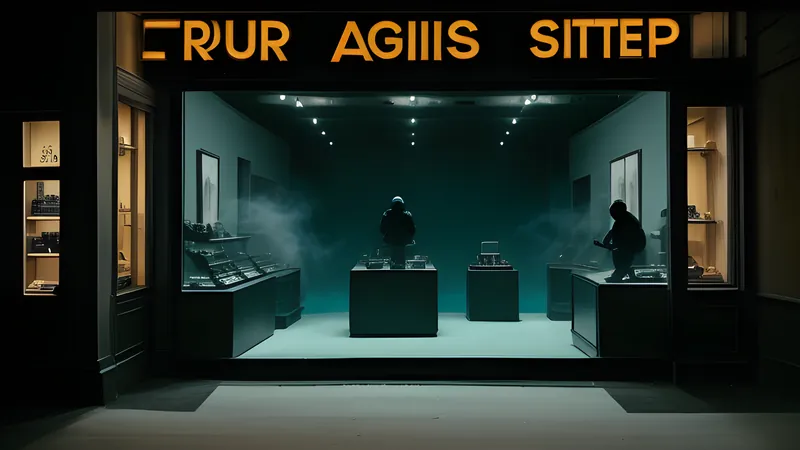
The centrepiece is the robbery itself, and it is one of cinema’s supreme set pieces: roughly twenty-five minutes of near-total silence as the three men break into a high-end jeweller’s, defeat an elaborate alarm system, and steal a fortune while barely exchanging a word. Melville strips the sequence of music and dialogue and lets it run on pure process — the tools, the timing, the single impossible shot Jansen must make to disable the last sensor. It is a sequence about competence rendered as a kind of prayer. The tension is generated entirely by silence and duration: with no score to tell you how to feel and no dialogue to explain what is happening, you are forced to read the men’s hands, their glances, the tiny mechanical sounds of tools on metal, and your own pulse fills the vacuum where music would be. Modern heist films almost always score their set pieces to the hilt; Melville understood that the absence of sound is louder.
Melville is quoting himself and his peers here, deliberately. The silent-heist idea belongs to Jules Dassin’s Rififi, whose wordless robbery Melville openly revered, and the obsessive attention to the mechanics of the job runs straight back through his own Bob le Flambeur and across to Kubrick’s The Killing. If Dassin set the template for why the heist film is really about process, Le Cercle Rouge is the form’s cathedral — the version where the ritual has become so refined it approaches the sacred. The men do not speak because there is nothing to say. The plan is the language.
Blue, grey, and the drained palette of fate
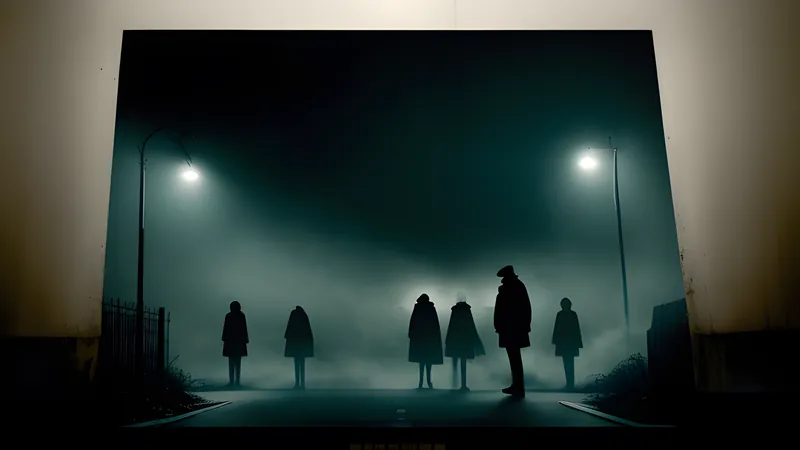
Watch the colour. Melville and cinematographer Henri Decaë drain Le Cercle Rouge almost to monochrome — everything is blue-grey, slate, dove, gunmetal, the greens of billiard baize and the browns of leather and wood, all pushed toward cold and low. There is barely a warm tone in the film. This is a deliberate assault on the romance of crime. Melville disliked colour and only reluctantly abandoned black and white; his solution was to shoot colour as if grieving for monochrome, bleeding the warmth out until the film sits in a permanent blue dusk. The world Corey moves through is beautiful and utterly without comfort, a Paris of rain-slicked streets, empty nightclubs and impersonal hotel rooms, and the palette tells you these men are already ghosts.
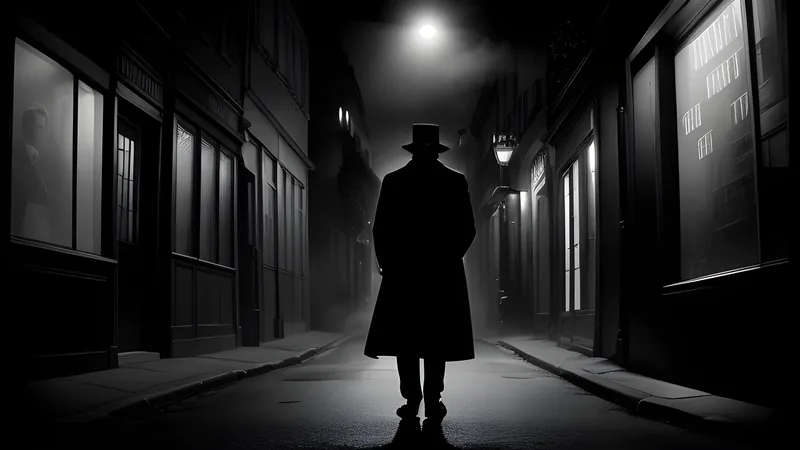
The visual iconography is Melville at full strength — the trench coats, the fedoras, the American cars, the ritualised smoking, the men who dress like they are attending their own funerals because on some level they are. This is the same austere grammar he perfected in Le Samouraï three years earlier, and Delon is the bridge between the two films: his Corey is a warmer, more sociable cousin of Jef Costello, the hitman he played for Melville in that earlier masterpiece, both men encased in the same beautiful ice. Where Le Samouraï isolates one figure, Le Cercle Rouge studies what happens when several such figures are forced into orbit.
The moral weight the film carries lightly
For all its cool, Le Cercle Rouge is a serious moral document. The line “all men are guilty,” delivered early by Mattei’s superior, hangs over everything. Melville, who fought in the Resistance and knew about loyalty, betrayal and the machinery of policing at first hand, treats his cops and his criminals with exactly the same grave respect. Mattei is not a villain; he is a professional doing a job, just as Corey and his crew are professionals doing theirs. The tragedy is structural. Everyone in the film is competent, dignified and honourable within their own code, and the red circle closes on them regardless. Melville withholds the usual thriller pleasures of a rooting interest; you admire all four men and can wish salvation on none of them, because the film has told you from its false-Buddha epigraph exactly how the geometry resolves.
That refusal to distinguish morally between the hunter and the hunted is Melville’s deepest theme, and it reaches its most anguished expression in Army of Shadows, where the same men, the same trench coats, the same fatalism are transposed onto the French Resistance and the stakes become life, death and the murder of one’s own friends. Le Cercle Rouge is the crime-genre statement of a philosophy that Army of Shadows turns into history. Seen together, the two films reveal that Melville’s gangsters and his partisans are the same men wearing different labels.
Why it endures
Le Cercle Rouge is, for my money, the most perfectly controlled heist film ever made — cooler than Rififi, grander than Bob, and animated by a philosophy that most genre entries never even reach for. It is long, patient and almost entirely without sentiment, and it rewards that patience with a sense of design so total that the ending feels less like a plot resolution than the completion of a geometric proof. Every element clicks into the red circle exactly where Melville’s invented Buddha said it would.
Newcomers should approach it as the summit of a trilogy of Melville crime films worth taking in order: Bob le Flambeur for the warm origin, Le Samouraï for the frozen archetype, and this for the fatalist masterpiece that gathers both strands. Then Army of Shadows for the same craft aimed at something that will break your heart.
Spoilers below
The red circle closes hard, so stop here if you haven’t seen it.
Every path leads to the same clearing. After the robbery succeeds, Corey needs a fence, and Mattei engineers the trap through Jansen’s and the underworld’s connections, using a nightclub owner, Santi, as leverage. The genius of Melville’s fatalism is that the men’s own competence delivers them. Jansen, having beaten his delirium long enough to make the miraculous shot that cracked the heist, is present at the end. Vogel, the escapee Corey sheltered and made his partner, is loyal to the last.
The finale is a police ambush at Corey’s country meeting place. Mattei’s men close in, and in the confusion Vogel is shot, then Corey is gunned down, and Jansen too — the entire crew wiped out within moments of one another, the fortune recovered, the circle sealed. Bourvil’s Mattei walks through the aftermath with no triumph on his face, only the tiredness of a man who was always going to be standing here. His superior’s earlier verdict — all men are guilty — is confirmed as a physical law with the impartial force of gravity, well past the reach of moral judgement. The men were guilty because they were men, and they met in the red circle because that is what the epigraph promised on the first frame.
There is a poignant real-world coda. Le Cercle Rouge was Bourvil’s final film; a beloved comic actor cast against type as the grave detective, he died shortly before its release, which lends Mattei’s weariness an accidental elegy. And Melville himself had only a few years left. The film stands as the near-final, near-perfect statement of everything he believed about fate, loyalty and the beautiful uselessness of a well-executed plan.
Related Content