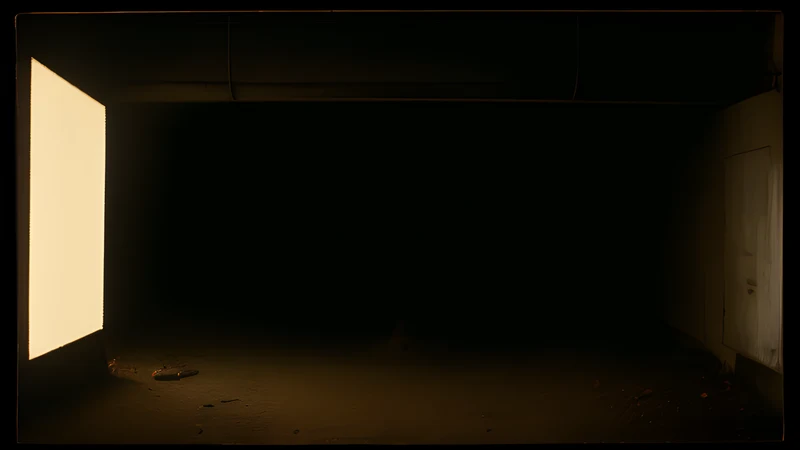
Larry Cohen: The Guerrilla Auteur of New York
The man who stole Manhattan without a permit and put a social thesis inside every monster

Contents
Larry Cohen shot a scene for God Told Me to inside the New York St Patrick’s Day parade by putting his actors in police uniforms, pointing a camera from a doorway, and waiting. The parade belonged to the city. The day it fell on belonged to anyone with a camera and a doorway, and cost nothing. Andy Kaufman — in his first film role, months before Taxi — is the cop who opens fire on the crowd, and the crowd’s reaction is largely the reaction of real people watching a man with a gun in a parade they came to enjoy.
That is the Cohen method in a sentence, and it produced a filmography that looks disreputable and functions as one of the most politically alert bodies of work in American genre cinema. He was born in Manhattan in 1936, died in Los Angeles in 2019, and in between he wrote or directed roughly a film a year in which a monster turns out to be a thesis about capitalism, policing, medicine, motherhood or the church.
Television first, and a habit of high concepts
Before any of the monsters, Cohen was a television creator with a genuinely startling hit rate. He created Branded (1965), the Chuck Connors western about a disgraced cavalry officer, and The Invaders (1967), in which one man knows aliens have infiltrated society and nobody believes him — a paranoid premise sold to a network two years before the counterculture made paranoia respectable. He also created Coronet Blue and wrote features for hire, including Return of the Seven (1966) and El Condor (1970).
The television years matter because they taught him the thing his later work runs on: a premise you can state in one line and sell in ten seconds. Every Cohen picture has a logline that could be a TV Guide entry. The art is what he smuggles underneath it.
Blaxploitation, and a monster with a lawyer
His directing debut, Bone (1972), is a Beverly Hills home invasion in which Yaphet Kotto’s intruder terrorises a rich white couple and then discovers their marriage is a more efficient horror than anything he could do to them. Nobody knew how to release it; it was retitled repeatedly and buried.
Black Caesar (1973) is the one that connected. Fred Williamson as a Harlem shoeshine boy who takes over the rackets, with a James Brown score and a shoot-anywhere New York that no studio picture of the period could match for texture. Cohen followed it inside a year with Hell Up in Harlem (1973), shot largely because Williamson was available and Cohen was constitutionally incapable of not shooting. It belongs in the argument alongside Across 110th Street as social fury in gangster clothing, and both films sit in the blaxploitation canon for the same reason: the crime is the plot and the city is the subject.
Then It’s Alive (1974), and the shape of the rest of his life. A mutant infant kills the delivery room staff and escapes into Los Angeles, and the film is a family melodrama about a father asked to hunt his own child while a pharmaceutical company quietly hopes the evidence dies with it. Rick Baker built the creature. Bernard Herrmann — Herrmann, of Psycho and Vertigo, in the last months of his life — wrote the score. That a $500,000 exploitation picture about a killer baby carries a Herrmann score is the single best fact in American genre cinema, and Herrmann took the job because he read the script and found a mother in it.
The mechanics: steal the city, hire an eccentric, keep the concept honest
Three things make a Cohen film work, and they are all economic decisions that became aesthetic ones.
First, the location theft. Cohen shot on real New York streets without permits, on the reasonable calculation that a small crew reads as nobody and by the time anyone objects you have the shot. Q: The Winged Serpent (1982) exists because he was fired from I, the Jury, had a crew and a city and a fortnight of spite, and put a Quetzalcoatl in the Chrysler Building — the aerial work is a helicopter and nerve. The consequence is a New York that no permitted production has ever photographed: actual pedestrians, actual weather, actual grime, and a documentary charge that money cannot buy.
Second, the actor as detonator. Michael Moriarty appears in four Cohen films, and Cohen’s direction of him amounted to letting him improvise and then building the cut around whatever happened. Moriarty’s small-time crook in Q — a failed pianist bargaining with the city over a monster’s nest — is one of the great American screen performances, and it is loose in a way no studio would have permitted. Tony Lo Bianco carries God Told Me to on the opposite principle: total containment, a detective whose Catholicism is a locked room.
Third, the concept stays honest. A lesser film-maker makes a killer-yoghurt film as a joke. The Stuff (1985) takes its dessert seriously enough to follow the marketing campaign, the industrial espionage, the FDA and the shelf placement, and the horror arrives because the satire is being played straight. That discipline is what separates his creatures from a hundred forgettable creature features of the same decade.
The theology and the late career
God Told Me to (1976) is the masterpiece and the least classifiable film he made — a police procedural about ordinary New Yorkers committing massacres and calmly explaining that God asked them to, which turns into a science-fiction nativity and then into something closer to a religious crisis. It has a Herrmann score too. It was released, retitled, misunderstood and abandoned, and it is now the film that Cohen obsessives lead with.
The Private Files of J. Edgar Hoover (1977) is his most audacious act: a hostile biography of a man dead only five years, shot in and around real Washington locations, financed independently because no studio would touch it. Full Moon High (1981) is a werewolf comedy. A Return to Salem’s Lot (1987) has Samuel Fuller in it, playing a Nazi hunter, because Cohen asked. The Ambulance (1990) sends Eric Roberts after a vintage ambulance that collects diabetics.
From the late eighties he was mostly a writer-producer, and a very rich one: the Maniac Cop films (1988–1993) for William Lustig, Best Seller (1987) with James Woods and Brian Dennehy, and then the two single-location scripts that made him mainstream money — Phone Booth (2002) and Cellular (2004). Both are television premises executed with feature-length rigour, and both are recognisably the man who created The Invaders: one person knows the truth, nobody will listen, the clock runs.
The case against
He was fast, and fast leaves marks. Hell Up in Harlem is barely a film. The It’s Alive sequels dilute a perfect idea across two thinner ones. Cohen’s endings frequently arrive because the money ran out rather than because the argument concluded, and his tonal control is erratic — Full Moon High is limp, and the scenes he could not steal are often the scenes he could not stage. He got fired from I, the Jury and from The Ex and there is no version of the story where that is entirely the studio’s fault.
The defence is that his ceiling is astonishing and his floor is still interesting. Nothing in Q or God Told Me to could have been made by anyone else, at any budget, and the compromises are visible on screen precisely because he refused to hide them. He is the closest American cinema has to an argument against professionalism — and the useful comparison is Roger Corman, who industrialised the margins while Cohen simply lived there.
Start with Q: The Winged Serpent, follow it with God Told Me to, then It’s Alive for the Herrmann. The boutique labels have restored most of the important titles, and King Cohen (2017) is a documentary in which he tells these stories himself, at length, and enjoys every one of them.
Spoilers below
It’s Alive ends with Frank Davis carrying his own child out of a storm drain in his arms and refusing to hand it over, and the film’s last line is a radio report that another one has just been born in Seattle. The sequel hook is the thesis: the drug company shipped the product nationally, so the mutation is a distribution problem. Cohen gets his monster, his melodrama and his indictment in a single closing beat, and the reason it lands is that the film has spent seventy minutes on a father’s shame rather than on the creature — you see the baby properly for a handful of frames in the whole picture, because Rick Baker’s work was expensive and Cohen was broke. The restraint everyone praises was a budget line.
God Told Me to pays off with Peter Nicholas discovering that the killers’ god is a glowing hermaphroditic being in a tenement, and that he and it share a mother — both of them the products of abductions, both virgin births, one raised as a policeman and one kept in the dark. Cohen shoots the confrontation in a bare room with a light source doing most of the effects work, because a bare room was what he could afford, and the scene plays as scripture rather than science fiction. The detective’s final confession, delivered to camera in a corridor, is the closest American genre cinema of the 1970s came to a genuinely blasphemous ending, and it went out on a double bill.
The Stuff finishes with the product pulled from supermarket shelves and immediately resold on the black market to people who miss it. The horror is unresolved because demand is unresolved. Every other killer-food film ends with an antidote.
Related Content