Kuroneko: Shindō's Other Reed-Field Ghost Story
The black-cat spirits, the floating camera, and the ghost story Kaneto Shindō built in the shadow of Onibaba
Contents
Four years after Onibaba made him famous outside Japan, Kaneto Shindō returned to the tall grass and the ghostly woman and made Kuroneko, and for decades it lived in the shadow of its more celebrated sibling. That neglect has been quietly corrected. The 1968 film — its full title Yabu no Naka no Kuroneko, “A Black Cat in a Bamboo Grove” — is one of the most beautiful ghost stories the Japanese cinema ever produced, a supernatural revenge tale shot in silver monochrome that moves like a slow, cold current. It is a companion piece to Onibaba, and it is also a rebuke to it, answering the earlier film’s earthbound cruelty with something floating, formal, and unbearably sad.
The black cat of the title is the hinge of the whole conceit. In the folklore Shindō drew on, the bakeneko is a cat that has taken on supernatural power, and the animal here is the agent of the transformation, the creature that finds the murdered women and grants them their terrible second life. Shindō keeps the cat mostly at the edge of the frame, a pair of eyes in the dark, so that its influence is felt more than seen, and the women’s feline movements — the way they lap at blood, the way they spring — carry the animal into every scene without a single unconvincing effect.
Shindō made both films in the same landscape of grasses and mud and marauding samurai, drawing on the folklore of a country at war with itself. Onibaba kept its horror human and physical, a story of two women and a demon mask with a rational explanation. Kuroneko lets the ghosts be ghosts, and in doing so it reaches for a purer, older register of dread, the kaidan tradition of vengeful spirits who cannot rest until a wrong is answered.
The grove and the vow
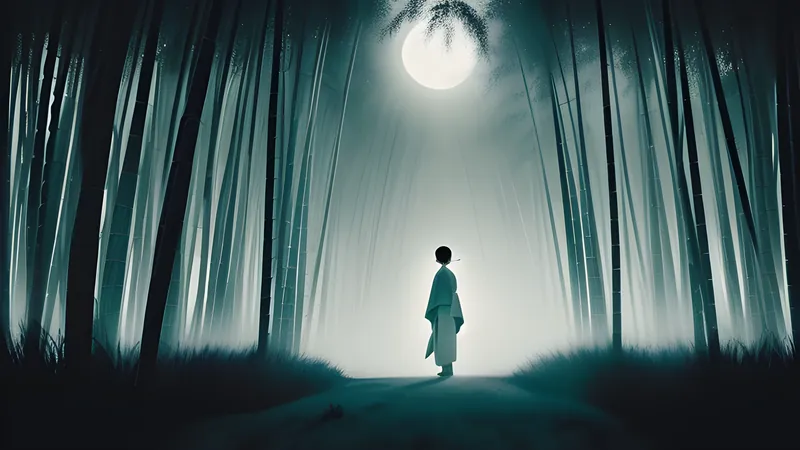
The premise is a folk tale sharpened to a blade. In a time of civil war, a woman named Yone and her daughter-in-law Shige are set upon in their home by a band of famished samurai, who rape and murder them and burn the house. A black cat comes to the ruins and licks the bodies. The two women return as vengeful spirits, bound by a pact to drink the blood of every samurai they can lure, and they take up residence in a ghostly mansion at the Rajōmon gate, where they appear to passing warriors as noblewomen offering hospitality, guiding them home through the bamboo before killing them.
The trap has the rhythm of ritual, and Shindō films it as one. Each victim is met at the edge of the grove, escorted through the swaying reeds, welcomed into the mansion, given sake, and then destroyed. The repetition is the point; we watch the ceremony assemble itself the way a spell does, and the horror accretes through familiarity. Nobuko Otowa, Shindō’s wife and constant collaborator, plays the mother Yone with a terrible composure, and Kiwako Taichi plays Shige, the daughter-in-law, whose beauty is the bait and whose grief is the film’s true subject. These are not monsters who hate. They are women performing an obligation they did not choose, and the sorrow underneath the killing is what gives the film its ache.
Why the camera terrifies
It is worth remembering the conditions Shindō worked under. He had founded his own independent production company precisely so he could make films outside the studio machine, and Kuroneko was produced for a major distributor while retaining the spare, hand-built quality of his independent work. That economy shows in the best way. The mansion is a set of screens and lanterns and negative space, the forest a few dozen metres of bamboo lit to look infinite, and the restraint forces every element to carry meaning. Nothing is decorative. A single shaft of light across a face does the work a lesser film would spend a fortune to achieve.
The greatness of Kuroneko is in its movement, and the movement is unlike almost anything else in the horror cinema of its moment. Working with the cinematographer Kiyomi Kuroda, Shindō renders the spirits weightless. They drift rather than walk; they leap impossible heights and land without sound; they arc through the air in slow, suspended somersaults achieved with wirework and trampolines and reverse motion, their white robes trailing like smoke. The compositions are stark and theatrical, pools of light suspended in absolute black, the bamboo raked by wind, and the ghosts seem to hang inside the frame like figures in a scroll painting come loose from the paper.
This is the mechanism worth naming: the film uses the grammar of dance and Noh theatre to make the supernatural legible without ever explaining it. There is no rational undercutting here, no mask to pull off. The unnatural glide of the bodies tells you, at a level beneath argument, that the ordinary rules have been suspended, and the effect is more disquieting than any amount of gore. Hikaru Hayashi’s score reinforces it, using percussion and silence and sudden stabs of sound in the manner of the traditional stage, so that the film feels less like a story being told than a rite being performed. When a samurai enters the mansion and the geometry of the space subtly refuses to behave, we understand we are watching something that operates by the logic of a nightmare, and Shindō never breaks the spell to reassure us.
The bloodline of the Japanese ghost
Kuroneko stands at a crossroads of Japanese horror traditions, and tracing them is half the pleasure. Its most obvious relation is Onibaba, Shindō’s own earlier film, with which it shares the setting, the wartime savagery, the reed fields, and Nobuko Otowa; watch them together and they play as a diptych, one grounded and one spectral, on women preying on the men who prey on them. It belongs equally beside Kwaidan, Masaki Kobayashi’s stately 1965 anthology of ghost stories staged like living paintings, which shares Kuroneko’s conviction that the way to film the supernatural is through the formal beauty of the theatre rather than the shock of the slaughterhouse.
What distinguishes Shindō from the tradition he draws on is the sympathy. The classical kaidan often treats its avenging spirits as forces to be pacified, obstacles in a moral universe that must be set right. Shindō inverts the emphasis and gives the film to the ghosts, so that the samurai they destroy register as the intruders and the audience’s loyalty rests with the dead women. That reallocation of sympathy is a political act as much as an aesthetic one, and it is what keeps the film feeling modern nearly six decades on.
The line runs forward, too. The vengeful female spirit bound to a specific place, driven by a wrong done in life, is the ancestor of the modern Japanese ghost that conquered the world at the turn of the millennium; the drowned, implacable revenant of Ringu descends directly from figures like Yone and Shige, the woman who cannot be reasoned with because reason is not what she is owed. Shindō’s cats prowl in the bloodline of every long-haired ghost that has crawled out of a television since.
Spoilers below
The devastation of Kuroneko is that the ghosts’ vow and their love turn out to be at war. Into the pattern of killings rides Hachi, or Gintoki, a peasant who has become a decorated samurai in the wars and is sent by his lord to destroy the demon murdering the region’s warriors. He is Yone’s son and Shige’s husband, the man both women waited for in life, and he does not at first recognise the spirits of his own mother and wife in the noblewomen of the haunted mansion.
Shindō stages the recognition as an agony rather than a twist. Shige, encountering her husband, is caught between the vow that binds her to kill samurai and the love that survives her death, and she chooses seven nights with him at the price of breaking her pact — a transgression that begins to unmake her, night by night, until she must vanish. The mother, held to her bargain, cannot be released so easily. The son, ordered to bring the demon’s severed arm to his lord as proof, is drawn into a final confrontation with the spirit of the mother who bore him, and the film ends in the ruins where it began, love and duty having annihilated one another and left nothing standing.
There is no comfort in the resolution and Shindō offers none, because the film’s deepest horror is not the ghosts. It is the war that made them, the machinery of a feudal order that turns peasants into rapists and murderers, elevates one such man to a samurai, and then sends him to kill the family the same system destroyed. The cat spirits are the wound the era could not stop bleeding. Watch it directly after Onibaba and the two films complete each other, a single unblinking look at what violence does to the women left in the grass, told once in flesh and once in shadow.
Related Content