Killer Klowns from Outer Space: The Big-Top Invasion
The Chiodo brothers spend everything on the design and win the argument
Contents
The title is doing something clever and almost nobody notices. Killer Klowns from Outer Space announces itself as a joke, which lowers the shutters on any expectation of quality, and then the film that follows is one of the most rigorously designed genre pictures of its decade. The gap between the marquee and the object is enormous. Watch it expecting a rubbish parody and you get a film in which every single gag has been physically built, at scale, by people who could have got better-paid work almost anywhere.
That is the whole story of the Chiodo brothers’ 1988 debut. Stephen directed, he and Charles wrote it, Edward produced, and all three ran an effects shop — which means the film was made by the department that usually gets told there is no money. Handed a feature, they spent everything on the thing they knew how to do, and the result is a picture whose ideas are entirely visual and entirely realised.
The premise, straight
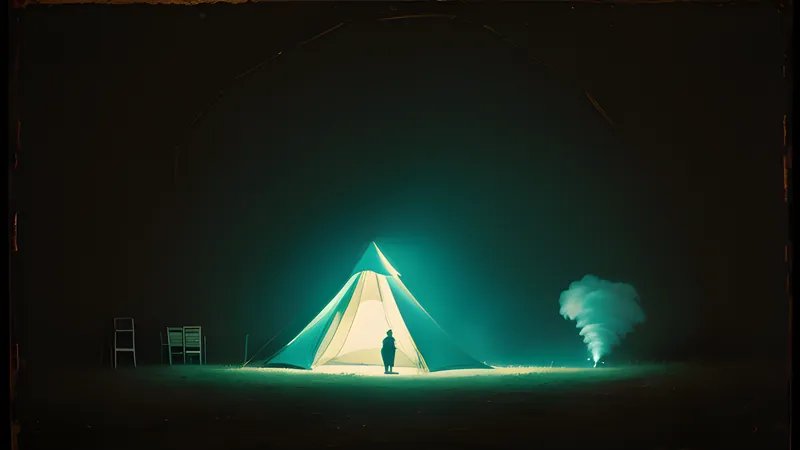
A shooting star comes down outside Crescent Cove, a small American coastal town. Two teenagers drive out to look at it and find a circus tent standing in the woods where no tent was that afternoon. Inside is a spaceship. The occupants are clowns, they are here for food, and the food is us.
That is stated in the opening fifteen minutes with no coyness. The film never pretends the klowns might be misunderstood, never wastes a reel on ambiguity, and never — and this is the crucial discipline — makes a joke at its own expense. Nobody in Crescent Cove says anything like “clowns from space, that’s ridiculous”. The characters treat the invasion as an emergency, because it is one.
The workshop that made it
The Chiodos came to this from the effects trade rather than from film school, and the distinction matters. They had spent years on stop-motion and creature work for other people’s productions — the discipline where you build a thing, shoot it a frame at a time, and live with the consequences of every design decision for months. That background explains the film’s odd priorities. A director who came up through screenwriting protects the script; a director who came up through a workshop protects the object in front of the lens, and will happily let a scene of dialogue die on its feet if the puppet in the next shot is right.
It also explains the film’s patience. Stop-motion teaches you that an effect is worth doing only if it will still read on the twentieth viewing, and almost everything in Killer Klowns is built to that standard. The film has been playing to full houses every October for over thirty years and the design has never once been the thing that dates.
The design is the argument
Every piece of klown technology is a circus object repurposed as a weapon, and the invention rate is astonishing. Humans are wrapped in cotton candy cocoons and stored; the klowns drink them later through curly straws. The guns fire popcorn, and the popcorn grows. A klown fights a crowd with a shadow puppet that becomes an actual dinosaur. A balloon animal, twisted into a dog, is used as a tracking bloodhound and follows a scent. A klown works a punch-and-judy routine and a puppet mallet does real damage. Late on, a boxing glove on a spring arrives with the force of artillery.
Take any one of these and it is a sketch. Taken together, in sequence, with no explanation offered, they constitute a rule set — and this is where the Chiodos are doing genuinely sophisticated work. The film establishes that klown physics operate on the internal logic of a circus act, and then obeys that logic without exception for eighty-eight minutes. Once you accept the premise that a balloon dog tracks scent, everything downstream is consistent, and consistency is what generates dread. The audience learns the rules and starts anticipating. That is the same mechanism that makes a good haunted-house film work; the Chiodos just applied it to novelty items.
The klowns themselves are the technical centrepiece: performers in suits with animatronic heads, oversized, with the proportions slightly wrong in a way that reads before you can articulate why. The heads have real range — they blink, they grin, they register decisions — and they never look at the camera for approval. The man-in-the-suit essay argues the general case for why this survives; here is the specific proof. These things share a physical space with the actors, cast the right shadows, and cannot be sped up or lit around. A rendered klown would be free to do anything and would therefore be worth nothing.
The other decision worth naming is the score. Composer John Massari’s music leans circus and carnival, which means the horror arrives in a major key. When a klown kills someone while calliope music runs underneath, the film is refusing to tell you how to feel, and the sequence is far worse for it.
The performances that hold it
John Vernon does something valuable as Officer Mooney, the town’s contemptuous senior policeman: he plays the character as a genuinely unpleasant bully, on the reasonable theory that a comedy needs at least one person the audience will enjoy seeing dealt with. Grant Cramer and Suzanne Snyder are pleasant and unremarkable, and the film knows it, keeping them moving. The Terenzi brothers, the ice-cream men, are the film’s weakest concession to eighties comedy and its only real tonal wobble. Royal Dano, a man with forty years of American film behind him, appears as a farmer and is treated with exactly the seriousness that gives the opening its weight.
The real ancestor of this is a fifties drive-in picture
The obvious sibling is TerrorVision, which shares the Empire-adjacent eighties taste for rubber and saturation. The genuine ancestor is older and more specific: the small-town invasion picture of the fifties, the one where a thing lands in a field, two teenagers see it, and no adult with authority will believe them. The Blob is the direct template — teenagers, a dismissive police force, a gelatinous consumption metaphor — and It Came from Outer Space supplies the desert-arrival grammar. The Chiodos’ insight was that the fifties invader was always a design problem dressed as a story, and that if you solved the design brilliantly enough the story could stay exactly as thin as it was in 1958.
There is a second parent, and it is the reason the film unsettles people who find it silly. The evil-clown idea has a long tail in horror, and the carnival strand runs through The Funhouse, where Tobe Hooper works out that the fairground’s cheerfulness is what makes it frightening, and reaches its baroque extreme in Santa Sangre. The Chiodos took the same observation and made it literal. A clown’s face is already a mask worn by an adult who wants children to come closer; the film’s only real leap is asking what the mask is for.
For the general problem of pitching comedy and horror in the same shot, the tightrope essay has the taxonomy, and this film sits at the far end of it — a picture that is funny throughout and never once undercuts its own threat.
The case against
The human material is thin to the point of transparency. The love triangle between Mike, Debbie and Dave has no content whatsoever. The Terenzis are a drag on every scene they are in. The dialogue exists to move bodies to the next set piece. The film has a genuinely great third-act location and does slightly less with it than it might. And a real objection: the picture’s ideas are all in the design department, which means once you have seen the balloon dog and the shadow puppet you have received the film’s entire thesis, and the plot is a delivery mechanism.
The rebuttal is that the delivery mechanism does its job in eighty-eight minutes without a single dead reel, and that “the ideas are all in the design” describes most of the best genre cinema ever made — a large fraction of the Universal cycle, most kaiju, and Alien. Design-first film-making is a legitimate school. This is one of its purest American examples, and it was made by three brothers with a workshop.
Spoilers below
The film’s most quietly horrible sequence involves the cocoons. Once you understand what the cotton candy is for — that people are stored alive, in a state the film declines to describe, and drunk later — the whole first act reorganises itself. The klowns are shopping in the town, and every death in the film is a purchase. The tent’s interior, revealed properly in the third act, is a larder with the lights on, and the reveal is staged with the calm of a supermarket aisle.
The climax gives us Klownzilla, an enormous klown that emerges when the smaller ones are dealt with, and the film has enough good sense to make the final confrontation a physical joke rather than a battle: the giant is beaten by an attack on its nose, which honks, because that is what the film has told you for eighty minutes that klowns are. The rule set pays out. Everything the Chiodos established in act one is what wins in act three, which is the sign of a script that was actually engineered rather than assembled.
The last beat, with the Terenzi brothers and a shower of cream pies, is the film’s one moment of pure relief, and by then it has been earned. There is no sequel hook worth the name, and thirty-five years of the brothers trying to make a follow-up has produced everything except a follow-up, which may be the correct outcome. The film is a complete object.
Where to watch
It has been restored properly and looks superb — the klown suits reward the resolution, which is the whole point of a film like this. It appears regularly on ad-supported streaming and is a permanent fixture of the repertory Halloween circuit, where a full room genuinely improves it. Follow it with Night of the Creeps for the other great eighties film about an alien delivery problem.
Related Content