Kill, Baby... Kill!: Bava's Ghost-Child Nightmare
The 1966 gothic that gave horror its bouncing white ball and one impossible corridor of rooms
Contents
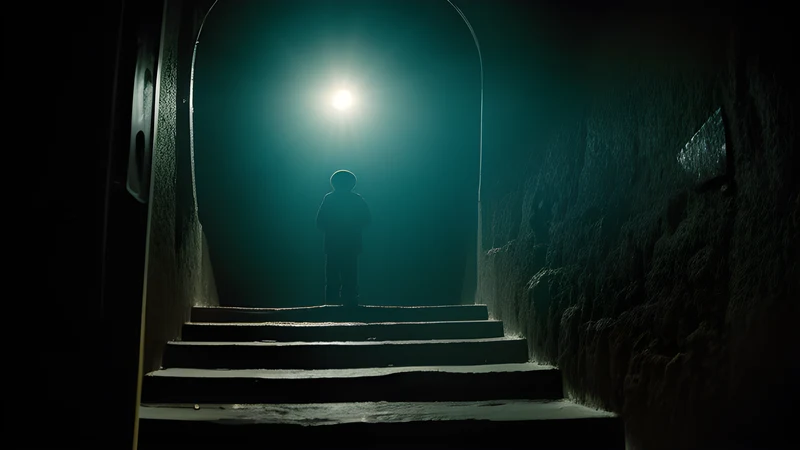
A white ball comes down a staircase. That is the whole apparatus. Mario Bava spent 1966 in a Carpathian village that was really a piazza in Calcata, north of Rome, with a production that had run out of money before he finished, and he built the most durable image in Italian gothic out of a child’s toy and a flight of steps.
Operazione paura — “Operation Fear”, which is a title from a spy-film cycle the producers were chasing, and has nothing to do with the film — reached English-speaking territories as Kill, Baby… Kill!, a title from a different and even less relevant cycle. Both names are lies about a slow, sad, chromatically deranged ghost story concerning a seven-year-old girl who was left to die and has been collecting the debt ever since. The distribution history is the reason the film spent decades as a rumour among people who had seen it on a bad print and could not persuade anyone else it existed.
The ball, and why it works
Melissa Graps announces herself with the ball before she appears. It bounces into frame, or down a stair, or across a floor, and the sound arrives a beat before the image. Bava then makes you wait.
The mechanics are worth taking apart, because the device has been copied so often that its cleverness has worn smooth. A ball is a child’s object, which means the audience’s first reading is benign — a toy, a game, a small person nearby. The second reading arrives about a second later, once you register that there is no child. Horror normally works by showing you something wrong. Bava shows you something right and lets the wrongness be the absence attached to it. The ball is evidence of a girl, and the girl is what is missing, and your mind supplies her before Bava does.
He compounds it by refusing to give the ball a source. It never rolls in from a visible direction. Bava frames the stair so the top is out of shot, so the ball simply begins, and the film never once cuts to what released it. In a genre that reflexively wants a reverse angle, the withheld reverse is the trick, the same discipline that makes the unseen ghost work in The Haunting three years earlier.
The room that folds
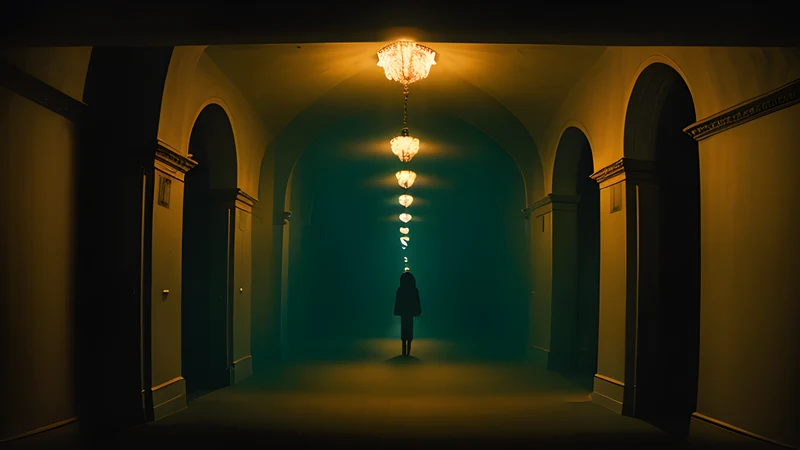
Roughly an hour in, Dr Paul Eswai pursues a figure through a door in the Villa Graps and into a room. He crosses it, goes through the next door, and is in the same room. He does it again. The camera tracks him through a sequence of identical chambers in what reads as a single geography that has stopped obeying arithmetic. Then he catches up with the man he has been chasing, grabs his shoulder, and it is himself, seen from behind.
Bava achieved this with doors, a repeated set dressing and precise blocking — a carpentry solution to a metaphysical problem, which is his entire method. The effect on a viewer is unlike a jump scare and unlike a gore beat. It is the specific nausea of a floor plan turning hostile, and it is the sequence that made the film’s reputation among directors long before it had one among audiences.
Martin Scorsese has been the most public advocate, and the debt worth naming is Fellini’s. The “Toby Dammit” episode of Spirits of the Dead, made two years later in 1968, hands its devil to a small girl in a white dress with a white ball, and the lift is close enough that Bava’s admirers have argued about it ever since. A hack borrowing from a genre film is ordinary. A Fellini borrowing from one is a review.
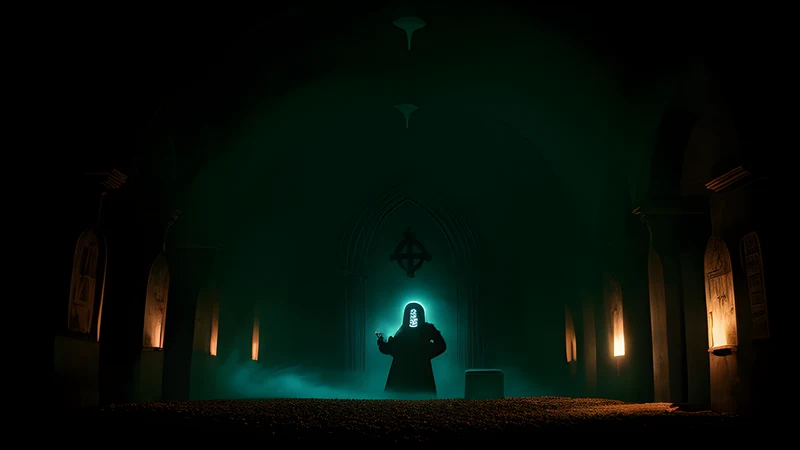
Bava’s colour is at full strength here and it is doing structural work rather than decoration. The villa is lit in greens and violets that no source in the room could produce, and the film never pretends otherwise. He gels the lamps to a scheme rather than a physics, so the villa reads as a psychological interior from the first shot, which is why the folding room does not feel like a cheat when it comes. The rules were suspended in reel one. We follow that technique forward in Colour timing as horror: from Bava to Refn.
The boy in the girl’s dress
Melissa is played by Valerio Valeri, a boy. Bava cast him in a blonde wig and a white dress, and the decision is the film’s most discussed piece of casting because it is the reason Melissa is unbearable to look at. There is a fractional wrongness in the proportions and the walk that the audience registers without diagnosing. A little girl playing a ghost girl would have been sad. This is something else — a shape that has assembled itself into the memory of a child and has got a detail slightly off.
The rest of the cast works in the register Bava’s gothics require, which is to say close to opera. Giacomo Rossi Stuart’s Eswai is the standard-issue rationalist doctor, sent to a village to perform an autopsy the locals do not want, and he is once again the man who understands last — Bava’s recurring joke about educated men, established six years earlier in Black Sunday when a physician’s carelessness resurrects a witch. Erika Blanc’s Monica is the film’s actual protagonist in everything except billing. Fabienne Dali plays Ruth, the village sorceress, with a total absence of camp, and the film is better for treating folk practice as a working profession with a technique and a fee.
The production’s collapse is visible in the finished film and improves it. The money ran out with the shoot unfinished, the crew worked on without certainty of being paid, and Bava covered the gaps by shooting what he had from angles that implied what he did not. The Villa Graps is a handful of rooms photographed as a mansion. The village is one square. The famous stair is one stair. A director working from a full budget would have built the geography and lost the claustrophobia, and the film’s suffocating sense that Karmingam has about nine locations and no exit is a direct product of the accounts department.
Where it sits
The ancestor is Jack Clayton’s The Innocents, which established five years earlier that a child in a horror film is most disturbing when perfectly composed. Bava strips out Clayton’s ambiguity — Melissa is unquestionably real and unquestionably killing people — and keeps the composure. The village-with-a-debt frame, meanwhile, is the folk-horror engine running in Italian, arriving before the British films that got the credit.
The descendants are a genre. Every ghost child who arrives with a toy, every haunted villa whose plan stops working, every horror film that puts the sound before the image, is operating on Bava’s licence. The Japanese wave took the pale small figure and made an industry of it, which we trace in The J-horror wave and what the American remakes lost; the direct line to Argento is the colour, and the direct line to nearly everyone else is the ball.
Where to watch: this film has been through more butchered public-domain transfers than almost any other Bava, and a muddy print destroys it completely — the greens go grey, the folding room reads as a continuity error, and the ball becomes a smudge. A restoration with the original Italian track and Carlo Rustichelli’s score is the only version worth your evening.
Spoilers below
The village of Karmingam is dying at a rate of roughly one person a week, and every corpse the film examines has a gold coin embedded in its heart. The coin is Ruth’s work. She places it in the dead so their souls cannot be taken, which means the film’s apparent desecration is a rescue operation, and the sceptical doctor cutting the coins out for evidence is unknowingly delivering the dead to the thing that wants them.
The deaths themselves are suicides. Anyone who sees Melissa is compelled to kill themselves, which is why the film has no monster attacks and no chase in the conventional sense — Bava’s ghost never lays a hand on anybody. The victim does it. That is a far nastier proposition than a spectral murder, and it is why the film’s violence feels obscene despite being almost bloodless.
Melissa died at seven during a village festival, trampled in the crowd, and the villagers stood and watched her bleed to death rather than help. Her mother, Baroness Graps, is a medium of real ability, and the film’s revelation is that she has been directing her daughter’s ghost at the village for twenty years as an act of maternal revenge. Melissa is a weapon held by a grieving woman. The child is a victim twice over — once of the crowd, and then permanently of her mother.
Monica Schuftan, the nurse who came to help with the autopsy, is Melissa’s sister, sent away as an infant and raised elsewhere with no knowledge of the Graps name. She has walked back into her own family’s crime scene as a stranger, which retroactively explains why the villa keeps letting her in.
Ruth reaches the Baroness before Eswai does and finishes her, and the reckoning that follows makes the film’s final point plainly: the ghost does not distinguish between the mother who aimed her and the sorceress who fought her. Melissa was released by nobody’s kindness. She was simply put down.
Related Content