Ken Russell: The Wild Man of British Cinema
The composer biopics, the blasphemy, and the most flamboyant eye Britain ever produced
Contents
British cinema has always prized restraint, good manners and the well-made understatement, which is precisely why Ken Russell terrified it. For half a century he made films of operatic excess — feverish, sensual, blasphemous, drenched in music and lit like a fever dream — and he did it in a national industry that wanted him to calm down. He never did. Russell is the great maximalist of British film, a director who believed that if a thing was worth showing it was worth showing at full volume, and the results range from the sublime to the ridiculous, often inside the same reel. He remains the wildest talent the country ever produced, and the most divisive.
From the BBC to Glenda Jackson
Russell came to film late and sideways. He had been a dancer, a merchant seaman and a stills photographer before landing at the BBC in the early 1960s, where he made a celebrated run of arts documentaries for the Monitor and Omnibus strands. His films on Elgar, Debussy and others quietly revolutionised the form, abandoning the dry talking-head convention for dramatised, visually inventive portraits that treated composers as characters in their own passionate lives. This is the seedbed of everything that followed. Russell learned to tell a life through music and image, and he learned it on the most respectable platform in Britain before turning it inside out.
His cinema breakthrough was Women in Love (1969), an adaptation of D. H. Lawrence that earned Glenda Jackson an Academy Award and gave Russell a mainstream reputation. It is a lush, physical, emotionally raw film, and it contains a celebrated firelit wrestling scene between two men that scandalised audiences of the day with its frankness about the body and male intimacy. The film established the Russell signature: literary source material treated with total sensual seriousness, the camera unembarrassed by flesh, desire or spiritual anguish.
Those documentary years deserve more than a footnote, because they contain the whole method in miniature. Denied the budget for spectacle, Russell learned to convey a composer’s inner world through editing, landscape and the music itself, staging biography as reverie. When he later had money and freedom, he simply amplified those techniques rather than replacing them. The dreamlike composer films of the seventies are recognisably the same artist who had made Elgar for the BBC, just with the volume turned past the point the medium was built to withstand.
The composer films and the great scandal
Russell’s true subject was the artist, and specifically the composer, whose inner life he could stage as pure cinema. The Music Lovers (1971), on Tchaikovsky, sold to backers with the wry pitch of a love story between a homosexual and a nymphomaniac, is a delirious, tragic account of a great artist trapped in an impossible marriage. Mahler (1974) and the deliberately outrageous Lisztomania (1975), which reimagined Franz Liszt as a rock star played by Roger Daltrey, pushed the biopic toward outright fantasia. Russell had no patience for the reverent, plodding great-composer film. He wanted the music made visible as ecstasy and torment.
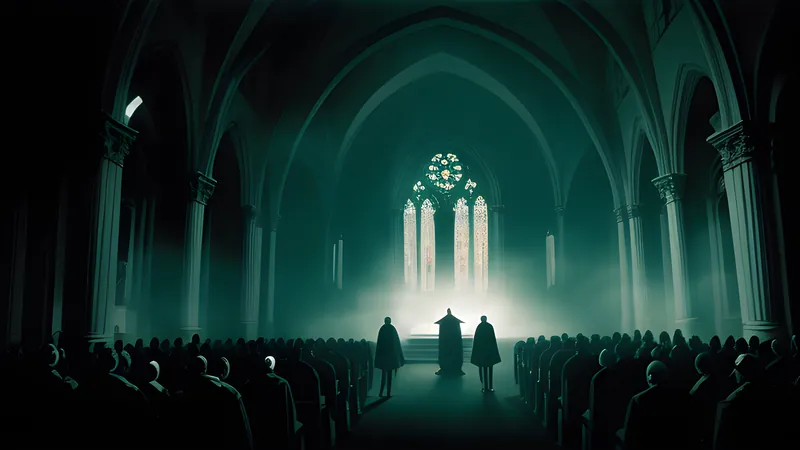
And then there is The Devils (1971), the film that defines both his genius and his notoriety. Adapted from Aldous Huxley’s account of a real seventeenth-century witch-hunt in the French town of Loudun, with Oliver Reed as the doomed priest Urbain Grandier and Vanessa Redgrave as the disturbed prioress whose accusations destroy him, it is a savage, magnificent assault on religious hysteria and political power. It was also one of the most heavily censored films in British history, cut by the studio and the censors, banned outright in some territories, and fought over for decades before anything close to Russell’s intended version could be seen. Strip away the scandal and what remains is a masterwork: a genuinely serious film about faith, corruption and mass delusion, staged with an intensity no British director had dared before. It is his greatest achievement and the clearest proof that the provocation was always in the service of ideas.
The Loudun material had defeated more cautious talents before him — Huxley’s book and John Whiting’s stage play had both circled the story of Grandier and the possessed nuns — and Russell saw in it the perfect vehicle for his obsessions: sex weaponised by repression, faith curdling into hysteria, the state exploiting a religious panic to crush a political rival. Derek Jarman’s stark white sets, built to loom like a modernist cathedral, gave the delirium an architectural coldness that makes the fever more shocking. It is a film about how power manufactures hysteria and then burns someone alive for it, and its arguments have only grown sharper with time.
Tommy, and the rock-opera detour
Russell’s love of music and spectacle found an unlikely mass audience in 1975 with Tommy, his film of The Who’s rock opera. Roger Daltrey as the deaf, dumb and blind pinball prodigy, Ann-Margret drowning in a room of baked beans and soap suds, Tina Turner and Elton John in gleeful cameos — it is Russell’s sensibility poured into a pop framework, garish and overwhelming and genuinely popular. Tommy proved that the wild man could deliver a hit, and it remains the most accessible entry point to his imagination, the excess channelled through songs everyone already knew.
Hollywood, horror and the late flourish
The one time Hollywood handed Russell a big science-fiction budget, the result was Altered States (1980), a hallucinatory film about a scientist using sensory-deprivation tanks and psychoactive drugs to regress toward primal states of consciousness. William Hurt made his screen debut, the effects sequences are a torrent of religious and evolutionary imagery, and the whole thing is Russell’s fascination with transcendence dressed as a monster movie. Studio friction was intense, and Russell being Russell, he alienated collaborators along the way, but the film endures as a genuine cult object and one of the strangest studio pictures of its decade.
His later career grew scrappier and more openly outrageous. Crimes of Passion (1984), with Kathleen Turner and Anthony Perkins, is a lurid, satirical melodrama that divided critics and has since been reclaimed as a demented gem. Gothic (1986) staged the famous stormy night at the Villa Diodati that produced Frankenstein, turning Byron, the Shelleys and their circle into feverish grotesques. The Lair of the White Worm (1988), from Bram Stoker’s late novel, is a camp horror romp with an early Hugh Grant and Amanda Donohoe having tremendous fun. The budgets shrank and the discipline loosened, but the imagination never dimmed.
There is a cost to a career built on excess, and Russell paid it. His refusal to modulate made him hard to finance, and the last two decades of his life were spent scrabbling for money, shooting shorts on video in his own home when nobody would fund a feature. British cinema’s caution, the very quality he spent his life rebelling against, eventually starved him of the resources his imagination required. There is a grim justice to it and a real loss, because a director who could stage The Devils was reduced to guerrilla filmmaking in his final years. The wild man was never quite forgiven for being wild while it counted.
The case for the maximalist
Russell died in 2011, and British cinema has spent the years since slowly deciding it was proud of him after all. Retrospectives now treat The Devils as the masterpiece it always was, and a generation of filmmakers who grew up on his excess — Guillermo del Toro among his loud admirers — cite him as permission to be extravagant. The through-line across the whole body of work is a refusal of the tasteful. Russell believed that art, faith, sex and music were violent, overwhelming forces, and that a film about them should feel violent and overwhelming too. When it worked, as in The Devils, the result is unmatched in British cinema. When it did not, the failures are at least never boring, which is more than most careers can claim.
There is a real craft under the flamboyance, and it is easy to overlook. Russell composed frames like a painter, cut to music with a dancer’s timing, and drew ferociously committed performances from actors — Reed, Redgrave, Jackson, Turner — who trusted him to push them past decorum. The excess was controlled, a deliberate aesthetic rather than mere self-indulgence, and the discipline of those BBC documentary years is visible even in his most unhinged features.
Where to begin is a question of temperament. Women in Love is the respectable gateway, the film that made his name. Tommy is the pop-cultural crowd-pleaser. Altered States is the accessible cult classic. And The Devils, when you are ready for it, is the summit — a difficult, censored, magnificent film that shows exactly what British cinema was capable of when it stopped minding its manners. Watch them and you understand why the industry could neither tame Ken Russell nor do without him.
Related Content